


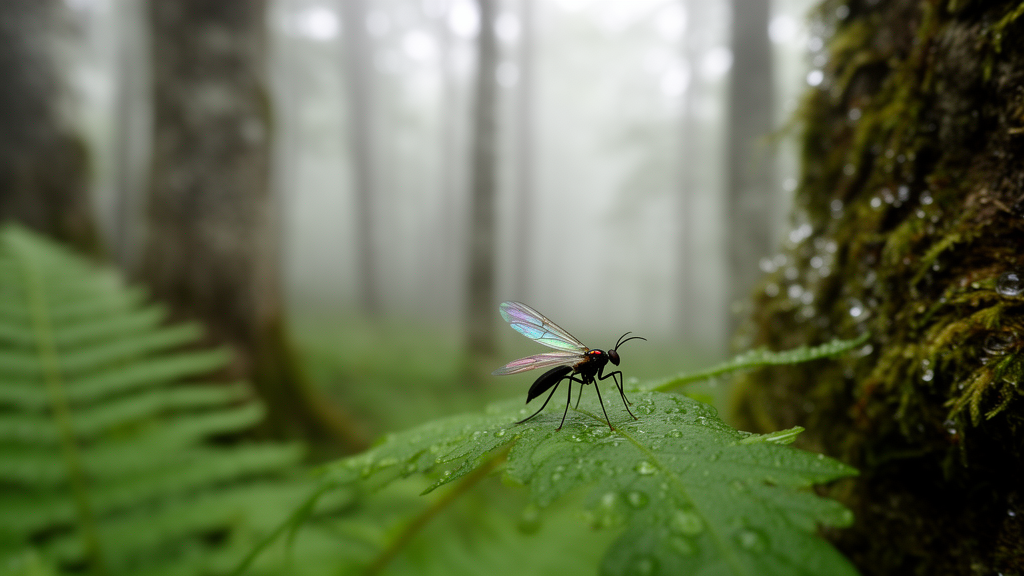
Deep in the forests that climb the southern slopes of the Greater Caucasus Mountains, a quiet census of some of the world’s smallest wasps has just rewritten the map of their distribution. A survey of Lagodekhi Protected Area in northeastern Georgia (Sakartvelo) has added dozens of genera and species of tiny parasitoid wasps to the region’s known fauna, many of them recorded for the first time anywhere in the Caucasus. The findings, published in the journal Caucasiana, push the protected area’s documented insect inventory to 1,682 species and underline how much biodiversity still hides in plain sight even in well-studied landscapes.
The study focused on seven families of so-called microhymenoptera: Ceraphronidae, Diapriidae, Ismaridae, Megaspilidae, Platygastridae, Proctotrupidae and Scelionidae. These are minute wasps, most of them barely a few millimeters long, but their ecological weight is enormous. Nearly all of them are parasitoids, meaning their larvae develop inside or on the bodies of other insects, ultimately killing their hosts. Because of this lifestyle, parasitoid wasps are considered major players in terrestrial ecosystems and may account for up to a fifth of all insect species. Selected members of the family Scelionidae, which attack the eggs of pest insects, rank among the most important biological control agents deployed against crop pests.
Despite that importance, the microhymenopteran fauna of Georgia has been remarkably neglected. Apart from some families within the superfamily Chalcidoidea, these tiny wasps have scarcely been studied in the country. Before this survey, only a handful of species from the seven target families had ever been documented there. The new paper changes that picture dramatically: 33 genera are recorded for the first time from Georgia, and 25 of those genera are new to the entire Caucasus region. At the species level, 16 taxa are newly recorded in Georgia, and 14 identified species are new records for the Caucasus.
The fieldwork behind the results was methodical and demanding. Malaise traps, tent-like interception devices that passively capture flying insects, were deployed at seven sites spanning the protected area’s dramatic vertical zonation, from low-altitude forest at roughly 450 to 750 meters up to the alpine zone above 2,500 meters. The traps operated throughout the entire growing season, from April to November of 2014, and were emptied roughly every ten days. Captured specimens were preserved in 96 percent alcohol, dried using a critical-point drying procedure, and card mounted for study. Samples were then sent to Dr. Lubomir Masner, a renowned authority on these wasp groups, who screened, sorted and prepared the material, with identifications based on published taxonomic keys. All voucher specimens are deposited in the entomological collection of the Agricultural University of Georgia in Tbilisi.
The vertical gradient proved essential to the survey’s success. Each trap site represented a distinct vegetation zone: low-altitude forest, mid-altitude forest, high-altitude forest, subalpine forest, subalpine meadows and shrublands, and the alpine zone. This design allowed the researchers to sample wasp communities across more than 2,000 meters of elevation, capturing species that specialize in different climatic and vegetational bands. Among the most striking discoveries was the family Ismaridae, historically treated as a subfamily of Diapriidae but elevated to full family rank in recent integrative taxonomic work. The survey recorded two Ismarus species, I. dorsiger and I. haliday, and the family had no previous records anywhere in the Caucasus region.
Other families yielded equally significant additions. From the Diapriidae, species of the genus Entomacis, including E. perplexa and E. platyptera, appear for the first time in Georgia, a country where only two diapriid species had been known before. The Megaspilidae, previously represented in Georgia by a single species, now include the genus Trichosteresis with T. glabra. The Platygastridae, a family of egg-parasitizing wasps, gained four new genera for the country: Iphitrachelus, Metaclisis, Platystasius and others, with species such as Iphitrachelus gracilis and Metaclisis areolata newly documented. From the Proctotrupidae, the genera Brachyserphus, Disogmus, Exallonyx, Mischoserphus, Phaenoserphus and Tretoserphus were all recorded, with Phaenoserphus calcar standing out as new for the entire Caucasus.
The Scelionidae, the family with the greatest direct relevance to agriculture, contributed some of the most consequential records. The genus Idris, represented by I. pedestris, is new to Georgia, as is the genus Xenomerus with X. ergenna. The genus Scelio, new to Georgia, includes S. rugulosus, which is also new for the Caucasus. Perhaps most notably, Trissolcus basalis, a species famous worldwide as a biological control agent against the southern green stink bug, a major agricultural pest, was recorded in Georgia for the first time and is new to the Caucasus. Teleas lamellatus likewise represents a first record for the country. These findings matter beyond pure taxonomy, because knowing which natural enemies occur in a region is the foundation for any future biological control program.
Beyond the formally identified species, the survey collected a substantial number of taxa that could not yet be assigned to named species. These include representatives of genera such as Aphanogmus from the Ceraphronidae, Acanosema, Acropiesta, Aneurhynchus, Basalys, Pantoclis, Paramesius, Synacra and Trichopria from the Diapriidae, Conostigmus, Dendrocerus and Lagynodes from the Megaspilidae, Isocybus, Piestopleura, Platygaster, Pyrgaspis, Tetrabaeus, Leptacis and Synopeas from the Platygastridae, and Anteris, Gryon, Sparasion, Telenomus and Trimorus from the Scelionidae. Many of these genera are themselves new records for Georgia or the Caucasus, and some were captured at specific elevations that hint at their ecological preferences. The presence of Gryon and Sparasion, for example, both genera with known pest-suppressing members, adds to the agricultural significance of the inventory.
The cumulative effect of these records is considerable. With the new additions, the number of insect species documented from Lagodekhi Protected Area has reached 1,682, consolidating its status as one of the most diverse and best-studied protected areas in Georgia. Established in 1912, the reserve has been the focus of more than ten publications over the past decade detailing hundreds of new faunal records, and the latest survey continues that tradition. The authors emphasize that the current knowledge of hymenopterans in Georgia and the Caucasus as a whole remains incomplete, and that further research will almost certainly reveal many more new taxa.
For conservationists and entomologists alike, the message is clear: even a single season of standardized trapping in a well-protected mountain landscape can transform understanding of an entire insect lineage. Tiny parasitoid wasps, often overlooked because of their size, are now firmly on the map of Caucasian biodiversity, and Lagodekhi Protected Area has proven itself a hotspot for their hidden diversity. As sampling continues and unidentified specimens are worked through, the region’s true wasp fauna may turn out to be far richer than anyone imagined.
Subject of Research: First records of 33 microhymenopteran wasp genera from Georgia and 25 from the Caucasus, based on Malaise trap sampling in Lagodekhi Protected Area.
Article Title: New data on some microhymenopteran families from Lagodekhi Protected Area, with new records for Georgia (Sakartvelo) and the Caucasus
Article References: Japoshvili, G. (2022). New data on some microhymenopteran families from Lagodekhi Protected Area, with new records for Georgia (Sakartvelo) and the Caucasus. Caucasiana, 1, 7-11. https://doi.org/10.3897/caucasiana.1.e81647
Image Credits: AI Generated
DOI: 10.3897/caucasiana.1.e81647
Keywords: parasitoid wasps, Hymenoptera, Lagodekhi Protected Area, Georgia, Caucasus biodiversity, Malaise traps, Scelionidae, biological control, data, some, microhymenopteran, families
Cite Scienmag News
Margaret Porter. (October 19, 2026). Hidden Wasp Diversity Surges in Georgia’s Lagodekhi Protected Area. Scienmag. https://scienmag.com/hidden-wasp-diversity-surges-in-georgias-lagodekhi-protected-area/
Margaret Porter. "Hidden Wasp Diversity Surges in Georgia’s Lagodekhi Protected Area." Scienmag, 19 October 2026, https://scienmag.com/hidden-wasp-diversity-surges-in-georgias-lagodekhi-protected-area/. Accessed 19 October 2026.
Margaret Porter. "Hidden Wasp Diversity Surges in Georgia’s Lagodekhi Protected Area." Scienmag. October 19, 2026. https://scienmag.com/hidden-wasp-diversity-surges-in-georgias-lagodekhi-protected-area/


