


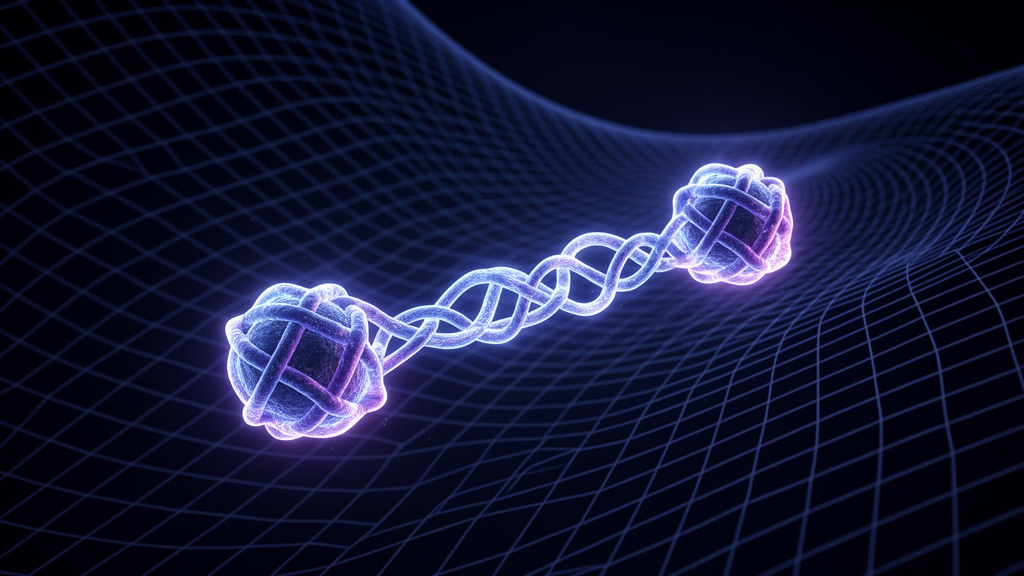
Physicists have long assumed that when quantum entanglement travels into the relativistic realm, its fate is written by a single villain: the thermal noise that acceleration induces through the Unruh effect. A new theoretical study published in The European Physical Journal C challenges that assumption, showing that the architecture of an entangled state — its topology — can matter just as much as the acceleration itself. The research, led by Shu-Min Wu of Liaoning Normal University together with colleagues at Xiangtan University, demonstrates that accelerating different qubits within the same quantum network produces dramatically different entanglement dynamics, even when the acceleration experienced is physically identical.
The team focused on a three-qubit Star state, an asymmetric entangled configuration in which a central qubit is maximally correlated with two peripheral qubits, while the outer nodes share no direct entanglement with each other. This network-like structure, familiar from distributed quantum communication schemes, stands in sharp contrast to the permutation-symmetric GHZ and W states that have dominated previous studies of relativistic quantum information. In those symmetric states, every qubit plays an equivalent structural role, so accelerating one qubit is mathematically indistinguishable from accelerating another — a feature that has effectively hidden any dependence of entanglement degradation on the state’s internal geometry.
To model the relativistic scenario realistically, the researchers employed the Unruh–DeWitt detector framework, in which each qubit is represented by a localized two-level atom coupled to a quantum field. This approach avoids the idealized assumption of globally excited field modes used in earlier treatments and better reflects how real detectors interact with their environment. In their setup, Alice, Bob, and Charlie each hold a detector initially prepared in the Star state, and one of them — either the peripheral detector Bob or the central detector Charlie — undergoes uniform proper acceleration while the others remain inertial.
Using first-order perturbation theory, the authors derived the final density matrix of the detector system after the accelerated detector interacts with the massless scalar field. The key mathematical step involves Bogoliubov transformations, which relate the field modes seen by the accelerated observer in Rindler region I to those seen by inertial observers in Minkowski spacetime. The acceleration enters through the parameter q, defined as the exponential of minus two pi times the detector energy gap divided by the acceleration, which runs from zero in the inertial limit to one at infinite acceleration. Tracing out the field degrees of freedom leaves a mixed state of the three detectors whose entanglement properties can then be analyzed.
The results are striking. When the peripheral qubit Bob accelerates, the one-tangle — a measure of entanglement between a single qubit and the remaining pair — first decreases, reaches a minimum, and then revives as the acceleration approaches its infinite limit. When the central qubit Charlie accelerates instead, the same measure decays monotonically and eventually vanishes entirely. Two physically equivalent accelerations, applied to structurally different nodes of the same entangled network, therefore produce qualitatively different outcomes: one configuration permits a recovery of bipartite entanglement, the other does not.
The authors trace this revival to a non-monotonic redistribution of quantum correlations rather than a reversal of Unruh-induced degradation. As the accelerated qubit becomes increasingly entangled with inaccessible modes in the opposite Rindler wedge, the correlations among the accessible subsystems are reshuffled in a way that depends on each qubit’s structural role. In the Star state, accelerating the peripheral node allows correlations involving the remaining accessible qubits to partially recover at large acceleration. Such behavior cannot arise in a permutation-symmetric state, where all qubits are interchangeable and the one-tangle dynamics are identical regardless of which detector is accelerated.
Genuine tripartite entanglement, quantified through the Coffman–Kundu–Wootters monogamy relation as the minimal residual entanglement across all bipartitions, tells a complementary story. In both acceleration configurations, this measure decays monotonically and suffers sudden death — the irreversible loss of three-party quantum correlations. No revival occurs, indicating that the one-tangle recovery reflects a redistribution of bipartite correlations rather than a restoration of the global multipartite resource. Notably, throughout the entire acceleration regime, the configuration with the central qubit accelerating always retains more genuine tripartite entanglement than the one with the peripheral qubit accelerating, despite identical relativistic conditions.
These findings establish entanglement topology as an independent physical ingredient in relativistic quantum information science, on par with Unruh thermalization itself. The degradation of multipartite entanglement is not determined solely by the strength of the relativistic effect but jointly by that effect and by the structural role of the subsystem being accelerated. For the field, this resolves a long-standing blind spot: because prior work concentrated almost exclusively on symmetric states, the influence of network architecture on relativistic quantum resources had remained invisible.
The practical implications extend to the emerging infrastructure of quantum networks, satellite-based communication, and distributed quantum processing, where relativistic motion is unavoidable. The study suggests that deliberately engineering asymmetric entanglement structures — choosing which nodes of a network carry central versus peripheral roles — could serve as a design principle for protecting quantum resources against acceleration-induced degradation. In scenarios where certain nodes are known to undergo relativistic motion, placing them in peripheral positions of a Star-like topology might preserve more usable entanglement than symmetric alternatives.
The work, published as an open-access article in The European Physical Journal C and supported by the National Natural Science Foundation of China and regional research programs, marks a shift in how physicists think about quantum resources in noninertial frames. Asymmetric quantum networks, the authors conclude, constitute a distinct platform for controlling relativistic quantum correlations — one in which the shape of entanglement, not merely its amount, becomes a tunable resource for the quantum technologies of the future.
Subject of Research: Topology-dependent degradation of multipartite quantum entanglement under relativistic acceleration
Article Title: Topology-dependent relativistic degradation of multipartite entanglement
Article References: Wu, S.-M., Shang, S.-H., Han, X., Yang, H.-C., & Liu, Q. (2026). Topology-dependent relativistic degradation of multipartite entanglement. The European Physical Journal C, 86(10), Article 1182. https://doi.org/10.1140/epjc/s10052-026-16401-9
Image Credits: AI Generated
DOI: 10.1140/epjc/s10052-026-16401-9
Keywords: quantum entanglement, relativistic quantum information, Unruh effect, Unruh-DeWitt detector, Star state, multipartite entanglement, quantum networks, Rindler spacetime, one-tangle, genuine tripartite entanglement, quantum field theory, noninertial frames
Cite Scienmag News
Katie Riggs. (October 19, 2026). When Acceleration Isn’t the Whole Story: Entanglement Topology Reshapes Relativistic Quantum Degradation. Scienmag. https://scienmag.com/when-acceleration-isnt-the-whole-story-entanglement-topology-reshapes-relativistic-quantum-degradation/
Katie Riggs. "When Acceleration Isn’t the Whole Story: Entanglement Topology Reshapes Relativistic Quantum Degradation." Scienmag, 19 October 2026, https://scienmag.com/when-acceleration-isnt-the-whole-story-entanglement-topology-reshapes-relativistic-quantum-degradation/. Accessed 19 October 2026.
Katie Riggs. "When Acceleration Isn’t the Whole Story: Entanglement Topology Reshapes Relativistic Quantum Degradation." Scienmag. October 19, 2026. https://scienmag.com/when-acceleration-isnt-the-whole-story-entanglement-topology-reshapes-relativistic-quantum-degradation/


