


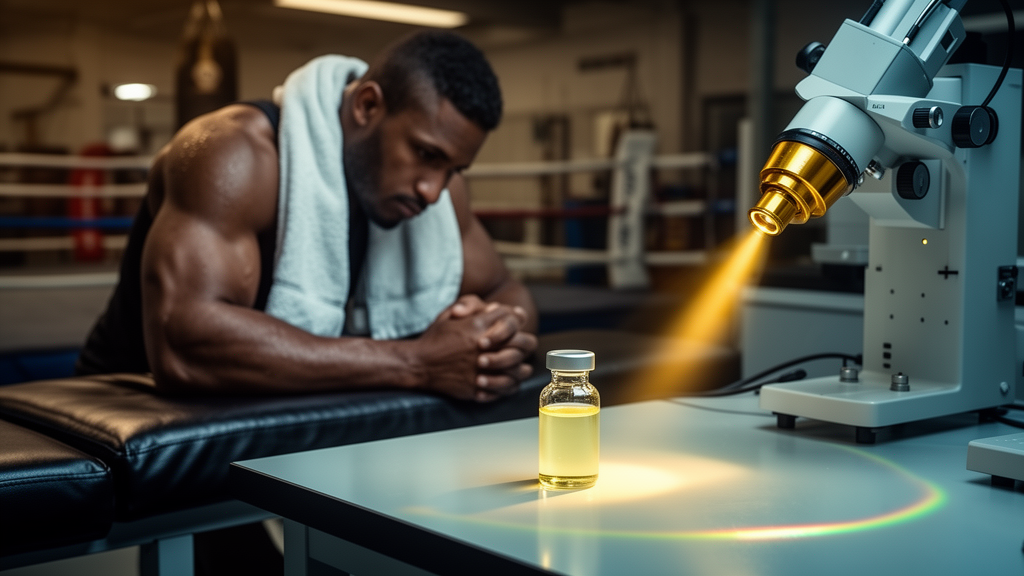
In the thirteen days before a professional heavyweight bout, a boxer’s body undergoes a carefully choreographed transformation. Training volume is slashed while intensity is preserved, allowing accumulated fatigue to dissipate and hard-won physiological adaptations to surface. Polish researchers have now captured this process from an unusual angle: by shining infrared light on tiny droplets of the athlete’s blood plasma and reading the molecular vibrations that bounce back. The exploratory single-case study, published in Frontiers in Physiology, monitored one 38-year-old professional heavyweight boxer through his pre-competition taper and asked whether attenuated total reflectance Fourier transform infrared (ATR-FTIR) spectroscopy could technically keep pace with the biochemical storm unfolding inside him.
The participant was no ordinary subject. Standing 186 centimeters tall and weighing 103.7 kilograms at study entry, he carried eleven years of professional experience and sixteen bouts into the observation window, which preceded a scheduled fight against a highly ranked opponent. His coaching staff prospectively recorded every training session, and the data tell the story of a textbook taper. In the forty-eight hours before the first blood collection, he completed 195 minutes of training with an internal load of 1,310 arbitrary units and six rounds of sparring. By the final collection, those figures had collapsed to 60 minutes, 240 units, and zero sparring rounds. Sleep quality scores barely moved throughout, and body mass drifted down by just 1.6 kilograms, with no rapid weight-loss or dehydration procedures applied.
Fasting morning blood was drawn on five occasions, on 10, 13, 17, 20, and 23 May 2024, always at 07:30 after at least ten hours of overnight fasting, at least fourteen hours after the previous training session, and fifteen minutes of seated rest before venipuncture. Tubes were centrifuged within thirty minutes, and plasma was aliquoted and stored at minus eighty degrees Celsius until all assays and spectroscopic measurements were performed in a single analytical run. Conventional laboratory methods quantified twelve biochemical variables: creatine kinase (CK), C-reactive protein (CRP), glucose, cortisol, testosterone, total and reduced glutathione, oxidized glutathione calculated from the other two fractions, malondialdehyde, zinc, and the derived testosterone-to-cortisol and glutathione ratios. Crucially, FTIR was never used to quantify any of these analytes; the laboratory results served as reference values against which the spectral data were examined for co-variation.
The FTIR workflow itself was strikingly economical. Just four microliters of plasma were deposited onto a calcium fluoride window, dried at room temperature for roughly ten minutes, and then placed on the diamond ATR crystal of a Nicolet iS50 spectrometer. Background spectra were collected before each measurement, and spectra were recorded from 400 to 4,000 inverse centimeters at a resolution of 4 inverse centimeters using 32 scans per spectrum. Each plasma sample was measured eight times under identical conditions, yielding 40 spectra from five biological observations. Between consecutive measurements the diamond crystal was cleaned with seventy percent ethanol and thoroughly dried. Preprocessing in OPUS 7.0 software included Rubberband baseline correction and vector normalization, after which the eight technical replicates per sample were averaged into a representative mean spectrum.
The biochemical picture painted by conventional assays was coherent with recovery. CK activity fell from 495 units per liter on the first day to 183 on the day before the fight, a sixty-three percent decline consistent with decreasing myocellular damage and progressive cell membrane repair during tapering. The baseline value, though elevated relative to the non-training population, is typical for elite combat sports athletes in a load accumulation phase, and heavyweight athletes’ large muscle mass predisposes them to larger enzyme releases at the same relative load. CRP dropped from 0.27 to 0.13 milligrams per deciliter, a positive indicator, since even small oscillations within the laboratory norm carry physiological implications and a persistently elevated pre-competition CRP would signal incomplete adaptation and heightened risk of immunosuppression. Testosterone rose from 15.23 to 17.55 nanomoles per liter, although the fitted slope was not distinguishable from zero, and the testosterone-to-cortisol ratio climbed from 3.4 to 4.1, a barometer many sports scientists regard as key to the balance between anabolic and catabolic processes.
Cortisol, by contrast, refused to follow the textbook script. Reducing training volume during tapering should, from a classical physiological perspective, produce a clear drop in this adaptive hormone, which mobilizes energy substrates through gluconeogenesis, proteolysis, and lipolysis. Instead, cortisol oscillated within a narrow band of 426 to 481 nanomoles per liter across all thirteen days, showing a coefficient of variation of just 4.4 percent. The researchers interpret this stability not as poor recovery but as anticipatory stress, a phenomenon well described in sports psychophysiology. High-ranking sporting events trigger strong activation of the sympathetic nervous system and the hypothalamus-pituitary-adrenal axis as psychological pressure mounts, the upcoming confrontation is visualized, and fear of failure builds. The cerebral cortex and amygdala signal the hypothalamus, which releases corticotropin-releasing hormone, stimulating the anterior pituitary to secrete adrenocorticotropic hormone and thereby sustaining cortisol synthesis in the adrenal cortex.
The oxidative stress panel added its own nuance. Malondialdehyde, the primary marker of lipid peroxidation, remained stable between 0.62 and 0.81 micromoles per liter, suggesting the athlete’s antioxidant defenses neutralized free radicals in real time before they could damage membrane lipids. Total glutathione, however, showed the only slope whose ninety-five percent confidence interval excluded zero, rising at 41.0 micromoles per liter per day, and reduced glutathione climbed alongside it. The largest between-day variability was recorded for the reduced-to-oxidized glutathione ratio at 133.9 percent, though this figure was driven largely by a single low oxidized glutathione value. Zinc, glucose, and the glutathione ratios completed the panel, with cortisol and glucose showing the smallest relative fluctuations of all measured parameters.
Then came the spectroscopy. The spectra exhibited consistent vibrational profiles, with the same molecular vibrations visible in every sample: C-H out-of-plane aromatic bands at 671 and 699 inverse centimeters, thymine N-H vibrations at 721 and 797, nucleic acid C-C stretching at 846 and 929, phosphate stretching at 1,024 and 1,260, amide vibrations at 1,376, 1,542, 1,642, and 3,272, protein and lipid CH2 and CH3 vibrations at 1,415 and 1,458, and lipid C=O, CH2, and CH3 vibrations at 1,711 through 3,065. A screening analysis of 264 correlations between 22 spectral peaks and 12 biochemical variables identified four regions of interest. Total glutathione correlated negatively with bands at 671, 699, and 721 inverse centimeters, reduced glutathione with 671 and 699, and cortisol correlated positively with the band at 3,009, which is typically assigned to stretching vibrations of cis-unsaturated acyl chains. Linear regression yielded apparent in-sample R-squared values of 0.80 to 0.92 for the glutathione bands and 0.77 for cortisol.
The researchers are emphatic that these numbers must not be mistaken for validated calibrations. With only five biological observations, six of the 264 spectral-biochemical coefficients reached an uncorrected p-value below 0.05, yet with this number of tests approximately thirteen nominal results could be expected purely by chance, and none survived Benjamini-Hochberg false discovery rate correction. The regression bands were selected based on their correlations within the same five observations later used to fit the models, a procedure that inflates R-squared values and makes them represent fit to the analyzed sample rather than predictive capability. The cortisol band poses a particular interpretive puzzle: at a plasma concentration of roughly 450 nanomoles per liter, cortisol is far too scarce to contribute measurably to the 3,009 band’s intensity. One unverified hypothesis invokes an indirect relationship in which cortisol stimulates lipolysis and co-occurs with changes in the circulating pool of unsaturated fatty acids, but confirming this would require simultaneous fatty acid profiling. For glutathione, the authors speculate that protein S-glutathionylation and deglutathionylation processes might alter the local environment of sulfur-containing and aromatic residues, though all three signals were weak and located in the region with the lowest signal-to-noise ratio in the spectra.
What the study does establish is narrower but genuinely useful: that repeated ATR-FTIR measurements of plasma are technically feasible and visually consistent under realistic pre-competition conditions, using a sample volume of just four microliters. The eight technical replicates per sample illustrate within-sample consistency but do not establish quantitative repeatability across independent runs, operators, instruments, or measurement days, and the single-participant design precludes any estimate of inter-individual variability. All assays and spectra were acquired in a single analytical run, eliminating between-run drift but also precluding independent replication of the entire analytical process, and samples underwent a single freeze-thaw cycle that may have been particularly significant for the unstable reduced glutathione fraction. The authors conclude that their findings are preliminary and hypothesis-generating, that they provide no evidence that ATR-FTIR enables quantitative determination of glutathione or cortisol, and that it cannot yet be used to assess competitive readiness. Confirmation of such capabilities, they write, requires studies involving adequately large and diverse groups of participants. Still, the vision is tantalizing: a technique that images the metabolite fingerprint of an athlete’s blood almost instantaneously, in training camps where every hour of recovery counts, could one day transform how fight-week readiness is read, one infrared spectrum at a time.
Subject of Research: Application of FTIR to detect changes in blood plasma during a pre-competition period in a professional heavyweight boxer
Article Title: Application of FTIR to detect changes in blood plasma during a pre-competition period in a professional heavyweight boxer
Article References: Król, P., Depciuch, J., Reich, A., Cebulski, J., Obmiński, Z., Kasicki, K., Czarny, W., Różański, Ł., & Rydzik, Ł. (2026). Application of FTIR to detect changes in blood plasma during a pre-competition period in a professional heavyweight boxer. Frontiers in Physiology, 17, Article 1845333. https://doi.org/10.3389/fphys.2026.1845333
Image Credits: AI Generated
DOI: 10.3389/fphys.2026.1845333
Keywords: Application, FTIR, detect, changes, blood, plasma, during, pre-competition, period, professional, heavyweight, boxer
Cite Scienmag News
Gavin Prescott. (October 19, 2026). Infrared fingerprint of blood plasma tracks a boxer’s fight-week recovery. Scienmag. https://scienmag.com/infrared-fingerprint-of-blood-plasma-tracks-a-boxers-fight-week-recovery/
Gavin Prescott. "Infrared fingerprint of blood plasma tracks a boxer’s fight-week recovery." Scienmag, 19 October 2026, https://scienmag.com/infrared-fingerprint-of-blood-plasma-tracks-a-boxers-fight-week-recovery/. Accessed 19 October 2026.
Gavin Prescott. "Infrared fingerprint of blood plasma tracks a boxer’s fight-week recovery." Scienmag. October 19, 2026. https://scienmag.com/infrared-fingerprint-of-blood-plasma-tracks-a-boxers-fight-week-recovery/


