


Gallium oxide has quietly become one of the most coveted materials in semiconductor research. Its ultrawide bandgap of roughly 4.7 to 4.9 electron volts, its remarkable thermal stability, and its enormous breakdown field make beta-phase gallium oxide, or β-Ga2O3, a leading candidate for power electronics and radiation detectors that must survive where silicon cannot—inside nuclear reactor cores, in deep-space probes, and in high-energy physics experiments. But a material destined for those environments has one essential qualification to prove: it must withstand a relentless barrage of neutrons without degrading. A new study has now tracked, defect by defect, what actually happens inside β-Ga2O3 crystals under neutron irradiation, and the results reveal a strikingly simple lever that controls the damage—temperature.
The research, published in the Journal of Materials Science by a team led by Ming Liu and Ge Yang of North Carolina State University, exposed twelve sets of undoped β-Ga2O3 single crystals to fast neutron fluences approaching 10^18 per square centimeter inside the university’s PULSTAR research reactor. Half the samples were irradiated at room temperature, while the other half were held at 700 degrees Celsius during exposure, using custom-built vertical irradiation facilities that allowed individual sample capsules to be retrieved at predetermined dose levels without interrupting the ongoing irradiation of the remaining specimens. It is one of the first systematic positron annihilation studies ever conducted on how vacancy populations in gallium oxide evolve with progressively increasing neutron fluence.
The choice of measurement techniques was deliberate. Neutrons knock atoms out of their lattice sites through elastic collisions, generating vacancies and interstitials, but these defects are vanishingly small and often carry no convenient magnetic or optical signature. Positron annihilation spectroscopy, however, is exquisitely sensitive to open-volume defects: when a positron from a sodium-22 source encounters a vacancy, it lingers slightly longer before annihilating with an electron, and that extended lifetime directly reveals both the presence and approximate size of the trap. The team combined positron annihilation lifetime spectroscopy with Doppler broadening spectroscopy, which analyzes the energy spread of the 511 kilo-electron-volt annihilation gamma rays to probe the local electronic environment of the annihilation sites, and paired these with ultraviolet-visible optical transmittance measurements spanning 200 to 950 nanometers.
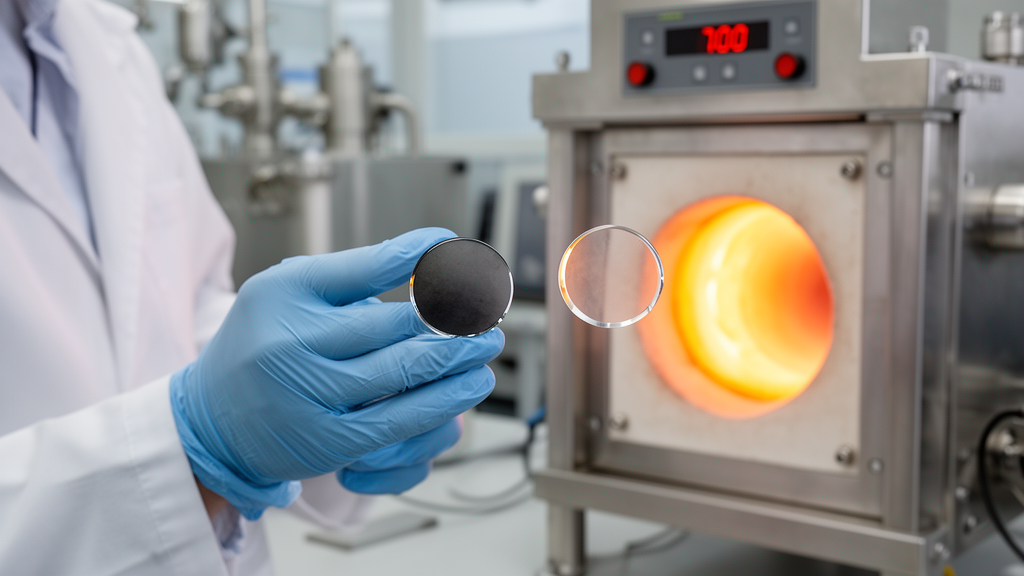
The room-temperature results were visually dramatic. Crystals that began as optically pristine and highly transparent progressively darkened with increasing neutron exposure, developing a yellow-to-brown tint as their transmittance fell across the entire visible and near-ultraviolet range. The relative absorbance grew most rapidly during the first 15 hours of irradiation and again between 15 and 75 hours, and beyond a fast neutron fluence of roughly 10^17 per square centimeter a distinct absorption band emerged near 440 nanometers, equivalent to about 2.8 electron volts. That feature corresponds to the well-documented blue defect band of gallium oxide, associated with deep donor and acceptor transitions involving oxygen vacancies, gallium vacancies, or complexes of the two—in other words, the color change was not cosmetic but a direct optical fingerprint of accumulating lattice damage.
The optical data also hinted that damage does not accumulate linearly. When the team fitted the integrated transmittance loss as a function of fast neutron fluence, the best description required two channels: one that saturates rapidly at low doses and a second, slower channel that keeps growing at higher fluences. A transition appeared somewhere between the 37.5-hour and 75-hour irradiations, suggesting that the initially dominant defect species either reach saturation or give way to more complex, stabilized defect structures. This kind of kinetic complexity matters enormously for anyone designing detectors that must predict their own performance decades into a reactor campaign.
The positron measurements told the deeper story. Pristine crystals showed a shortest lifetime component of about 179 to 180 picoseconds—far longer than the roughly 135 picoseconds predicted for a defect-free gallium oxide lattice but close to the calculated lifetime for gallium vacancies, particularly the split-vacancy configuration that recent computational and experimental work has identified as the dominant form of gallium vacancies in as-grown material. The as-grown samples therefore already contained a substantial native gallium vacancy population before any irradiation began. With increasing room-temperature neutron dose, the lifetime climbed monotonically, rising rapidly at low fluence and then plateauing near 205 picoseconds as fluence exceeded the 75-hour mark. That asymptotic value matches the lifetime estimated for unrelaxed gallium vacancies in proton-irradiated gallium oxide and slightly exceeds the theoretical prediction of 189 picoseconds for an isolated monovacancy—implying either that theory systematically underestimates the values or that larger vacancy clusters begin to form at the highest doses, with positron trapping shifting from the ever-present split vacancies toward the larger radiation-induced monovacancies.
Then came the twist. The crystals irradiated at 700 degrees Celsius showed no visible coloration whatsoever, no measurable transmittance loss, and positron lifetimes indistinguishable from pristine material across the entire fluence range. At elevated temperature, the crystal was effectively healing itself in real time. The team attributes this to dynamic annealing: the thermal energy at 700 degrees Celsius, on the order of 0.08 electron volts, is sufficient to mobilize oxygen and gallium interstitials, allowing them to recombine with the vacancies created by neutron collisions before those vacancies can aggregate into detectable clusters. The finding is consistent with earlier reports that radiation-induced electrical degradation in gallium oxide diminishes at temperatures approaching 1000 kelvin, and with work showing that defects from deuterium implantation become undetectable by positron lifetime spectroscopy after annealing at just 625 degrees Celsius.
Not every measurement moved. Doppler broadening spectroscopy revealed only minor variations in its S and W parameters, with total changes remaining below about 1 percent—within the uncertainty of repeated runs. The likely explanation is that the dominant vacancy species generated under neutron irradiation possess such similar electron momentum distributions that the technique, in its current resolution, cannot separate them. Even so, the S-parameter showed a gentle, non-monotonic rise with dose, dipping near the 37.5-hour exposure before climbing again at 300 hours, qualitatively mirroring the lifetime evolution and suggesting that positrons shift among different vacancy configurations as irradiation progresses. The authors appropriately treat this subtle signal as provisional, calling for higher-precision measurements to confirm it.
The practical implications reach well beyond the laboratory. β-Ga2O3 is being actively developed for neutron detectors intended for in-core nuclear reactor environments, where high radiation tolerance is not optional but definitional. The new results establish what amounts to a thermal threshold governing defect diffusion, recombination, and trapping in the material: keep the crystal cool and gallium vacancies accumulate until they blunt both optical and, by extension, electronic performance; keep it hot enough and the same bombardment leaves the lattice essentially unscathed. For device engineers, that points toward strategies ranging from hot irradiation and intentional thermal cycling to post-damage annealing schedules, and it helps explain why earlier studies reported conductivity collapses at fast fluences around 10^17 per square centimeter even though gallium and oxygen atoms carry relatively high displacement energies of 28 and 14 electron volts respectively.
The work also closes a persistent gap in the defect physics of gallium oxide. Its monoclinic lattice contains two inequivalent gallium sites, producing a rich menu of possible vacancy configurations and gallium vacancy–oxygen vacancy complexes, both intrinsic and radiation-induced, and positron experiments on neutron-irradiated samples had been essentially absent. By combining careful dosimetry—cobalt and nickel wires, cadmium-covered foils, and neutron activation analysis—with rigorously deconvoluted positron spectra in which the Kapton film contribution of about 380 picoseconds was explicitly calibrated against directly deposited sources, the team has produced the clearest timeline yet of how vacancies are born, migrate, cluster, and recover in this ultrawide-bandgap semiconductor. The remaining open questions—the precise charge states, migration barriers, and recombination dynamics of the gallium and oxygen vacancy complexes—now have a well-defined experimental foundation to build on, and a compelling reason to believe that the future of radiation-hard gallium oxide devices may be written at 700 degrees.
Subject of Research: Neutron-irradiation-induced vacancy defects and their thermal recovery in beta-phase gallium oxide
Article Title: Multimodal optical positron characterization of radiation-induced defects and their evolution in β-Ga2O3
Article References: Liu, M., Noor, S., Wells, A., Gomez Hurtado, L. R., Hawari, A. I., & Yang, G. (2026). Multimodal optical positron characterization of radiation-induced defects and their evolution in β-Ga2O3. Journal of Materials Science, 61(42), 32624-32639. https://doi.org/10.1007/s10853-026-13696-7
Image Credits: AI Generated
DOI: 10.1007/s10853-026-13696-7
Keywords: gallium oxide, neutron irradiation, positron annihilation spectroscopy, radiation damage, vacancy defects, dynamic annealing, ultrawide-bandgap semiconductor, radiation detectors, optical transmittance, defect physics, PULSTAR reactor, gallium vacancies
Cite Scienmag News
Katie Riggs. (October 19, 2026). Neutron Bombardment Turns Gallium Oxide Dark—Unless It Is Heated to 700 Degrees. Scienmag. https://scienmag.com/neutron-bombardment-turns-gallium-oxide-dark-unless-it-is-heated-to-700-degrees/
Katie Riggs. "Neutron Bombardment Turns Gallium Oxide Dark—Unless It Is Heated to 700 Degrees." Scienmag, 19 October 2026, https://scienmag.com/neutron-bombardment-turns-gallium-oxide-dark-unless-it-is-heated-to-700-degrees/. Accessed 19 October 2026.
Katie Riggs. "Neutron Bombardment Turns Gallium Oxide Dark—Unless It Is Heated to 700 Degrees." Scienmag. October 19, 2026. https://scienmag.com/neutron-bombardment-turns-gallium-oxide-dark-unless-it-is-heated-to-700-degrees/


