


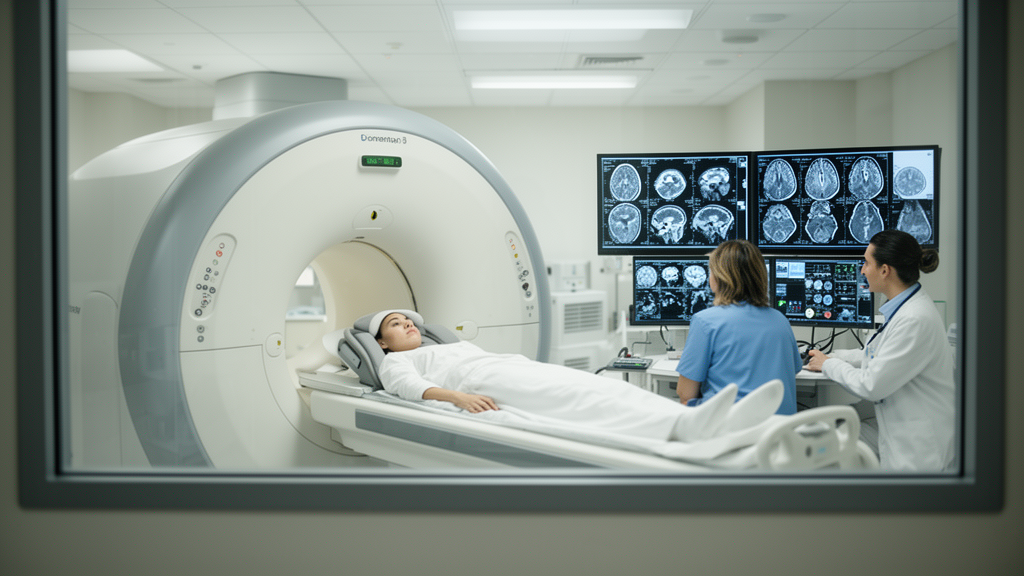
When patients with brain metastases undergo stereotactic radiosurgery, a highly focused form of radiation therapy delivered in a single session, one of the most frustrating questions for their doctors is deceptively simple: is it working? Conventional magnetic resonance imaging, the workhorse of brain tumor follow-up, often shows little or equivocal change in the first weeks after treatment. Tumors may look essentially the same on standard scans even as radiation begins to dismantle their blood supply at the microscopic level. A new prospective study published in BMC Medical Imaging suggests that a more sophisticated imaging technique, dynamic contrast-enhanced MRI, can detect meaningful biological changes in brain metastases just four to eight weeks after radiosurgery, potentially offering clinicians an earlier window into treatment response than conventional imaging allows.
The research, led by Oğuzhan Türksayar of Başakşehir Çam and Sakura City Hospital in Istanbul and colleagues at institutions across Türkiye, focused on 17 brain metastases treated in 12 consecutive patients who received single-session Gamma Knife radiosurgery. Each patient underwent dynamic contrast-enhanced MRI before treatment and again at the four-to-eight-week mark. Rather than simply observing whether lesions shrank, the team used pharmacokinetic modeling to quantify how the blood-brain barrier and tumor vasculature were behaving, extracting parameters that reflect the movement of contrast agent between blood vessels and tumor tissue.
The technical core of the study lies in the Tofts pharmacokinetic model, a mathematical framework that describes how gadolinium-based contrast material leaks from blood plasma into the extravascular extracellular space of tissue. From this model, the researchers derived several quantitative parameters. The volume transfer constant, known as Ktrans, measures how quickly contrast crosses from the vascular compartment into tissue, serving as a proxy for vascular permeability and blood flow. Kep, the rate constant, describes how rapidly contrast returns from tissue back to the plasma, while Ve represents the fraction of tissue volume occupied by the extravascular extracellular space. The team also measured the initial area under the concentration-time curve, or iAUC, a semiquantitative indicator of early contrast enhancement that captures the first blush of agent entering the lesion.
In addition to these model-based parameters, the researchers extracted semiquantitative features directly from the signal-intensity curves generated during the dynamic scan, including the upslope and the initial gradient of enhancement. These metrics do not require pharmacokinetic assumptions, making them quicker to compute, but they are also more sensitive to variations in scanning protocol. By combining both approaches, the study aimed to determine which measurements best captured the biological consequences of radiation in the earliest phase of treatment.
The results showed a consistent pattern. After radiosurgery, Ktrans, Kep, and iAUC all decreased significantly across the treated lesions, and these reductions remained statistically meaningful even after the researchers applied Benjamini-Hochberg false discovery rate correction, a conservative statistical adjustment designed to guard against false positives when many comparisons are made. The initial gradient also decreased in unadjusted analysis, but this finding did not survive correction. In practical terms, the tumors’ permeability-surface characteristics declined measurably within weeks of treatment, suggesting that radiosurgery was already altering the abnormal vasculature that sustains metastatic growth.
Response classification followed the RANO-BM criteria, the standardized framework developed by the Response Assessment in Neuro-Oncology working group for evaluating brain metastases. Of the 17 lesions, six, representing 35.3 percent, were classified as partial response, while eleven, or 64.7 percent, showed stable disease. Notably, no lesion progressed during this early window, and none achieved complete response, which is typical at such an early checkpoint since tumor shrinkage lags behind vascular change.
The most provocative finding emerged when the researchers examined whether the magnitude of imaging change tracked with the degree of response. In unadjusted analyses, the percentage change in Ktrans was associated with concurrent early radiologic response, with a Spearman correlation coefficient of negative 0.553, and the percentage change in upslope showed a similar association with a coefficient of negative 0.503. Lesions classified as partial response also showed a greater absolute reduction in Ktrans than stable-disease lesions before correction for multiple comparisons. However, the authors are careful to note that none of these between-group or correlation findings survived false discovery rate correction, a caveat that colors the entire study’s conclusions.
This statistical honesty is a defining feature of the work. The researchers label their findings as hypothesis-generating and explicitly state that they require validation in larger, adequately powered, and methodologically standardized cohorts before any clinical application. Recognizing that their small sample involved multiple lesions per patient, which can inflate statistical confidence, they performed a sensitivity analysis using only one lesion per patient. The direction of the Ktrans difference remained consistent with the lesion-level analysis, offering some reassurance that the signal, while not statistically robust in a sample of this size, was not an artifact of clustering within individual patients.
The implications, if confirmed, could be substantial. Early identification of nonresponding lesions would allow oncologists to adjust treatment sooner, whether by adding systemic therapy, planning repeat radiosurgery, or intensifying surveillance, rather than waiting months for conventional scans to reveal failure. Dynamic contrast-enhanced MRI is already available on most modern clinical scanners and can be added to routine follow-up protocols, though its pharmacokinetic modeling demands careful attention to acquisition parameters. The prospective design of this study, with baseline and early post-treatment imaging performed under controlled conditions, strengthens its foundation compared with retrospective analyses, and the lesion-level approach provides fine-grained detail about how individual metastases behave rather than averaging across patients.
For now, the study stands as an early but carefully executed proof of concept. Brain metastases affect a large proportion of patients with advanced cancer, and stereotactic radiosurgery is one of the most common treatments delivered to them, making any tool that accelerates response assessment clinically valuable. The Turkish team’s work demonstrates that measurable vascular changes appear within four to eight weeks of Gamma Knife treatment and that Ktrans, the volume transfer constant, was the most consistent parameter associated with early radiologic response in unadjusted analyses. The road from exploratory association to clinical decision-making runs through larger, standardized, multi-center trials, but this study charts a plausible path toward a future in which the effectiveness of radiation against brain tumors can be read not just in their size, but in the chemistry of their blood vessels.
Subject of Research: Early dynamic contrast-enhanced MRI biomarkers of radiologic response after stereotactic radiosurgery for brain metastases
Article Title: Early DCE-MRI changes and concurrent radiologic response after stereotactic radiosurgery for brain metastases: a prospective exploratory study
Article References: Türksayar, O., Öner, A. Y., Cindil, E., Erpolat, P., & Emmez, H. (2026). Early DCE-MRI changes and concurrent radiologic response after stereotactic radiosurgery for brain metastases: a prospective exploratory study. BMC Medical Imaging. https://doi.org/10.1186/s12880-026-02756-8
Image Credits: AI Generated
DOI: 10.1186/s12880-026-02756-8
Keywords: DCE-MRI, stereotactic radiosurgery, brain metastases, Ktrans, Tofts pharmacokinetic model, Gamma Knife, RANO-BM criteria, treatment response assessment, blood-brain barrier, MRI biomarkers, false discovery rate, radiation oncology
Cite Scienmag News
Cassandra Pierce. (October 19, 2026). Advanced MRI Spots Early Signs of Radiation Success in Brain Tumors Within Weeks. Scienmag. https://scienmag.com/advanced-mri-spots-early-signs-of-radiation-success-in-brain-tumors-within-weeks/
Cassandra Pierce. "Advanced MRI Spots Early Signs of Radiation Success in Brain Tumors Within Weeks." Scienmag, 19 October 2026, https://scienmag.com/advanced-mri-spots-early-signs-of-radiation-success-in-brain-tumors-within-weeks/. Accessed 19 October 2026.
Cassandra Pierce. "Advanced MRI Spots Early Signs of Radiation Success in Brain Tumors Within Weeks." Scienmag. October 19, 2026. https://scienmag.com/advanced-mri-spots-early-signs-of-radiation-success-in-brain-tumors-within-weeks/


