


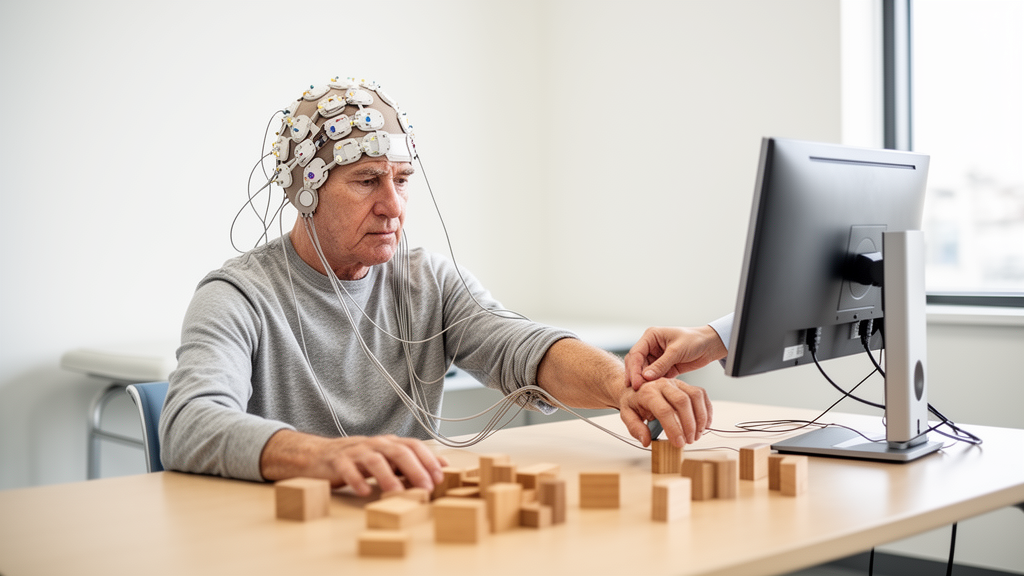
Rehabilitation scientists have long hoped that zapping the brain before a brain-computer interface training session could supercharge recovery of the paralyzed arm after stroke. A new systematic review and meta-analysis, published in Frontiers in Neurology, has now put that hope under the microscope for the first time — and the verdict is sobering. Adding non-invasive brain stimulation (NIBS) to brain-computer interface (BCI) training did not produce the anticipated synergistic boost in upper extremity motor function, and in some analyses the combination actually fared worse than BCI training alone.
The team, led by Shutao Qiu, Li Zhang, and Qiang Gao of West China Hospital, Sichuan University, systematically searched four major medical databases — EMBASE, PubMed, Web of Science, and the Cochrane Library — from their inception to October 2025. Their prespecified protocol was registered in PROSPERO before the search began, and their reporting followed the PRISMA guidelines for systematic reviews. After screening 555 records, removing duplicates, and assessing 175 full-text articles, the researchers ultimately included seven randomized controlled trials comparing NIBS plus BCI against BCI alone in stroke patients.
The theoretical rationale for the combination is elegant. NIBS techniques such as transcranial direct current stimulation (tDCS) and repetitive transcranial magnetic stimulation (rTMS) can modulate cortical excitability and rebalance activity between the two hemispheres of the brain, potentially priming the motor cortex for learning. BCI training, in turn, translates a patient’s brain signals — typically motor imagery of the paretic hand — into control commands for external devices or robotic feedback, engaging motor intention and reinforcing use-dependent plasticity. The idea was that stimulation would create a more favorable neural state, and BCI would then exploit that state through task-specific practice, producing coordinated modulation of cortical state and contingent feedback.
Yet the pooled data told a different story. In the primary meta-analysis of five studies involving 124 participants, the combination of NIBS and BCI was associated with lower improvement on the Fugl-Meyer Assessment for Upper Extremity (FMA-UE) — the gold-standard clinical measure of arm motor recovery — compared with BCI alone. The mean difference was −3.67 points (95% confidence interval −5.32 to −2.01), with zero statistical heterogeneity across studies. Subgroup analysis suggested this effect was driven mainly by trials using tDCS combined with BCI, while no significant difference emerged for rTMS combined with BCI.
But here is where the story takes a twist worthy of any good detective novel. A leave-one-out sensitivity analysis identified a single trial — a 2025 study of kinesthetic motor imagery BCI combined with tDCS in subacute stroke — as the most influential study in the entire pooled estimate. That trial carried a disproportionately large weight, partly because of an unusually small standard deviation reported in its control arm. When the researchers excluded it, the overall between-group difference was no longer statistically significant (mean difference −1.66, 95% CI −4.63 to 1.32). The apparent advantage of BCI alone in the primary analysis was therefore not robust and may have been an artifact of one study’s statistical weight.
The certainty of the evidence, evaluated using the GRADE framework, ranged from moderate to very low. The immediate post-intervention FMA-UE outcome was rated moderate in the main analysis and low in a secondary analysis, with downgrading driven mainly by risk of bias and imprecision. Follow-up outcomes and the rTMS subgroup were rated very low. Methodological quality of the included trials, assessed with the PEDro scale, ranged from 5 to 9 out of 10, with common limitations in concealed allocation, therapist blinding, and intention-to-treat analysis.
Long-term outcomes offered no redemption for the combination either. Three studies involving 55 participants reported follow-up FMA-UE data, and the pooled analysis showed no significant difference between the combined therapy and BCI alone (mean difference −0.23, 95% CI −4.22 to 3.75). An exploratory comparison of ipsilesional versus contralesional 1 Hz rTMS combined with BCI — two studies, 22 participants — also found no significant difference between stimulation targets (mean difference 0.49, 95% CI −6.38 to 7.37). No adverse events were reported in any of the included publications, though the authors caution that adverse event reporting was inconsistent and likely incomplete.
Why did the theoretically appealing combination fail to deliver? The authors offer several explanations. The effects of tDCS are highly dependent on stimulation polarity, intensity, target site, and timing relative to task-specific training. When these parameters are not tailored to an individual patient’s neurophysiological condition, tDCS may fail to facilitate motor recovery — and could potentially interfere with the relearning processes engaged during BCI training. Meanwhile, BCI alone may already provide substantial therapeutic benefit, leaving limited room for detecting an incremental effect of adjunctive stimulation. Post-stroke cortical reorganization is also highly individual: the optimal rTMS target depends on recovery stage, lesion location, hemispheric balance, and residual corticospinal tract integrity, making a one-size-fits-all neuromodulation strategy inadequate.
The clinical implications are clear. The routine addition of NIBS to BCI training cannot yet be recommended on the basis of current evidence. These results apply specifically to comparisons with BCI alone and should not be interpreted as evidence about conventional rehabilitation or usual care. Identifying responder populations — patients defined by stroke chronicity, severity, lesion topology, or neurophysiological profile — should be a priority for future research, as should biomarker-informed or personalized stimulation protocols.
The authors acknowledge important limitations: only seven studies were available, total sample sizes were small, methodological quality was generally modest, and publication bias could not be formally assessed because fewer than ten studies were available for each meta-analysis. Given the limited number of trials and the instability of the pooled result in sensitivity analysis, the findings should be interpreted cautiously. More rigorous and adequately powered randomized controlled trials are needed to determine whether optimized stimulation protocols or specific patient subgroups may benefit from this combined strategy — or whether the synergy that neuroscientists have been chasing simply does not exist in the form clinicians had hoped.
Subject of Research: Effects of combined non-invasive brain stimulation and brain-computer interface on upper extremity motor function after stroke: a systematic review and meta-analysis
Article Title: Effects of combined non-invasive brain stimulation and brain-computer interface on upper extremity motor function after stroke: a systematic review and meta-analysis
Article References: Qiu, S., Zhang, L., & Gao, Q. (2026). Effects of combined non-invasive brain stimulation and brain-computer interface on upper extremity motor function after stroke: a systematic review and meta-analysis. Frontiers in Neurology, 17, Article 1993570. https://doi.org/10.3389/fneur.2026.1993570
Image Credits: AI Generated
DOI: 10.3389/fneur.2026.1993570
Keywords: stroke rehabilitation, brain-computer interface, non-invasive brain stimulation, tDCS, rTMS, meta-analysis, motor recovery, Effects, combined, non-invasive, brain, stimulation
Cite Scienmag News
Cassandra Pierce. (October 19, 2026). Brain stimulation plus brain-computer interface shows no clear extra benefit for stroke arm recovery. Scienmag. https://scienmag.com/brain-stimulation-plus-brain-computer-interface-shows-no-clear-extra-benefit-for-stroke-arm-recovery/
Cassandra Pierce. "Brain stimulation plus brain-computer interface shows no clear extra benefit for stroke arm recovery." Scienmag, 19 October 2026, https://scienmag.com/brain-stimulation-plus-brain-computer-interface-shows-no-clear-extra-benefit-for-stroke-arm-recovery/. Accessed 19 October 2026.
Cassandra Pierce. "Brain stimulation plus brain-computer interface shows no clear extra benefit for stroke arm recovery." Scienmag. October 19, 2026. https://scienmag.com/brain-stimulation-plus-brain-computer-interface-shows-no-clear-extra-benefit-for-stroke-arm-recovery/


