


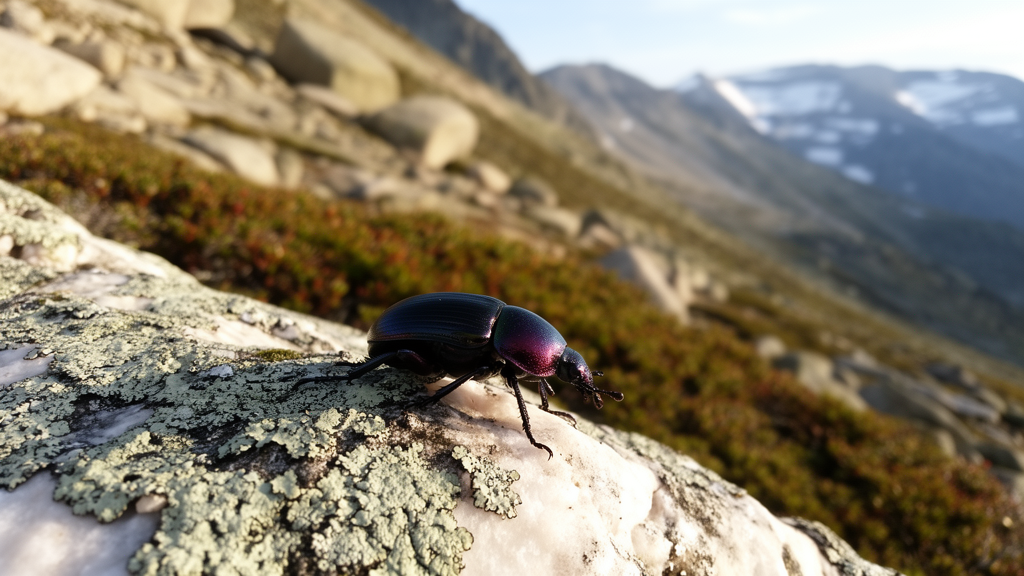
High in the eastern Central Alps of Switzerland, on a plateau above the hamlet of Sur in Graubünden, an unassuming mountain stream became the setting for a meticulous census of one of nature’s most reliable storytellers: the ground beetle. Over a single growing season in 2020, researchers from the Natural History Museum Basel set pitfall traps along an elevational transect running from roughly 2,100 to 2,500 metres above sea level, following the mountain brook Ava dallas Tigias toward the rugged peaks of Piz d’Err and Piz d’Agnel. What the traps yielded offers a vivid snapshot of life at the ecological edge, where cold, wind and thin soils test the limits of survival.
The survey formed part of a biodiversity initiative marking the twentieth anniversary of the foundation behind Alp Flix, an alpine farm perched on a high plateau at about 1,950 metres within Parc Ela, Switzerland’s largest nature park. While previous studies had documented the fauna on and below the plateau, the subalpine and alpine slopes above it remained largely unexplored territory. Ground beetles of the family Carabidae were chosen as the focal group for good reason: they are well-established bioindicators, easy to capture with pitfall traps, and their taxonomy and ecological requirements are among the best understood of any insect family in Central Europe.
Between 20 June and 11 November 2020, seven sampling stations operated continuously, each equipped with three white plastic cups sunk flush into the ground, covered by wire mesh and a transparent Plexiglas roof and filled with a four percent formalin solution. The traps were emptied at two-week intervals, with one collection skipped in October because of persistent snowfall. In the laboratory, specimens were softened using cherry laurel leaves, and genital preparations were made for selected species to confirm identifications. Reference specimens are now housed at the Natural History Museum Basel.
The haul was modest in numbers but rich in information. A total of 393 individual ground beetles were captured, representing 21 species across nine genera. The most abundant species, Pterostichus multipunctatus, accounted for 108 individuals, while five species, including Amara equestris, Harpalus solitaris and the delicately built Leistus montanus rhaeticus, were each recorded only once. Remarkably, seven of the 21 species had never before been documented at Alp Flix, among them two species considered very rare in Switzerland: Amara nigricornis and Leistus montanus rhaeticus.
To interpret these finds, the researchers went beyond a simple species list. They compared the beetle communities of all seven stations using a battery of quantitative similarity measures: Sørensen’s and Jaccard’s indices of species identity, Renkonen’s index of dominance identity, and the Wainstein index, which multiplies two percentage values and therefore yields markedly lower figures. High similarity between two sites suggests comparable ecological conditions, allowing sites to be grouped into shared habitats even when their vegetation types differ.
The analysis revealed a clear three-part structure along the mountainside. The lowest station, at 2,067 metres, sits in half-shaded green alder scrub with moderate moisture and dense shrub and herb layers, forming a distinctly subalpine habitat. Between roughly 2,146 and 2,375 metres lies a second, alpine zone of sun-exposed sites with strong herbaceous cover and moderately fresh to dry conditions, favoured by species such as Notiophilus aquaticus and Calathus micropterus. Above about 2,432 metres, a third, high-alpine habitat emerges: short-turfed or sparsely vegetated ground under full sun exposure and markedly dry-warm conditions, where the cold-adapted Amara erratica dominates.
Perhaps the most thought-provoking result is what the beetles did not do. The transect encompassed six distinct plant-sociological habitat types, yet the similarity indices could not separate the beetle communities along these same lines. Instead, the beetles carved the landscape into their own three zones, hinting that elevation itself may be overprinted by the ecology of each habitat type, as earlier work on spiders at Alp Flix had suggested. Some station pairs, such as sites 6 and 7 near the top, showed strikingly similar faunas, while others, notably the alder scrub site and the high summit scree, shared almost nothing at all.
The findings also underscore how incomplete our knowledge of alpine insect life remains. A third of the species recorded in 2020 were new to Alp Flix, even though the area had hosted a well-publicised biodiversity blitz in 2000 that documented 33 ground beetle species. The lower tally this time likely reflects the method: passive pitfall traps sample ground-dwelling beetles selectively, whereas the earlier event relied on expert hand-collecting, sweeping and sieving. Comparisons with comparable transect studies at the Albula Pass in 2008 and the Furkapass in 2012, which yielded similar species counts, suggest the 2020 results are indeed representative for these elevations.
For conservationists, the message is twofold. Rarity is easy to overlook when only a handful of individuals turn up in a season, and species such as Amara nigricornis and Leistus montanus rhaeticus may persist in small, specialised pockets that standard surveys can miss. Establishing a robust baseline, as this study has done, is the essential first step toward tracking how these sensitive mountain communities respond to a warming climate, in which alpine species face the twin pressures of shifting habitat zones and nowhere left to climb.
The researchers argue that biodiversity monitoring at Alp Flix should continue and expand, closing knowledge gaps about one of Europe’s most fragile ecosystems. Ground beetles, with their precisely mapped distributions and exacting habitat requirements, will remain indispensable guides in that effort, quietly mapping the changing architecture of life on the mountainside one specimen at a time.
Subject of Research: Ground beetle diversity and habitat preferences along a 2,100 to 2,500 metre elevational transect in the Swiss Alps
Article Title: Laufkäfer und ihre Habitatpräferenzen entlang eines Höhentransekts von 2100 bis 2500 m ü. M. oberhalb der Alp Flix in den Schweizer Alpen ( Coleoptera , Carabidae )
Article References: Lüdeke, M., Germann, C., & Jentzsch, M. (2023). Laufkäfer und ihre Habitatpräferenzen entlang eines Höhentransekts von 2100 bis 2500 m ü. M. oberhalb der Alp Flix in den Schweizer Alpen (Coleoptera, Carabidae). Alpine Entomology, 7, 57-62. https://doi.org/10.3897/alpento.7.102534
Image Credits: AI Generated
Keywords: ground beetles, Carabidae, Swiss Alps, Alp Flix, elevational transect, biodiversity, bioindicators, alpine ecology, pitfall traps, habitat similarity, Parc Ela, entomology
Cite Scienmag News
Gavin Prescott. (October 19, 2026). Alpine ground beetles reveal hidden habitat zones in the Swiss Alps. Scienmag. https://scienmag.com/alpine-ground-beetles-reveal-hidden-habitat-zones-in-the-swiss-alps/
Gavin Prescott. "Alpine ground beetles reveal hidden habitat zones in the Swiss Alps." Scienmag, 19 October 2026, https://scienmag.com/alpine-ground-beetles-reveal-hidden-habitat-zones-in-the-swiss-alps/. Accessed 19 October 2026.
Gavin Prescott. "Alpine ground beetles reveal hidden habitat zones in the Swiss Alps." Scienmag. October 19, 2026. https://scienmag.com/alpine-ground-beetles-reveal-hidden-habitat-zones-in-the-swiss-alps/


