


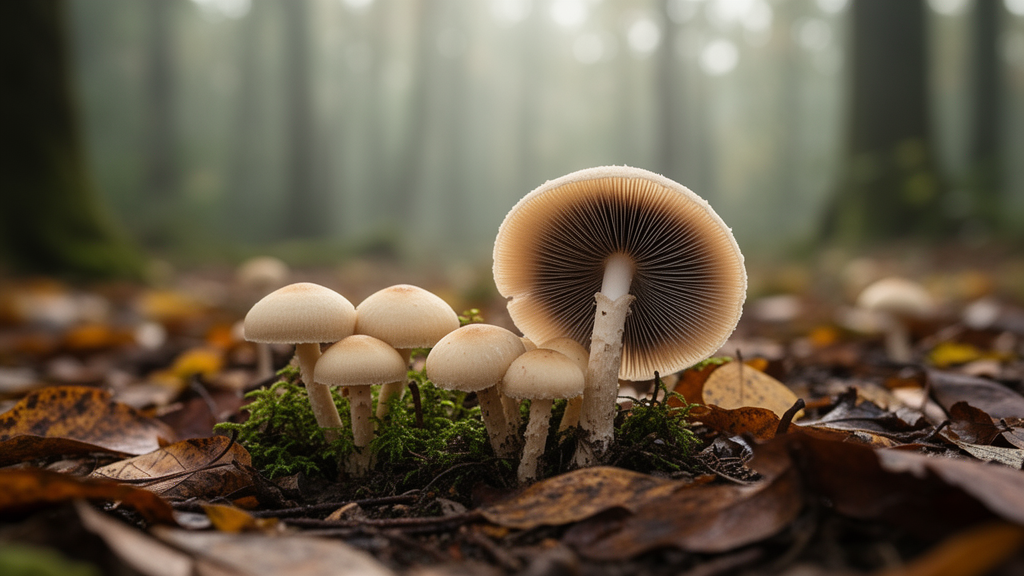
For decades, the small brown mushrooms known as Panaeolus have frustrated mycologists. They sprout on dung, in pastures, and on forest floors across the world, and a handful of them are famous as magic mushrooms because they produce the hallucinogen psilocybin. Yet their classification has been a tangle: nearly 200 published names, wildly variable appearances, and a family placement that has bounced between Coprinaceae, Psathyrellaceae, and Strophariaceae depending on which traits researchers chose to trust. A new systematic study published in IMA Fungus now untangles much of that knot, using genomes, six-gene phylogenies, molecular clocks, and chemical assays to redraw the evolutionary map of this enigmatic group.
The research team, led by Mao-Qiang He and Rui-Lin Zhao, analyzed 104 specimens collected from China, some dating back to 1958, and combined them with sequence data from public repositories. Their centerpiece was a phylogenomic analysis built from 1,764 single-copy genes extracted from 49 fungal genomes spanning 13 families within the suborder Agaricineae. Every node in the resulting tree was fully supported by bootstrap values, giving the researchers an unusually firm scaffold on which to hang their conclusions. The analysis confirmed that the panaeo-clade, the lineage containing Panaeolus and its relatives, forms a coherent evolutionary unit.
That confirmation matters because the panaeo-clade has been a taxonomic orphan. Earlier studies based on one or a few genes placed it near Bolbitiaceae, while a six-gene study in 2006 grouped it instead with Inocybeaceae, Crepidotaceae, and Tubariaceae. The new phylogenomic and multigene analyses, which included 137 samples representing 125 species from 14 families, resolved the conflict: the panaeo-clade is monophyletic and sits as the sister group to Bolbitiaceae, with strong statistical support. Just as importantly, the clade diverged approximately 87 million years ago, a timing that closely matches the stem ages of other recognized families in Agaricineae, which range from 59 to 130 million years.
Those three lines of evidence, monophyly, comparable divergence time, and a distinctive combination of morphological traits, convinced the authors that the panaeo-clade deserves full family rank. Under the rules of botanical nomenclature, the correct name is Galeropsidaceae, a name previously applied only to secotioid fungi, because the type species of the genus Galeropsis, Galeropsis desertorum, has been shown to belong to this clade. The family now contains two accepted genera, Panaeolus and the newly circumscribed Staktophyllus, while the genera Crucispora and Panaeolopsis are synonymized under Panaeolus based on their phylogenetic positions.
Within Panaeolus, the team recognized three subgenera instead of the four traditionally proposed on the basis of appearance. Subgenus Bresadolomyces, named in honor of the legendary mycologist Giacomo Bresàdola, roughly corresponds to the old subgenus Copelandia but is extended to include species formerly placed in Crucispora, such as those with distinctive cruciform-rhomboid spores. Subgenus Panaeolina now encompasses most of the Chinese species along with the Anellaria-like morphotypes, robust pale mushrooms that turn out to be scattered across unrelated lineages. Subgenus Panaeolus retains the type species Panaeolus papilionaceus and its complex, together with a western Asian clade represented by P. punjabensis. Notably, the authors found no single morphological feature that unites each subgenus, overturning long-held assumptions that spore shape and ornamentation could serve as reliable diagnostic characters.
The morphological plasticity that has plagued Panaeolus taxonomy is vividly illustrated by one of the new species. Panaeolus variabilicolor, described from the Xizang Autonomous Region, was found in six samples exhibiting four different pileus morphotypes, ranging from reddish brown and convex to grayish black and conic, likely reflecting adaptations to different habitats. In total, the study proposed one new subgenus and eight new species, including P. grandis with its large campanulate caps, P. limoniformisporus with lemon-shaped spores, P. medogensis from a grazing area at the forest edge in Mêdog County, P. nigrescens with its black hygrophanous stripes, P. pallidus with unusually large spores, P. subfoenisecii, P. variabilicolor, and P. xiaolanii, named in honor of Chinese mycologist Xiao-Lan Mao.
Perhaps the most striking finding concerns the psilocybin-producing traits themselves. The team tested 14 species using high-performance liquid chromatography coupled with tandem mass spectrometry, a technique sensitive enough to detect psilocybin and its analog baeocystin at trace levels. Only two species tested positive: the well-known P. cinctulus and the newly described P. subfoenisecii. Surprisingly, P. cyanescens, the most famous psilocybin producer in the genus, showed no detectable psilocybin in the specimen examined, though the authors note that the sample was 29 years old, and previous genomic and chemical studies have firmly established its psychoactive capabilities. Meanwhile, P. foenisecii, whose psychoactivity has been debated for decades, tested negative, supporting the idea that conflicting historical reports stem largely from misidentification.
The pattern of psilocybin production across the phylogeny is intriguing. The three confirmed or established producers, P. cinctulus, P. subfoenisecii, and P. cyanescens, are distributed across two lineages, subclades A2 and C1, both of which diverged around 30 million years ago. Within subclade A2, P. subfoenisecii and P. foenisecii are sister species, yet only one produces the compound. Previous research has suggested that horizontal gene transfer between genera has driven the diversity of hallucinogenic mushrooms in Agaricales, and the authors raise the possibility that such transfer may have occurred between these closely related sister species, a question they flag for future investigation.
The study also sheds light on the evolution of the coprophilous, dung-inhabiting lifestyle that characterizes many Panaeolus species. Staktophyllus, which occupies the basal position within Galeropsidaceae, grows mainly on sandy soil rather than dung, suggesting that the family originated from a non-coprophilous ancestor. The dung habit appears to have evolved independently in each subgenus rather than being inherited from a common ancestor. Remarkably, the diversification of Galeropsidaceae species coincides temporally with the diversification of ruminants and horses during the Miocene, hinting that the spread of large grazing mammals may have created the ecological opportunities that fueled mushroom speciation. The team also identified at least two independent gasteromycetation events, instances where the mushrooms evolved enclosed, puffball-like fruiting bodies, one at least 2.6 million years ago in P. plantaginiformis and another at least 7.4 million years ago in P. desertorum.
Beyond the evolutionary story, the study carries practical implications. The authors found that the widely used DNA barcode ITS is unreliable for species identification within Galeropsidaceae, showing far less variation than protein-coding genes such as rpb1, rpb2, and tef1. Two species, P. xiaolanii and P. parvisporus, share identical ITS sequences yet differ by more than ten nucleotide positions in tef1, meaning that routine barcoding could easily conflate distinct species. With 88 accepted species currently recognized worldwide and numerous unnamed lineages still awaiting formal description, the authors estimate that more than 100 species of Galeropsidaceae may exist. For a genus that includes some of the most chemically famous fungi on Earth, that is a reminder of how much remains to be discovered, even in groups growing underfoot in pastures around the world.
Subject of Research: Systematics and psilocybin chemistry of the mushroom genus Panaeolus and the family Galeropsidaceae
Article Title: Systematic study of Panaeolus ( Agaricales , Galeropsidaceae ) sensu lato and psilocybin-producing traits of species from China
Article References: He, M.-Q., Yang, W.-Q., Phurbu, D., Liu, F., Li, J.-X., Cao, B., & Zhao, R.-L. (2026). Systematic study of Panaeolus (Agaricales, Galeropsidaceae) sensu lato and psilocybin-producing traits of species from China. IMA Fungus, 17, Article e167329. https://doi.org/10.3897/imafungus.17.167329
Image Credits: AI Generated
DOI: 10.3897/imafungus.17.167329
Keywords: Panaeolus, Galeropsidaceae, psilocybin, phylogenomics, taxonomy, Agaricales, new species, molecular clock, China, coprophilous fungi, HPLC-MS, magic mushrooms
Cite Scienmag News
Juliet Wilcox. (October 19, 2026). Ancient Mushroom Family Gets a Genomic Makeover, Revealing New Psilocybin Producers. Scienmag. https://scienmag.com/ancient-mushroom-family-gets-a-genomic-makeover-revealing-new-psilocybin-producers/
Juliet Wilcox. "Ancient Mushroom Family Gets a Genomic Makeover, Revealing New Psilocybin Producers." Scienmag, 19 October 2026, https://scienmag.com/ancient-mushroom-family-gets-a-genomic-makeover-revealing-new-psilocybin-producers/. Accessed 19 October 2026.
Juliet Wilcox. "Ancient Mushroom Family Gets a Genomic Makeover, Revealing New Psilocybin Producers." Scienmag. October 19, 2026. https://scienmag.com/ancient-mushroom-family-gets-a-genomic-makeover-revealing-new-psilocybin-producers/


