


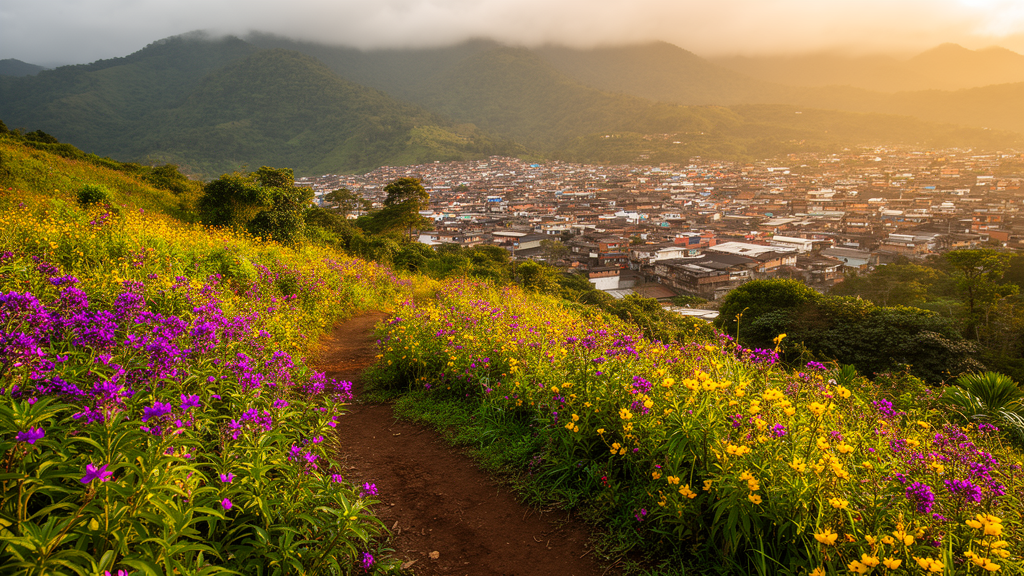
Central America holds roughly seven percent of the world’s plant and animal species on a narrow land bridge of just over 525,000 square kilometers, yet the forces shaping its non-native flora have remained surprisingly opaque. A new study published in NeoBiota has now mapped where naturalized plants — species that establish self-sustaining populations outside their native range — occur across all seven Central American countries, and the results point squarely at one dominant driver: us. Analyzing more than 42,000 occurrence records for 751 naturalized plant species drawn from the Global Biodiversity Information Facility, the researchers found that human population density was the strongest predictor of both where these plants appear and how many species coexist in a given area.
The team, building on an earlier expert-verified inventory of the region’s non-native flora, compiled records for Belize, Costa Rica, El Salvador, Guatemala, Honduras, Nicaragua, and Panama. Each species in the underlying dataset had been confirmed by local botanists working in national herbaria, with voucher specimens backing every inclusion. After cleaning geographic coordinates and removing duplicates, the researchers rasterized the occurrence data onto a five-minute-resolution grid and modeled two responses: the number of records per cell and the number of species per cell. Because only seven countries exist in the region, country-level statistics alone would have lacked statistical power, so the grid-based approach was essential.
The modeling itself was technically careful. The authors used mixed-effect regression with a Matérn correlation structure on latitude and longitude as random effects to control for spatial autocorrelation — the tendency for nearby grid cells to share similar values simply because they are adjacent. Country entered as a fixed effect, and for the richness model the number of records was included as a covariate, since sampling effort inevitably inflates species counts. Both response variables followed Poisson distributions. The result: population density carried a significant positive coefficient for both occurrences and richness, while annual mean temperature and a biodiversity integrity index carried significant negative coefficients. Annual precipitation, by contrast, showed no significant effect at all.
That negative temperature association initially looks counterintuitive. Global syntheses often find more naturalized species in warmer regions, and the study’s own life-zone analysis complicates the picture further. Using the Holdridge life-zone classification, which partitions landscapes by biotemperature, rainfall, and potential evapotranspiration, the researchers compared the number of occupied grid cells in each zone against a null distribution generated by randomly scattering the 14,125 occupied cells across the map 1,000 times. Tropical rainforests and other humid zones — including premontane wet forest, which showed the largest positive deviation at nearly four percent above expectation — held more naturalized species than chance would predict, while tropical moist and dry forests fell below expectation.
The authors reconcile this tension through regional biogeography and history. Most of Central America lies within humid tropical life zones where water availability, not warmth, is the critical filter for plant establishment; many of the region’s naturalized plants originated in the tropics themselves and are pre-adapted to high-rainfall environments. The weak negative temperature signal, they suggest, may trace back to the colonial era, when Spanish settlements clustered in mid-elevation zones with climates resembling Europe’s. Plants introduced centuries ago established in those mid-elevations, and that historical footprint still shapes today’s distribution patterns — a reminder that invasion biogeography is layered over centuries of human land use.
Protected areas emerged as a nuanced story. Of the 42,658 records, 33,211 fell outside protected areas versus 8,755 inside, and 729 species were recorded outside protection compared with 540 within. A chi-square test with Yates’s correction confirmed that the proportion of occupied cells was significantly higher outside protected boundaries. Yet the raw density of observations was nearly identical — about 6.9 occurrences per 100 square kilometers outside versus 6.5 inside. The striking asymmetry appeared in the species-to-records ratio: roughly six species per 100 records inside protected areas against about two per 100 outside.
To interpret that ratio without the distortion of unequal sampling effort, the researchers applied rarefaction analysis using Hill numbers of orders zero, one, and two — corresponding to total species richness, common species, and frequent species respectively. The curves showed no significant difference in common or frequent species between protected and unprotected land, meaning the richness gap comes almost entirely from rare, thinly documented species concentrated in disturbed, unprotected terrain. The authors read this two ways: it may reflect less intensive but more selective collecting inside parks, or it may signal that protected areas, despite lower propagule pressure and reduced disturbance, remain vulnerable to invasion — particularly those near cities such as Braulio Carrillo in Costa Rica, La Tigra in Honduras, and El Boquerón in El Salvador.
The negative relationship with the biodiversity integrity index reinforces the broader ecological interpretation. Intact ecosystems appear to resist naturalization, consistent with the biotic resistance hypothesis, while degraded landscapes — typically those near dense human populations and high propagule input — are more permeable to newcomers. The authors note that even after correcting for sampling bias, which notoriously concentrates biodiversity records around urban centers and roads, population density remained a robust predictor. This aligns with propagule-pressure theory: ornamental horticulture, gardens, and accidental transport along trade corridors such as the Panama Canal continuously seed the regional flora with new arrivals.
For conservation planners, the practical implications are concrete. Mid-elevation zones and densely populated areas should be prioritized for monitoring, and the disturbed, non-protected lands bordering parks deserve particular attention as likely entry points for future invaders. The study also champions citizen science: platforms like iNaturalist, whose research-grade observations feed into GBIF, generate far more detections in urban centers than professional surveys can, making public participation a genuine early-detection asset. The authors argue that education — from school curricula to community outreach about the risks of planting exotic ornamentals — is as central to invasion management as any ecological model.
What makes this study notable methodologically is its refusal to stop at country-level tallies, which would have been meaningless across seven heterogeneous nations, and its explicit handling of the two chronic pitfalls of distribution modeling: spatial autocorrelation and sampling bias. By combining expert-vetted species lists, null-model life-zone tests, rarefaction, and spatially explicit mixed models, the work delivers one of the first fine-scale, region-wide pictures of plant naturalization in the tropics. As climate change intensifies hurricanes, droughts, and displacement across Central America, and as urbanization accelerates, the coupling between human density and invasive flora will only tighten — making early detection and targeted management in the region’s crowded mid-elevations not just advisable, but urgent.
Subject of Research: Spatial distribution and environmental and anthropogenic drivers of naturalized plant species in Central America
Article Title: Geographical patterns in the distribution of naturalized plants in Central America
Article References: Chacón-Madrigal, E., Rojas-Sandoval, J., Ferrufino-Acosta, L., Flores, R., Galán, P., MacVean, A., Rodríguez-Delcid, D., Saldivar-Gómez, I., Ruiz, Y., & López, O. (2025). Geographical patterns in the distribution of naturalized plants in Central America. NeoBiota, 104, 361-379. https://doi.org/10.3897/neobiota.104.157379
Image Credits: AI Generated
DOI: 10.3897/neobiota.104.157379
Keywords: naturalized plants, Central America, invasive species, biodiversity, population density, protected areas, life zones, GBIF, biotic resistance, NeoBiota, propagule pressure, conservation
Cite Scienmag News
Patricia Pace. (October 19, 2026). Human Density Drives Spread of Naturalized Plants Across Central America. Scienmag. https://scienmag.com/human-density-drives-spread-of-naturalized-plants-across-central-america/
Patricia Pace. "Human Density Drives Spread of Naturalized Plants Across Central America." Scienmag, 19 October 2026, https://scienmag.com/human-density-drives-spread-of-naturalized-plants-across-central-america/. Accessed 19 October 2026.
Patricia Pace. "Human Density Drives Spread of Naturalized Plants Across Central America." Scienmag. October 19, 2026. https://scienmag.com/human-density-drives-spread-of-naturalized-plants-across-central-america/


