


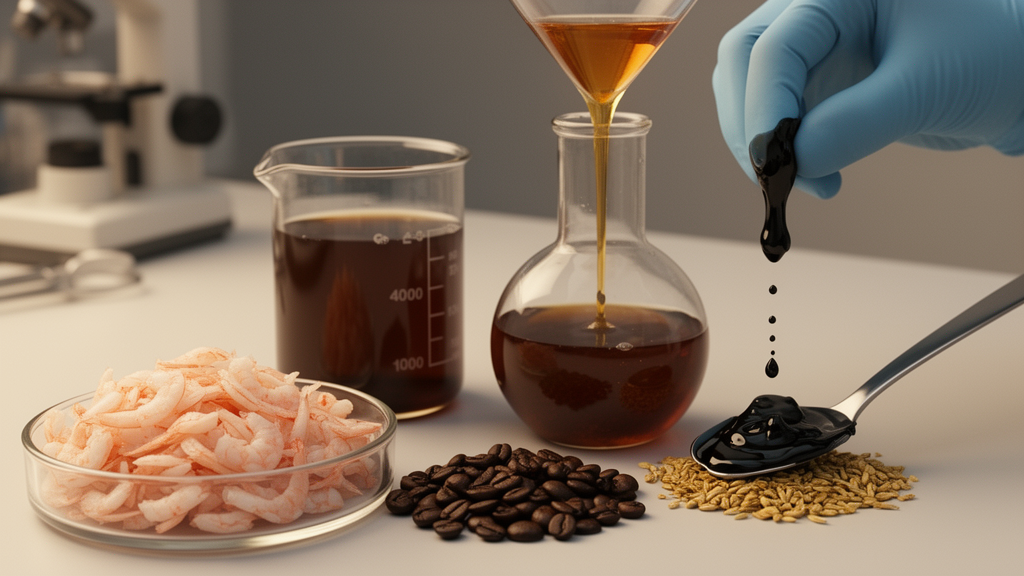
Every year, the world’s breweries and coffee shops discard mountains of barley spent grains and spent coffee grounds, while kitchens pour millions of liters of used cooking oil down the drain. A research team at the University of New Brunswick has now shown that this trio of food-industry waste can be transformed, with the help of an unlikely catalyst made from shrimp shells, into two products that could reshape road construction: a low-oxygen bio-oil and a nitrogen-rich biochar tailored for bio-asphalt formulations. The study, published in Environmental Science and Pollution Research, demonstrates that careful control of feedstock blends and catalytic co-pyrolysis conditions can produce materials with physicochemical properties unusually well suited to the demanding chemistry of asphalt binders.
The research, led by Laura Romero-Zerón and Christopher Grant of the Chemical Engineering Department together with civil engineer Xiomara Sanchez-Castillo, tackles a persistent problem in sustainable road materials. Bio-oils derived from biomass are attractive renewable substitutes for petroleum bitumen, but they typically carry high oxygen contents that accelerate ageing, hardening, and moisture damage in the finished pavement. At the same time, asphalt technologists have long sought anti-stripping agents, additives that help the binder cling to mineral aggregates in the presence of water, and nitrogen-containing compounds are known to serve exactly that role. The Canadian team set out to engineer both properties into their products from the very start of the production process rather than patching them in afterwards.
The feedstocks were chosen deliberately. Barley spent grains, the protein-rich residue left after brewing, and spent coffee grounds both contain substantial amounts of nitrogen, a feature that most lignocellulosic biomasses lack. Waste cooking oil, abundant and lipid-rich, contributes hydrogen-rich compounds that help dilute the oxygenated species generated when the solid biomasses decompose. Co-pyrolysis, in which several feedstocks are heated together in the absence of oxygen, allows these complementary chemistries to interact: the oil acts as a hydrogen donor that stabilizes reactive fragments from the grains and grounds, suppressing the formation of the acids, aldehydes, and water that plague conventional bio-oils.
The most distinctive element of the work, however, is the catalyst. Rather than employing synthetic zeolites or commercial metal oxides, the researchers selected waste shrimp shell powder, a calcium-rich byproduct of the seafood industry. Shrimp shells consist largely of calcium carbonate in its biogenic calcite form along with chitin, and when treated, they function as an alkali and alkaline earth metal (AAEM) catalyst. Such calcium-centric materials are known to promote deoxygenation reactions during pyrolysis, encouraging the removal of oxygen as carbon dioxide and facilitating the cracking of heavy oxygenated molecules. Using one waste stream to upgrade three others gives the process an elegant circular-economy logic that the authors emphasize as central to its appeal.
Under the optimized co-pyrolysis conditions with the shrimp shell catalyst, the team obtained a bio-oil yield of 37.1 plus or minus 1.6 percent by weight and a biochar yield of 22.6 plus or minus 1.8 percent by weight. Perhaps the most striking figure is the catalytic effect on oil production: the natural catalyst increased the bio-oil yield by 66.6 percent relative to the uncatalyzed process. For a process intended to valorize waste streams, that boost matters enormously, because bio-oil yield largely determines the economic viability of pyrolysis as a waste-to-material route. The result also underscores how much performance a cheap, abundant biogenic catalyst can deliver compared with more conventional options.
The chemical composition of the products is where the asphalt connection becomes concrete. The optimum bio-oil contained 5.3 plus or minus 0.1 percent nitrogen by weight, while the corresponding biochar held 3.2 plus or minus 0.02 percent. These are high nitrogen concentrations for biomass-derived materials, and they are precisely what makes the products candidates for anti-stripping functionality. Nitrogen-bearing compounds can adsorb onto acidic and siliceous aggregate surfaces, forming a bridge between the mineral and the organic binder that resists displacement by water. In effect, the researchers have built the adhesion-promoting chemistry directly into the binder components rather than relying on separate commercial additives.
Equally important is what the products do not contain. The oxygen contents of the bio-oils and biochars ranged from 7.1 plus or minus 0.2 to 10.1 plus or minus 0.63 percent by weight, figures the authors describe as relatively low compared with typical values reported in the literature for pyrolysis liquids and chars. Low oxygen is essential in bio-binders because oxygenated species are chemically reactive: over time they oxidize further, cross-link, and stiffen the binder, causing the premature ageing that shortens pavement life. By keeping oxygen in this range, the catalytic co-pyrolysis process produces liquids and solids that should remain stable when blended with aggregates and exposed to heat, air, and traffic loading.
The team then subjected the materials to wettability testing, a practical proxy for how they would behave on real road surfaces. Contact angle measurements of the optimum bio-oil on different rock surfaces indicated the formation of uniform films wetting the rock, exactly the spreading behavior expected of an effective anti-stripping agent that improves binder-aggregate adhesion. In parallel, contact angle measurements in the water-biochar system demonstrated that the biochar is hydrophobic. Hydrophobicity matters because a water-repelling filler can be dispersed into an asphalt binder without introducing moisture pathways, suggesting the char is compatible with asphalt formulations. Beyond its role in bio-binders, the team notes that fine powder biochars have the potential to partially replace binders in conventional asphalt formulations, offering a way to stretch petroleum bitumen with a carbon-rich solid.
The broader significance of the study lies in its demonstration that bio-asphalt ingredients can be designed rather than merely harvested. By tailoring feedstock selection, blending high-nitrogen residues with hydrogen-donating waste oil, and optimizing catalytic co-pyrolysis conditions around a natural calcium-based catalyst, the researchers produced bio-oils and biochars whose properties were matched to the requirements of bio-binder chemistry from the outset. This design philosophy addresses a common criticism of bio-based road materials, namely that bio-oils are too variable and too oxygen-laden to be trusted in infrastructure. The work also illustrates the cascading value of waste streams: brewery residue, coffee waste, used cooking oil, and shrimp shells, each a disposal liability in its own industry, become raw materials for a single integrated process.
The research is not yet a finished road. The authors report that they are currently evaluating the performance of several blends of these customized bio-oils and biochars at the bio-binder-aggregate level, the stage at which moisture sensitivity, rheology, and mechanical durability of actual mixtures are tested. Those experiments will determine whether the promising wetting behavior and hydrophobicity observed in the laboratory translate into pavements that resist stripping and ageing in service. Still, the study offers a compelling preview of what greener roads might be made of: binders brewed from the leftovers of beer, coffee, frying, and seafood, catalyzed by the skeletons of shrimp, and engineered molecule by molecule to hold a highway together.
Subject of Research: Catalytic co-pyrolysis of food-industry waste to produce bio-oils and biochars for bio-asphalt binders
Article Title: Production of tailored bio-oils and biochars via catalytic co-pyrolysis of barley spent grains–spent coffee grounds waste cooking for prospective application in bio-asphalt formulations
Article References: Romero-Zerón, L., Grant, C., & Sanchez-Castillo, X. (2026). Production of tailored bio-oils and biochars via catalytic co-pyrolysis of barley spent grains–spent coffee grounds waste cooking for prospective application in bio-asphalt formulations. Environmental Science and Pollution Research. https://doi.org/10.1007/s11356-026-38272-z
Image Credits: AI Generated
DOI: 10.1007/s11356-026-38272-z
Keywords: bio-asphalt, bio-oil, biochar, co-pyrolysis, barley spent grains, spent coffee grounds, waste cooking oil, shrimp shell catalyst, anti-stripping agent, bio-binder, biomass valorization, circular economy
Cite Scienmag News
Bethany Barker. (October 19, 2026). Shrimp Shell Catalyst Turns Brewery and Coffee Waste Into Road-Ready Bio-Asphalt Ingredients. Scienmag. https://scienmag.com/shrimp-shell-catalyst-turns-brewery-and-coffee-waste-into-road-ready-bio-asphalt-ingredients/
Bethany Barker. "Shrimp Shell Catalyst Turns Brewery and Coffee Waste Into Road-Ready Bio-Asphalt Ingredients." Scienmag, 19 October 2026, https://scienmag.com/shrimp-shell-catalyst-turns-brewery-and-coffee-waste-into-road-ready-bio-asphalt-ingredients/. Accessed 19 October 2026.
Bethany Barker. "Shrimp Shell Catalyst Turns Brewery and Coffee Waste Into Road-Ready Bio-Asphalt Ingredients." Scienmag. October 19, 2026. https://scienmag.com/shrimp-shell-catalyst-turns-brewery-and-coffee-waste-into-road-ready-bio-asphalt-ingredients/


