


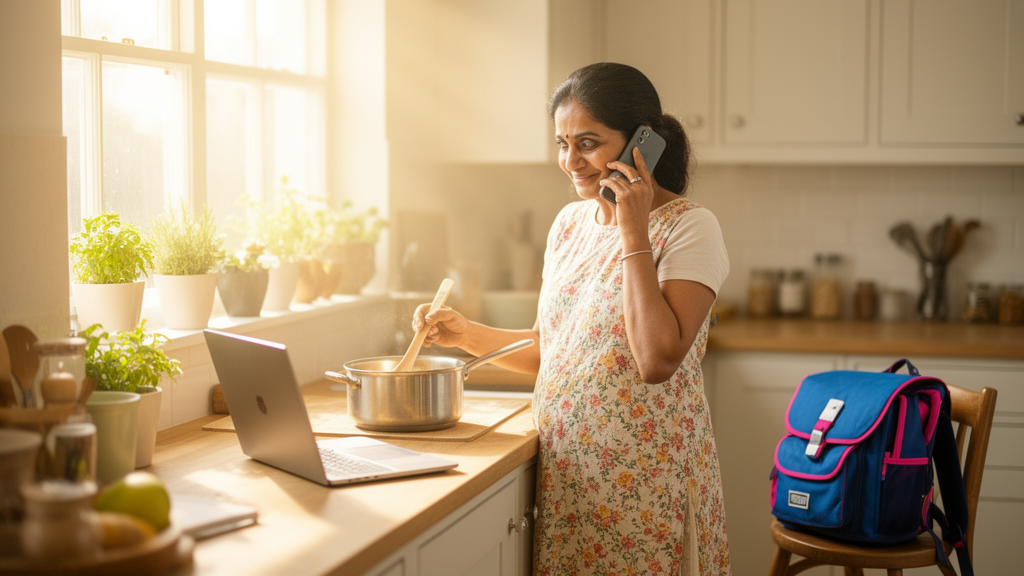
For decades, psychologists have treated the competing demands of work and family as a burden to be minimized, a source of stress that erodes mental health over time. A new study from India turns that assumption on its head. Researchers at the University of Delhi, Sibsagar University, and Dibrugarh University report that adults who carry heavy personal and professional responsibilities tend to show higher levels of psychological resilience, and that this resilience appears to act as a bridge linking responsibility to greater life satisfaction. The findings, published in SN Social Sciences, suggest that the daily juggling act many adults perform may not simply wear them down but could, under the right conditions, help build them up.
The research team, led by Amisha Singh of the Department of Applied Psychology at the University of Delhi, together with Parag Rajkhowa and Bahniman Boruah, set out to examine how responsibility, resilience, and well-being interact in a real-world population. Rather than studying a narrow slice of society, they recruited 200 adults from four Indian states: Delhi, Haryana, Uttar Pradesh, and Assam. The sample was evenly split between 100 men and 100 women and deliberately spanned a wide occupational range, including educators, healthcare workers, corporate professionals, manual laborers, entrepreneurs, and homemakers. This diversity matters, because much of the existing resilience literature has focused on Western, educated, and predominantly professional populations, leaving open the question of whether the same psychological dynamics operate in other socio-cultural settings.
Methodologically, the study is a textbook example of mixed-methods design. On the quantitative side, participants completed a demographic questionnaire, a researcher-developed Responsibility Assessment Scale designed to capture the weight of personal and professional obligations, the Nicholson McBride Resilience Questionnaire, a widely used instrument that measures an individual’s capacity to cope with adversity and recover from setbacks, and the Satisfaction with Life Scale, the classic five-item measure of subjective well-being developed by Ed Diener and colleagues in 1985. On the qualitative side, the researchers conducted semi-structured interviews, allowing participants to describe in their own words how their responsibilities shaped their inner lives. The combination is important: scales can reveal statistical patterns, but interviews reveal the mechanisms and meanings behind them.
The headline quantitative result is striking in its simplicity. Balancing multiple personal and professional roles was positively associated with resilience, meaning that participants who reported greater responsibility also reported a stronger capacity to withstand and bounce back from stress. Perhaps more surprising, the researchers found no statistically significant gender differences in this relationship. In a society where caregiving and household duties often fall disproportionately on women, one might have expected men and women to experience the responsibility-resilience link differently. Instead, the data suggest that the psychological payoff of being needed, of holding roles that others depend on, operates similarly across genders, at least in this sample.
Delving deeper into the statistical structure, the team tested a mediation model, a form of analysis that asks whether the relationship between two variables flows through a third. The results indicated an indirect association between responsibilities and psychological well-being through resilience. In plain terms, taking on responsibilities was not directly linked to feeling satisfied with life so much as it was linked to building resilience, which in turn was associated with greater well-being. This pathway is technically significant because it reframes responsibility not as a direct source of happiness or misery, but as a training ground for coping capacity. The mediation model follows the regression-based approach popularized by Andrew Hayes, allowing the researchers to estimate the indirect effect while accounting for the intercorrelations among the measured variables.
The qualitative interviews added texture to these numbers. Participants consistently described family dependence, caregiving, and professional obligations as important aspects of their resilience and well-being rather than purely as sources of strain. A homemaker managing a household, a healthcare worker supporting patients through difficult shifts, and an entrepreneur carrying the weight of a small business all described how being relied upon gave their efforts structure and meaning. This resonates with a broader theoretical tradition in psychology that views resilience not as a fixed trait but as a dynamic process, one that is exercised and strengthened through engagement with real demands. It also echoes earlier findings on benefit finding, in which caregivers and people facing adversity report unexpected psychological gains, including a stronger sense of purpose and competence, alongside the acknowledged burdens.
The study’s socio-cultural grounding is one of its most distinctive contributions. Resilience research has increasingly recognized that the concept is not culturally neutral. What counts as an adversity, what resources are available for coping, and what roles confer status or meaning all vary across societies. In the Indian context, where joint family structures, filial obligations, and community interdependence remain influential, responsibilities are often woven into identity rather than experienced as external impositions. The authors argue that their findings provide a contextually grounded understanding of the relationships among responsibility, resilience, and psychological well-being within this setting, complementing a literature that has been dominated by individualistic frameworks in which personal autonomy is treated as the primary engine of well-being.
The results also speak to a long-running debate about the nature of resilience itself. Some researchers treat resilience as a stable trait, something a person either has or lacks, while others conceptualize it as a state or process that fluctuates with circumstances. A third position, sometimes called transactional, holds that resilience emerges from ongoing transactions between individuals and their environments. The present findings lean toward the process view: if responsibilities, which are environmental and relational demands, are associated with higher resilience, then resilience is at least partly shaped by the roles people occupy and the demands those roles entail. This aligns with work by scholars such as Michael Ungar, who has argued that resilience must be understood across cultures as a function of the resources and obligations that communities provide, and with strengths-based approaches that emphasize what sustains people rather than what damages them.
There are, of course, important caveats. The study is cross-sectional, capturing a single moment in time, which means the direction of the associations cannot be definitively established. It is possible that resilient people are simply more willing and able to take on responsibilities, rather than responsibilities building resilience, or that some third factor, such as social support or personality, drives both. The sample of 200 adults, while diverse, was drawn from four states and may not generalize to India as a whole or to other countries. The Responsibility Assessment Scale was developed by the researchers themselves and has not yet accumulated the validation history of the older instruments used alongside it. The authors are candid about these limitations and explicitly recommend that future research examine these associations using longitudinal and culturally validated approaches to better understand how responsibility, resilience, and well-being develop and influence one another over time.
Even with those caveats, the implications are provocative. If the daily balancing of roles can foster the very psychological resources that protect against stress, then workplaces, families, and policymakers might reconsider how they frame the demands placed on adults. Rather than treating every obligation as a risk factor to be engineered away, the findings hint that meaningful responsibilities, when matched with adequate support, could be leveraged as assets in mental health promotion. For the educators, nurses, laborers, entrepreneurs, and homemakers of Delhi, Haryana, Uttar Pradesh, and Assam who took part in the study, the message is quietly empowering: the weight they carry each day may be doing more than testing their endurance. It may be building the very strength that keeps them standing.
Subject of Research: The relationship between personal and professional responsibilities, psychological resilience, and adult well-being in India
Article Title: Resilience in action: the influence of personal and professional responsibilities on adult well-being
Article References: Singh, A., Rajkhowa, P., & Boruah, B. (2026). Resilience in action: the influence of personal and professional responsibilities on adult well-being. SN Social Sciences, 6(9), Article 393. https://doi.org/10.1007/s43545-026-01687-z
Image Credits: AI Generated
DOI: 10.1007/s43545-026-01687-z
Keywords: resilience, psychological well-being, responsibilities, work-life balance, India, mixed methods, life satisfaction, caregiving, gender differences, mediation analysis, SN Social Sciences, mental health
Cite Scienmag News
Courtney Benton. (October 19, 2026). Juggling Duties May Build Resilience and Boost Well-Being in Indian Adults. Scienmag. https://scienmag.com/juggling-duties-may-build-resilience-and-boost-well-being-in-indian-adults/
Courtney Benton. "Juggling Duties May Build Resilience and Boost Well-Being in Indian Adults." Scienmag, 19 October 2026, https://scienmag.com/juggling-duties-may-build-resilience-and-boost-well-being-in-indian-adults/. Accessed 19 October 2026.
Courtney Benton. "Juggling Duties May Build Resilience and Boost Well-Being in Indian Adults." Scienmag. October 19, 2026. https://scienmag.com/juggling-duties-may-build-resilience-and-boost-well-being-in-indian-adults/


