


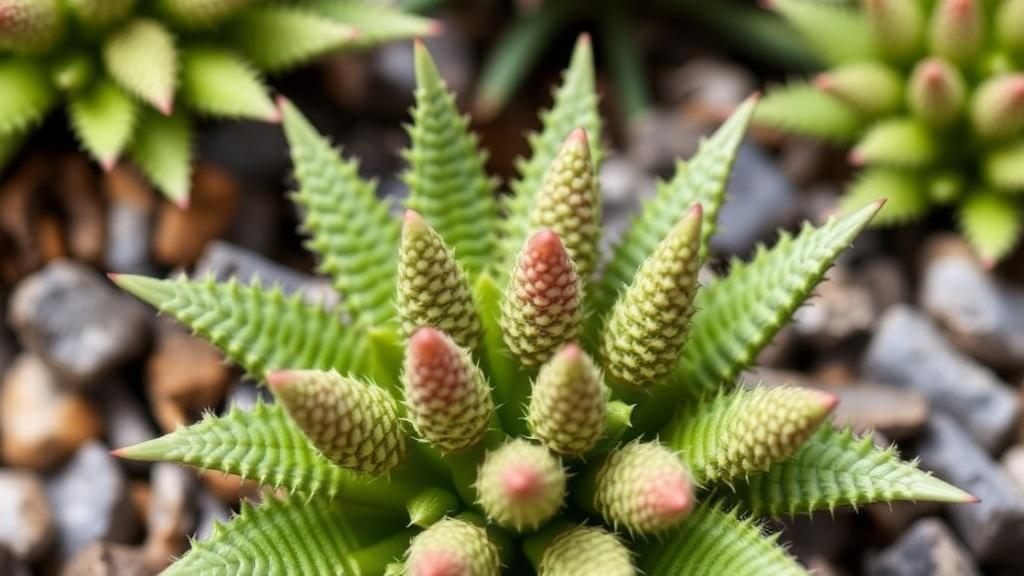
A quiet but consequential dispute in plant taxonomy has surfaced around a group of stonecrops whose leaf tips bear distinctive spinose appendages. In a paper published in the journal PhytoKeys, researchers argue that a newly coined generic name, Spinella, was applied incorrectly to species long placed in Orostachys subsection Appendiculatae, a lineage within the stonecrop family Crassaceae… rather Crassulaceae. The correction hinges not on new fieldwork or fresh DNA sequences but on a nomenclatural technicality with deep roots: the name Orostachys is conserved under the International Code of Nomenclature for algae, fungi, and plants, and its conserved type anchors it firmly to the spinose lineage rather than to the subsection that carries the generic name’s original type species.
Orostachys was established in 1809 and has long been a troublesome genus. Traditional classifications recognized two subsections within its core section: subsection Appendiculatae, characterized by the spinose appendages at the leaf apex, and subsection Orostachys, which lacks such appendages. Over decades of morphological and molecular scrutiny, these two subsections repeatedly failed to form a single monophyletic group, appearing in different studies as separate lineages. The trouble is that subsection Orostachys contains the original type species of the genus, Orostachys malacophylla… actually the type is O. malacophylla per the original designation, but the source here says the original type species of the genus is in subsect. Orostachys. Let me stick to the source: subsect. Orostachys contains the original type species of the genus. To stabilize nomenclature and minimize disruption to both Orostachys and the related genus Hylotelephium, a proposal was made in 2017 to conserve the name Orostachys with a new type, Orostachys chlorantha, a synonym of O. spinosa, which sits in subsection Appendiculatae. That proposal was accepted by the Nomenclature Committee in 2022.
The consequence is decisive. Under the Code, a conserved name must follow its conserved type. Because the conserved type Orostachys chlorantha belongs to the spinose lineage, the name Orostachys must apply to subsection Appendiculatae, not to subsection Orostachys. This means any new genus carved out of the spinose lineage is superfluous: those species remain within Orostachys as circumscribed by the conserved type.
Recent phylogenomic work has reinforced the biological reality behind the split. Studies using extensive sequence data, including work published in 2025 and 2026, recovered subsection Orostachys and subsection Appendiculatae as distinct lineages, each closer to other genera than to each other. One team responded by treating subsection Appendiculatae as Orostachys in the strict sense and establishing a new genus, named Amblystachys, for subsection Orostachys. That treatment respected the conserved type and is, according to the authors of the new paper, nomenclaturally sound.
A second team, however, took a different route. They described Spinella as a new genus segregated from Orostachys, explicitly intended to accommodate the taxa previously placed in subsection Appendiculatae, and designated Spinella japonica as its type. In doing so, the authors of the new paper contend, they overlooked the nomenclatural consequences of the conserved type. Because the spinose lineage is anchored to the name Orostachys by conservation, a new genus for that same lineage cannot stand: it is superfluous under the Code.
The authors therefore treat Spinella as a nomenclatural synonym of Orostachys. Names published under Spinella are to be regarded as homotypic synonyms of the corresponding names in Orostachys, meaning they refer to the same type and thus the same taxonomic entity. The nine taxa that were transferred into Spinella remain in Orostachys under their original names.
The case illustrates a broader principle in taxonomy: phylogenomic data can reveal where lineages lie, but only the Code, and the machinery of conservation, determines which name attaches to which lineage. When a name is conserved with a particular type, that decision binds all subsequent treatments, regardless of how intuitive an alternative circumscription might seem. The authors of the new paper emphasize that the earlier team’s error was not in the biology, which the phylogenomic studies support, but in the nomenclature, which the conservation decision settles.
For researchers working on East Asian stonecrops, the practical effect is that species formerly listed under Spinella should be cited under Orostachys. Herbarium labels, checklists, and floras that adopted Spinella will need updating. The authors suggest that the treatment respecting the conserved type, such as the one establishing Amblystachys for the non-spinose lineage, provides the stable framework going forward.
The episode also underscores why conservation proposals matter. By conserving Orostachys with a type in the spinose lineage, the botanical community deliberately chose to keep the familiar generic name attached to the larger, more species-rich group, minimizing disruption to the many names that had accumulated under it over two centuries. That choice, made through the formal mechanisms of the Code, now determines the correct application of the name, even when molecular data suggest alternative ways of dividing the lineage.
The authors conclude that Spinella must be treated as a synonym of Orostachys, and that the corresponding names under Spinella are homotypic synonyms of their counterparts in Orostachys. The correction, they argue, restores nomenclatural stability to a group whose evolutionary distinctness is no longer in doubt, even as its naming continues to be worked out under the rules that govern botanical nomenclature.
Subject of Research: Taxonomic revision of the stonecrop genus Orostachys and the superfluity of the new genus Spinella
Article Title: On the incorrect use of Spinella for species of Orostachys subsect. Appendiculatae ( Crassulaceae )
Article References: Wei, N., Qiu, X.-D., & Wang, Q.-F. (2026). On the incorrect use of Spinella for species of Orostachys subsect. Appendiculatae (Crassulaceae). PhytoKeys, 276, 13-16. https://doi.org/10.3897/phytokeys.276.195585
Image Credits: AI Generated
DOI: 10.3897/phytokeys.276.195585
Keywords: taxonomy, Crassulaceae, Orostachys, Spinella, nomenclature, phylogenomics, botany, incorrect, species, subsect, Appendiculatae, scientific research
Cite Scienmag News
Roger Howard. (October 19, 2026). Botanists Correct Misapplied Name for Spinose Stonecrop Lineage. Scienmag. https://scienmag.com/botanists-correct-misapplied-name-for-spinose-stonecrop-lineage/
Roger Howard. "Botanists Correct Misapplied Name for Spinose Stonecrop Lineage." Scienmag, 19 October 2026, https://scienmag.com/botanists-correct-misapplied-name-for-spinose-stonecrop-lineage/. Accessed 19 October 2026.
Roger Howard. "Botanists Correct Misapplied Name for Spinose Stonecrop Lineage." Scienmag. October 19, 2026. https://scienmag.com/botanists-correct-misapplied-name-for-spinose-stonecrop-lineage/


