


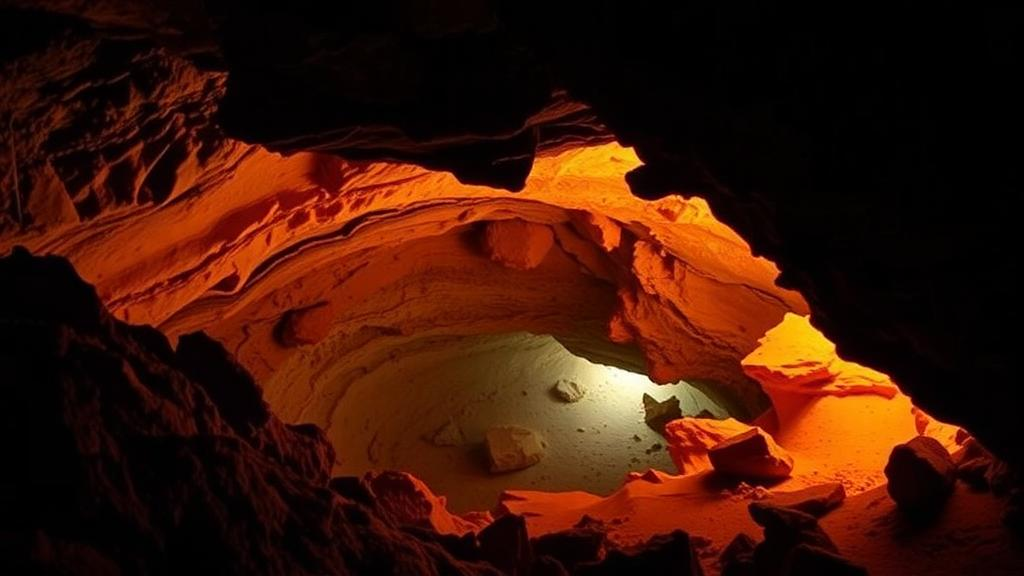
Deep beneath a stony desert plateau in eastern Morocco, a limestone cave system stretching more than four kilometers has emerged as the richest known reservoir of cave-restricted life on the African continent. A new study published in Subterranean Biology documents 26 troglobitic and stygobiotic species in Aziza cave, also known as Kef Aziza or Tazouguert cave, comprising 22 terrestrial troglobionts and four aquatic stygobionts. Of these, eight still require confirmation of their cave-restricted status, but at least 18 are confirmed obligate cave dwellers. The finding places this single cave system ahead of every other documented site in Africa and challenges the long-standing absence of the continent from global maps of subterranean biodiversity hotspots.
Aziza cave sits in the Tazzouguert Plateau in the Drâa Tafilalt region, roughly 80 kilometers from the city of Errachidia, within the Moroccan Eastern High Atlas. The surrounding landscape is classic pre-Saharan hamada: hard, rocky desert with sparse sand cover, where rainfall ranges from more than 250 millimeters in the High Atlas to under 75 millimeters on the Tafilalet plain and summer temperatures climb to 40 degrees Celsius. The cave itself lies 30 meters above the right bank of the Guir River, carved into Turonian limestone that forms part of the Guir’s Hamada, a plateau of roughly 1,000 square kilometers built from Cenomanian-Turonian bioclastic limestones and marls.
The cave’s dimensions alone make it exceptional. First explored in 1925 and surveyed incrementally by Moroccan, Spanish, Croatian, and Italian teams over the following decades, the system was mapped at approximately 3,500 meters in 2003, and a 2019 Moroccan survey using Disto X instruments and 3D laser representation extended the known network beyond 4,000 meters. That makes Aziza the fifth-largest cave system in Morocco and one of the ten largest in North Africa. Its galleries descend gently from two entrances, one horizontal and one vertical, past a vast chamber known as the Guano Room that reaches 30 meters in height and hosts a colony of hundreds of bats.
The cave’s very shape bears the imprint of its bat residents. Biogenic corrosion from bat secretions has reshaped the walls and ceilings: mineralized urine attacks the limestone directly, while ammonia from urine combining with carbon dioxide from bat respiration produces carbonic acid through condensation, etching bell holes, hemispherical domes, and smooth walls that have erased the cave’s original morphologies. Speleologists believe the cave formed in two stages, an ancient phreatic phase followed by more recent vadose enlargement, and the system is classified as hypogenic, fed by the Turonian aquifer that also supplies regional springs such as Meski and Tamazirt.
Inside, the climate could hardly contrast more sharply with the desert above. Researchers logged air temperatures averaging around 23 degrees Celsius with a standard deviation of 1.5 degrees, and relative humidity rising from about 62 percent near the entrance to 98.2 percent at distances beyond 800 meters. For eyeless, unpigmented animals adapted to saturated air, the parched exterior is a physiological barrier they cannot cross, which strengthens the case that the cave’s troglomorphic species are true obligate cave dwellers rather than soil fauna washed in from the surface.
The inventory itself is taxonomically broad. The richest groups are beetles with five species, spiders with four, elongate-bodied springtails with three, and isopods with two. Single representatives of bathynellaceans, copepods, pulmonate gastropods, geophilomorph centipedes, planthoppers, palpigrades, polydesmid millipedes, pseudoscorpions, scolopendromorph centipedes, and globular springtails round out the list. Among the confirmed troglobionts are the blind spider Dysdera caeca, the linyphiid spider Lepthyphantes fadriquei, the palpigrade Eukoenenia maroccana, the millipede Jeekelosoma abadi, and the beetles Apteranillus ruei and Torneuma troglodytis, several of which are known from nowhere else on Earth. Aquatic fauna includes the stenasellid isopod Magnezia gardei, a hydrobiid gastropod awaiting description as a new genus, a copepod, and a bathynellacean, found in clay-bottomed pools and a large lake beyond the cave’s second siphon.
Perhaps the most striking statistic is taxonomic, not ecological: only about 34.6 percent of the cave-restricted species found at Aziza have been formally described to science. The remainder are morphotypes known only from specimens, many of them almost certainly new species. The authors note that sampling methods capable of extracting tiny invertebrates from soil and sediment, such as Berlese-Tullgren funnels, were not employed, and that large portions of the system beyond the explored galleries remain biologically uncharted. The true diversity of the cave, in other words, is likely considerably higher than the 26 taxa documented so far.
The global context sharpens the significance. Subterranean biodiversity hotspots, conventionally defined as caves harboring 20 or more cave-restricted species, have been identified on every continent except Africa and Antarctica, with a pronounced concentration between 40 and 50 degrees north latitude in Europe’s Dinaric Karst and a secondary band in subtropical latitudes. Africa’s absence from that map has long been attributed to insufficient sampling rather than a genuine paucity of cave life. The closest African rival to Aziza is the Wynberg Cave System on South Africa’s Cape Peninsula, which hosts 19 cave-restricted species. With 18 confirmed and eight potential cave-restricted taxa, Aziza now stands as the richest documented cave fauna on the continent, and the authors argue both sites merit formal recognition as subterranean biodiversity hotspots.
Why does a cave in the Sahara harbor such wealth? The study points to a convergence of factors: the cave’s large size creates a mosaic of microhabitats from entrance gravels to saturated clay chambers; permanent subterranean water bodies provide aquatic habitat isolated from the surface; and the region’s climatic history, including the greening and desiccation cycles of the Sahara, likely stranded surface ancestors underground where they evolved in isolation. Nutrient inputs come chiefly from bat guano and carcasses, supplemented by scattered plant debris, on which the generalist millipede Jeekelosoma abadi was observed feeding directly.
That biological wealth sits inside a UNESCO Biosphere Reserve, the Oasis du Tafilalet, yet the cave itself is far from protected. Its entrance is ungated beside a paved road, tractors work the riverbed directly in front of it, and the accessible first sections are marred by graffiti, litter, broken glass, and fire remains. Bat colonies counted in the hundreds in 2002 had shrunk to roughly a third of that figure by spring 2003 and to about two hundred individuals by winter, a decline the authors link partly to local attempts to smoke the animals out using wind torches, driven by fears of guano-borne disease. The paper argues that Morocco’s Protected Areas law can be applied through a participatory approach that engages local communities, and that Aziza’s case should catalyze a broader effort to survey African caves before their undocumented fauna, much of it still nameless, is lost.
Subject of Research: Subterranean biodiversity and conservation of cave-restricted fauna in Morocco's Aziza cave
Article Title: A cave with remarkably high subterranean diversity in Africa and its significance for biodiversity conservation
Article References: Moutaouakil, S., Souza-Silva, M., Oliveira, L. F., Ghamizi, M., & Ferreira, R. L. (2024). A cave with remarkably high subterranean diversity in Africa and its significance for biodiversity conservation. Subterranean Biology, 50, 1-28. https://doi.org/10.3897/subtbiol.50.113919
Image Credits: AI Generated
DOI: 10.3897/subtbiol.50.113919
Keywords: Aziza cave, Morocco, subterranean biodiversity, troglobites, stygobionts, cave conservation, karst, Sahara, bats, endemic species, Subterranean Biology, biodiversity hotspot
Cite Scienmag News
Margaret Porter. (October 19, 2026). Moroccan Sahara cave reveals Africa’s richest known subterranean fauna. Scienmag. https://scienmag.com/moroccan-sahara-cave-reveals-africas-richest-known-subterranean-fauna/
Margaret Porter. "Moroccan Sahara cave reveals Africa’s richest known subterranean fauna." Scienmag, 19 October 2026, https://scienmag.com/moroccan-sahara-cave-reveals-africas-richest-known-subterranean-fauna/. Accessed 19 October 2026.
Margaret Porter. "Moroccan Sahara cave reveals Africa’s richest known subterranean fauna." Scienmag. October 19, 2026. https://scienmag.com/moroccan-sahara-cave-reveals-africas-richest-known-subterranean-fauna/


