


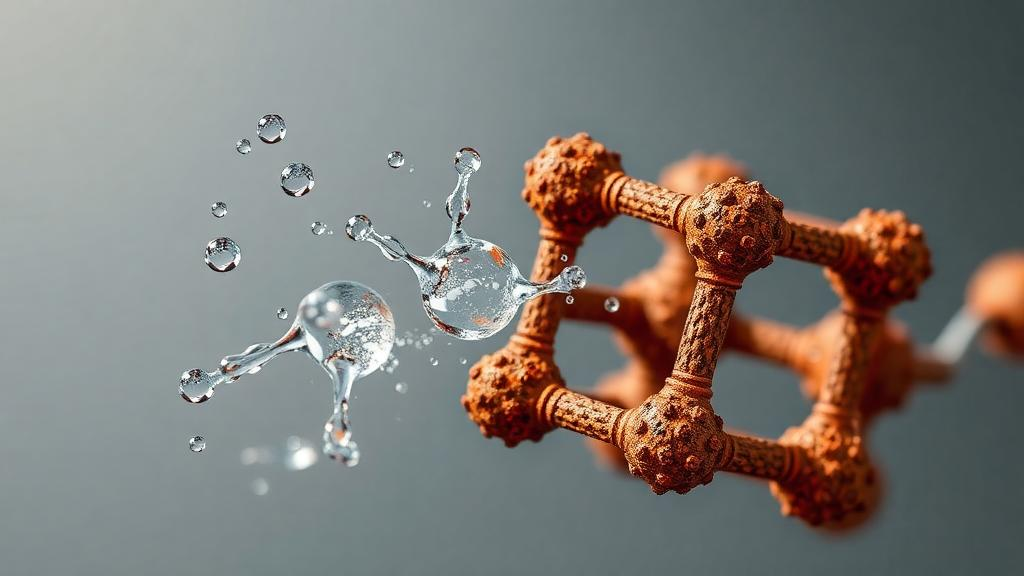
Hydrogen has long been heralded as the fuel of a clean energy future, but producing it without fossil fuels remains one of the central engineering challenges of the decade. The most elegant solution, splitting water into hydrogen and oxygen using renewable electricity, is held back by a stubborn problem: the electrodes that drive the two half-reactions are either too expensive, too fragile, or too slow. Now a team of researchers at Chengdu University in China reports a low-cost catalyst made from earth-abundant iron and cerium that performs both reactions efficiently in the same alkaline electrolyzer, reaching a cell voltage of just 1.56 volts to drive a current density of 10 milliamperes per square centimeter.
The work, published in the journal Ionics, centers on a composite material the researchers call CeO2/Fe3O4-0.2. Rather than mixing commercial powders, the team grew a metal-organic framework known as MIL-88, in which iron atoms are threaded into a crystalline scaffold of organic linkers, and then transformed it through hydrothermal treatment followed by high-temperature calcination. The result is a spindle-shaped particle architecture in which two oxides, cerium dioxide and magnetite, are intimately interwoven. This two-step strategy exploits the atomic precision of framework chemistry: the metal centers are already distributed uniformly at the molecular scale before the heat treatment locks them into their final oxide forms.
The choice of ceria is the scientific heart of the study. Cerium dioxide is famous in catalysis for its dual valence state, in which cerium atoms shuttle between the +4 and +3 oxidation states. Every time a Ce4+ ion is reduced to Ce3+, an oxygen vacancy is created in the crystal lattice, a missing oxygen atom that leaves behind a reactive pocket. These vacancies are not defects in the pejorative sense; they are the very sites where water molecules adsorb, dissociate, and hand over their electrons. The redox cycling between Ce4+ and Ce3+ continuously regenerates this population of active sites, allowing the surface to restructure itself in response to the electrochemical environment.
This is where the concept of surface reconstruction becomes crucial. Many promising catalysts are actually pre-catalysts: when a voltage is applied, their surfaces transform in situ into the truly active phase, often a metal oxyhydroxide. The trouble is that this reconstruction is frequently uncontrolled, producing active layers that are patchy, unstable, or prone to dissolution. The Chengdu team argues that the ceria component acts as a regulator of this process. By supplying a reservoir of mobile oxygen and variable-valence cations at the interface with the iron oxide, CeO2 guides the reconstruction toward a stable, highly active configuration rather than letting it proceed chaotically.
The synergy between the two oxides is measurable. According to the paper, the partnership between Fe3O4 and CeO2 increases the number of accessible active sites, accelerates charge transfer across the catalyst, and improves the interface between the electrode and the electrolyte. Magnetite, a conductive iron oxide, provides an efficient electronic highway, while the ceria domains inject oxygen vacancies and electronic flexibility. In electrocatalysis, where every electron must traverse the catalyst particle, the electrolyte film, and the current collector, bottlenecks at any of these junctions translate directly into wasted voltage. The composite design attacks all three at once.
The performance numbers are striking for a noble-metal-free material. For the oxygen evolution reaction, the more sluggish of the two half-reactions and typically the bottleneck of the entire electrolyzer, the CeO2/Fe3O4-0.2 catalyst required an overpotential of only 305 millivolts to reach 10 milliamperes per square centimeter in 1 molar potassium hydroxide. For the hydrogen evolution reaction, the same material needed just 73 millivolts of overpotential at the same current density. Overpotentials measure how far the applied voltage must exceed the thermodynamic minimum of 1.23 volts; every millivolt saved is energy that goes into chemical bonds rather than heat.
Durability, the graveyard of many laboratory catalysts, also fared well. The researchers report that the oxygen evolution electrode showed only a slight change in potential over 100 hours of continuous operation, an indication that the reconstructed surface layer is not flaking off or dissolving into the alkaline electrolyte. When the same composite was deployed as both the anode and the cathode of a two-electrode electrolyzer, the device split water at 10 milliamperes per square centimeter with a cell voltage of 1.56 volts, comfortably below the 1.8 to 2.0 volts typical of many non-precious systems and approaching the territory usually reserved for catalysts containing iridium and platinum.
The broader context makes the result more significant. Metal-organic frameworks have become a favored starting point for electrocatalyst design because their pyrolysis yields porous, high-surface-area oxides with morphologies that would be difficult to achieve by conventional synthesis. Recent studies in the same journal and elsewhere have explored MIL-88 derivatives, cobalt and nickel ferrites, and ceria-decorated heterojunctions for water splitting, and the Chengdu work builds directly on this lineage. What distinguishes the new study is the explicit focus on using the Ce4+/Ce3+ redox couple to steer surface reconstruction, effectively turning a well-known property of ceria into a design principle for stabilizing the active state of an iron-based catalyst.
The economics are equally compelling. Iridium and platinum, the benchmarks for oxygen and hydrogen evolution respectively, are among the rarest elements in the Earth’s crust, and their supply chains are concentrated in a handful of countries. Iron and cerium, by contrast, are abundant and inexpensive; ceria is already produced on the megaton scale for catalytic converters and glass polishing. A bifunctional catalyst that uses only these elements, synthesized through scalable hydrothermal and calcination steps, could meaningfully lower the capital cost of alkaline electrolyzers, particularly in the gigawatt-scale installations envisioned for green hydrogen production from solar and wind farms.
Challenges remain before such materials reach industrial electrolysis stacks. Laboratory tests at 10 milliamperes per square centimeter are a useful benchmark, but commercial devices operate at current densities an order of magnitude or two higher, where mass transport, bubble management, and catalyst loading dominate performance. Long-term testing must also extend well beyond 100 hours, ideally to thousands of hours under fluctuating renewable power. Nevertheless, the study offers a clear demonstration that rational interface engineering between a redox-active oxide and a conductive spinel can deliver both activity and stability from cheap, plentiful elements, and it adds a powerful tool to the growing toolbox for designing the electrodes that may one day make hydrogen from sunlight and seawater a routine commodity.
Subject of Research: MOF-derived CeO2/Fe3O4 bifunctional electrocatalysts for overall water splitting
Article Title: Synergism effect of CeO2 and Fe3O4 derived from MIL-88 regulating the surface reconstruction to achieve high-performance for overall water splitting
Article References: Luo, Z., Yuan, M., Zhao, P., Yang, X., & Zhang, Q. (2026). Synergism effect of CeO2 and Fe3O4 derived from MIL-88 regulating the surface reconstruction to achieve high-performance for overall water splitting. Ionics. https://doi.org/10.1007/s11581-026-07592-y
Image Credits: AI Generated
DOI: 10.1007/s11581-026-07592-y
Keywords: water splitting, electrocatalysis, hydrogen evolution reaction, oxygen evolution reaction, CeO2, Fe3O4, MIL-88, metal-organic frameworks, oxygen vacancies, surface reconstruction, bifunctional catalyst, green hydrogen
Cite Scienmag News
Bethany Barker. (October 19, 2026). Rust-and-Ceria Catalyst From Metal-Organic Framework Splits Water With Record Efficiency. Scienmag. https://scienmag.com/rust-and-ceria-catalyst-from-metal-organic-framework-splits-water-with-record-efficiency/
Bethany Barker. "Rust-and-Ceria Catalyst From Metal-Organic Framework Splits Water With Record Efficiency." Scienmag, 19 October 2026, https://scienmag.com/rust-and-ceria-catalyst-from-metal-organic-framework-splits-water-with-record-efficiency/. Accessed 19 October 2026.
Bethany Barker. "Rust-and-Ceria Catalyst From Metal-Organic Framework Splits Water With Record Efficiency." Scienmag. October 19, 2026. https://scienmag.com/rust-and-ceria-catalyst-from-metal-organic-framework-splits-water-with-record-efficiency/


