


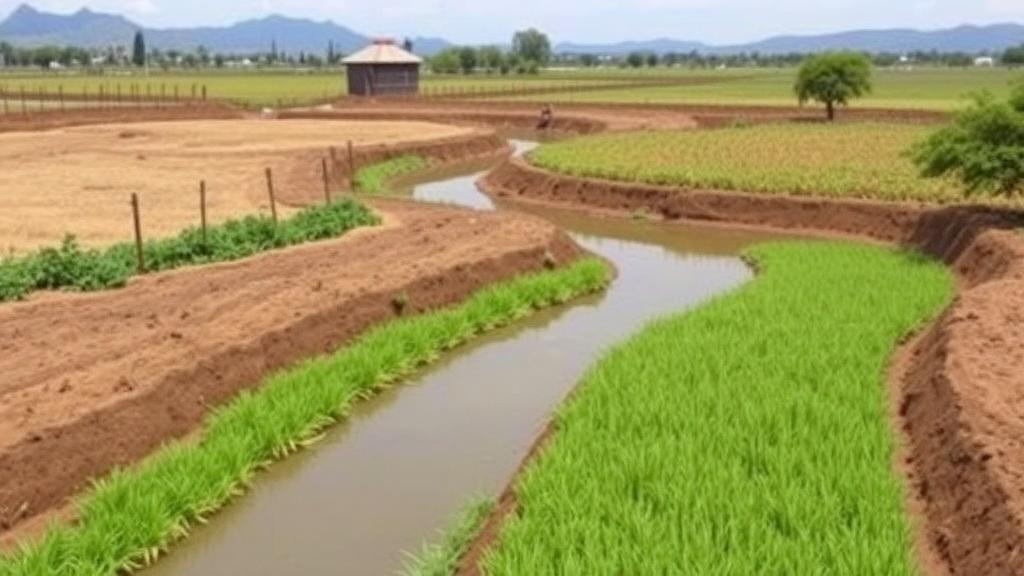
In the arid heart of Chihuahua, northern Mexico, a closed basin holds the answers to one of agriculture’s most pressing questions: what actually makes farmers go green? A new study of 95 Mennonite farmers in the Bustillos Lagoon region reveals that sustainable farming is not a single decision but a diverse portfolio of practices, and that two factors—technical assistance and environmental concern—are the strongest drivers of broader conservation management. The research, published in Environmental Management, offers a fresh perspective on how water-scarce farming communities adapt, and why simply facing environmental stress is not enough to trigger change.
The Bustillos Lagoon basin is a hydrologically isolated system covering roughly 3,288 square kilometers, part of Mexico’s Closed Basins of the North. Because the lagoon has no permanent natural surface outlet, water, sediments, nutrients, and contaminants transported from the surrounding landscape accumulate within the system rather than being flushed away. This endorheic character makes the basin acutely sensitive to cumulative agricultural pressures, from groundwater abstraction to land-use change and recurrent drought. The region’s economy is deeply tied to agriculture, livestock, and dairy farming, with crops including maize, wheat, barley, oats, forage crops, apples, and vegetables, all heavily dependent on irrigation and groundwater in an arid to semi-arid climate marked by interannual rainfall variability.
Mennonite communities have shaped the agricultural landscape of the Cuauhtémoc valley since the early twentieth century, developing colony-based farming systems characterized by mechanization, irrigation, and commercial production. These communities are distinguished by highly organized cooperative structures through which farmers share financial resources, agricultural inputs, machinery, infrastructure, and marketing networks. The FORTSCHRITT registry, a credit and financial support system, listed 839 active Mennonite farmers in the target agricultural zone at the time of the study. Because farming decisions are often shaped not only at the individual farm level but also through collective institutions within colonies and cooperatives, the management choices of these farmers carry weight far beyond individual plots—they matter for the regional land and water sustainability of an entire closed basin.
To understand what drives sustainable management in this setting, researchers surveyed 95 Mennonite farmers selected through simple random sampling from the FORTSCHRITT registry. The team assessed 13 sustainable agricultural practices spanning four functional domains: soil and residue management, water conservation, biological soil-fertility management, and agrochemical stewardship. Rather than classifying farmers as simple adopters or non-adopters, the researchers calculated a conservation-practice breadth score—the number of ten resource-management practices each farmer reported using always or sometimes. This portfolio-based approach reflects the multidimensional nature of sustainable agriculture and avoids assuming that all practices provide equivalent environmental benefits.
The results revealed striking variation in practice uptake. Residue incorporation was nearly universal at 98.9 percent, followed by residue cover at 89.4 percent and rainwater collection at 71.0 percent. Yet conservation tillage remained remarkably rare: zero tillage was reported by just 1.1 percent of farmers, reduced tillage by 8.5 percent, and biological soil-fertility practices such as compost or leachate use and mycorrhiza application each by only 5.3 percent. Among the 92 farmers with complete practice data, conservation-practice breadth ranged from 2 to 8 practices, with a mean of 3.76 and a standard deviation of 1.06. Most farmers occupied the middle of the distribution, using a moderate rather than very narrow or very broad portfolio of resource-management practices.
The functional-domain analysis showed that sustainable management was uneven across management types. Soil and residue management was moderately diversified, and water management was represented by substantial uptake of rainwater collection. In contrast, biological soil-fertility management was the least diversified domain, with most farmers using none or only one of the practices assessed. Agrochemical stewardship showed the highest and most uniform uptake, though these three items were excluded from the primary breadth score because they were nearly universal and provided little discriminatory information. The pattern suggests that practices compatible with established production routines are more embedded in the farming system, whereas biological inputs and conservation tillage remain comparatively marginal.
To identify the factors associated with broader practice portfolios, the researchers employed a robust Poisson regression model, a statistical framework well suited to non-negative count outcomes. The model simultaneously accounted for technical assistance, environmental concern, reported irrigation-water supply problems, producer-organization membership, education, and irrigated farm area. Because the observed Pearson dispersion statistic fell below 1, indicating underdispersion relative to the conventional Poisson mean-variance assumption, the team used robust sandwich standard errors to provide inference less dependent on the assumed variance structure. Exponentiated coefficients were reported as incidence-rate ratios, where a value greater than 1 indicates a higher expected practice count.
The adjusted analysis produced two clear winners. Technical assistance emerged as the strongest positive correlate of conservation-practice breadth, associated with a 37.8 percent higher expected count of practices (incidence-rate ratio 1.378, 95 percent confidence interval 1.168 to 1.626, p less than 0.001). Environmental concern also showed a positive independent association, linked to an 18.7 percent higher expected count (incidence-rate ratio 1.187, 95 percent confidence interval 1.017 to 1.385, p equal to 0.030). These findings align with a growing body of evidence that agricultural extension and advisory services can reduce informational barriers, strengthen farmers’ confidence in unfamiliar technologies, and support continued adoption, while behavioral research emphasizes that attitudes, perceived responsibility, and environmental orientation influence management decisions alongside material constraints.
Equally revealing were the factors that showed no independent association with practice breadth. Reported irrigation-water supply problems during the preceding 20 years, irrigated farm area, producer-organization membership, and secondary-or-higher education all failed to distinguish broader conservation portfolios once other measured characteristics were considered. The absence of a detectable relationship between water scarcity and practice breadth suggests that exposure to environmental stress does not automatically translate into broader conservation behavior. Farmers experiencing similar resource pressures may pursue different adaptation strategies, some of which may fall outside the practices measured in this study—such as pumping arrangements, infrastructure investment, crop choice, or changes in cultivated area. Similarly, the lack of an independent relationship between irrigated farm area and practice breadth indicates that productive scale alone does not determine management diversification, cautioning against the assumption that either resource scarcity or productive assets are sufficient drivers of sustainable management.
The findings carry significant implications for policy and practice in the Bustillos Lagoon basin and comparable water-constrained endorheic basins. The strong association between technical assistance and broader conservation-practice portfolios identifies agricultural advisory services as a practical intervention point, particularly given that relatively few respondents reported receiving such support. The researchers suggest that expanding locally appropriate technical assistance—directed toward practices that remain uncommon, including conservation tillage and biological soil-fertility management—may be more consequential than simply maintaining existing services. The association between environmental concern and broader practice portfolios further suggests that technical interventions should be accompanied by environmental communication linking farm management with soil conservation, groundwater security, and basin-scale resource pressures. At the basin scale, the authors argue that conservation practices should complement, rather than substitute for, regulation and monitoring of groundwater abstraction and cumulative agricultural pressures. Because the study did not directly measure groundwater abstraction, water quality, erosion, nutrient loading, or pesticide concentrations, the observed management portfolios should be interpreted as potentially relevant agricultural behaviors rather than direct evidence of improved lagoon condition. Future research combining farmer surveys with soil measurements, groundwater and irrigation records, water-quality monitoring, and spatial land-management data could clarify why particular practices remain uncommon and how farmers evaluate technical advice, environmental responsibility, and resource risk. The study’s principal contribution is farmer-level evidence from an understudied Mennonite agricultural community and a portfolio-based account of how sustainable management varies within an intensive dryland farming system—demonstrating that environmental pressure alone may not be sufficient to stimulate diversified sustainable management unless farmers also have access to relevant knowledge, institutional support, and perceive environmental stewardship as important.
Subject of Research: Patterns and Drivers of Sustainable Agricultural Practice Adoption Among Mennonite Farmers in a Closed Endorheic Basin of Northern Mexico
Article Title: Patterns and Drivers of Sustainable Agricultural Practice Adoption Among Mennonite Farmers in a Closed Endorheic Basin of Northern Mexico
Article References: Okyere, E. Y., Ochoa-Rivero, J. M., Borja-Bravo, M., Amoah-Nuamah, J., Ponce-Garcia, O. C., Arellano-Arciniega, S., & Gutiérrez-Jurado, H. A. (2026). Patterns and Drivers of Sustainable Agricultural Practice Adoption Among Mennonite Farmers in a Closed Endorheic Basin of Northern Mexico. Environmental Management, 76(11), Article 343. https://doi.org/10.1007/s00267-026-02637-4
Image Credits: AI Generated
DOI: 10.1007/s00267-026-02637-4
Keywords: Patterns, Drivers, Sustainable, Agricultural, Practice, Adoption, Mennonite, Farmers, Closed, Endorheic, Basin, Northern
Cite Scienmag News
Sloane Callahan. (October 19, 2026). Technical Advice and Environmental Concern Drive Sustainable Farming in Mexico’s Closed Basin. Scienmag. https://scienmag.com/technical-advice-and-environmental-concern-drive-sustainable-farming-in-mexicos-closed-basin/
Sloane Callahan. "Technical Advice and Environmental Concern Drive Sustainable Farming in Mexico’s Closed Basin." Scienmag, 19 October 2026, https://scienmag.com/technical-advice-and-environmental-concern-drive-sustainable-farming-in-mexicos-closed-basin/. Accessed 19 October 2026.
Sloane Callahan. "Technical Advice and Environmental Concern Drive Sustainable Farming in Mexico’s Closed Basin." Scienmag. October 19, 2026. https://scienmag.com/technical-advice-and-environmental-concern-drive-sustainable-farming-in-mexicos-closed-basin/


