


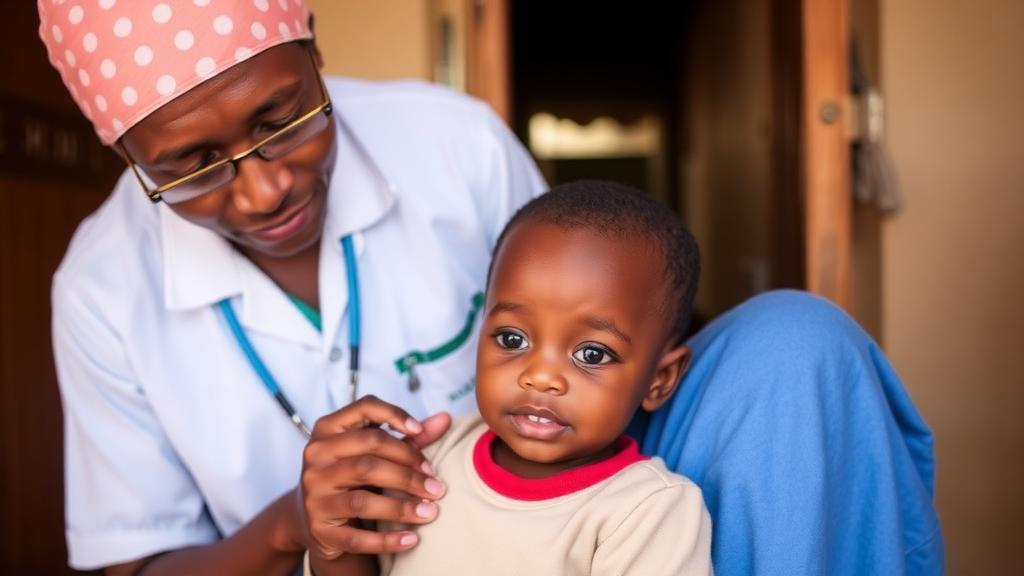
In the crowded counseling rooms of rural Ethiopian health posts, the difference between a fully vaccinated child and an unprotected one often comes down to a single conversation between a health worker and a worried mother. A new qualitative study published in BMC Health Services Research suggests that modest printed tools known as interpersonal communication job aids can make those conversations dramatically more effective, but only when the tools actually reach the frontline workers who need them. The research, conducted across three of Ethiopia’s most populous and diverse regions, offers one of the most detailed pictures to date of how low-cost communication supports shape immunization outcomes in a large, resource-constrained health system.
The study, led by Simegnew Handebo of St. Paul’s Hospital Millennium Medical College and the Ethiopian Health Education and Promotion Professionals Association, together with colleagues from Wolkite University, UNICEF Ethiopia, the Federal Ministry of Health, and the African Population and Health Research Center, set out to answer a deceptively simple question: do interpersonal communication job aids help health workers communicate better about childhood vaccines? Job aids in this context are practical reference materials, such as illustrated guides, counseling cards, and structured talking points, designed to be used during real clinical encounters rather than stored away in training manuals. They are intended to help workers value, acquire, and consistently apply the knowledge, skills, and attitudes required for effective dialogue with mothers and caregivers.
Between January 1 and February 28, 2020, the research team carried out fieldwork in the Oromia, Amhara, and Afar regions, a deliberately varied selection that captures Ethiopia’s linguistic and geographic diversity, including pastoralist communities in Afar where access to services is often hardest. Participants were purposively selected to include Expanded Programme of Immunization focal persons, health workers, health extension workers, and mothers and caregivers. The data collection was extensive for a qualitative design: twenty-five in-depth interviews, seventeen key informant interviews, and six focus group discussions, supplemented by direct observations of immunization sessions to see how the job aids were actually used in practice rather than how they were described in policy documents.
The methodological rigor of the work deserves attention. Interviews and discussions were conducted in Amharic, Oromo, and Afar languages, transcribed verbatim, edited, and translated into English. The team used ATLAS.ti software for coding and applied thematic analysis, a systematic approach in which researchers identify, analyze, and report patterns of meaning across qualitative data. The study protocol was reviewed and approved by the Federal Ministry of Health of Ethiopia, and informed consent was obtained from all participants, with research activities conducted in accordance with the Declaration of Helsinki. UNICEF Ethiopia funded the work through a collaboration with the Ethiopian Health Education and Promotion Professionals Association, though the funder had no role in study design, data collection, analysis, or manuscript preparation.
Four major themes emerged from the analysis. The first concerned the availability and distribution of the job aids, and here the findings were sobering. The interpersonal communication job aids for immunization were not adequately available in health facilities, and once distributed, the supply was not maintained. Health posts and health centers that received materials in one distribution cycle often found themselves without replacements as materials wore out, went missing, or were never replenished. This pattern of one-time distribution without follow-up is a familiar weakness in health communication programs across low-resource settings, and the Ethiopian data show how quickly it erodes an intervention’s value.
The second theme documented how health workers used the aids when they did have them. Rather than treating the materials as decorative compliance items, workers employed them to complement immunization counseling and health education sessions. Observations confirmed the practical application: workers referenced the aids during conversations with caregivers, using them to structure explanations of vaccination schedules, side effects, and the importance of completing the full series of doses. In a system where health extension workers, the backbone of Ethiopia’s primary care network, often have limited formal clinical training, such structured supports serve as a kind of cognitive scaffold, prompting workers to cover critical points they might otherwise omit in a busy session.
The third theme, and the one with the most significant implications, concerned the effect on performance. According to the study, the job aids enhanced health professionals’ knowledge, confidence, and teaching skills, leading to improved immunization counseling that ultimately increased routine immunization coverage for children. This chain of effect, from a printed card to a more confident counselor to a mother who returns for the next dose, illustrates a principle well established in health communication research: the quality of the provider-client interaction is one of the strongest modifiable predictors of vaccine uptake. Caregivers who understand why each dose matters, and who feel respected during the encounter, are far more likely to complete immunization schedules than those who receive rushed or unclear instructions.
The fourth theme captured the barriers that undermined these gains. Inconsistent supply, language limitations, insufficient training, logistical problems, and high staff turnover all restricted effective use of the job aids. Each barrier is instructive. Language limitations matter enormously in a country where counseling may need to happen in Amharic, Oromiffa, Afar, or dozens of other languages; a card printed only in the national working language loses much of its power in a community where mothers speak something else. Insufficient training meant that some workers received materials without guidance on how to integrate them into counseling. High staff turnover meant that aids distributed to one cohort of workers often left with them, and replacements rarely arrived for their successors.
The authors conclude that interpersonal communication job aids improved the interpersonal communication skills of frontline health workers and thereby increased routine immunization service utilization, but they are careful to note that significant challenges persist in availability, distribution, and utilization across regions. Their recommendations are concrete: health systems must prioritize consistent availability and equitable distribution of the aids across all health facilities, and on-site supervision, follow-up after distribution, quality evaluations of the materials, and skills training are essential for sustained improvements in immunization coverage. In other words, the job aid is not an intervention that can simply be shipped and forgotten; it functions as part of a continuous cycle of distribution, supervision, feedback, and refreshment.
The broader lesson extends well beyond Ethiopia. As global health programs push to reach the millions of children who remain unvaccinated or under-vaccinated, attention has increasingly turned from vaccine supply to demand generation, and demand generation lives or dies in the space of a conversation. This study demonstrates that cheap, well-designed communication tools can measurably strengthen that conversation, and that the failure mode is rarely the tool itself but the supply chain and support system around it. For ministries of health and partners such as UNICEF and the World Health Organization, the message is that investing in interpersonal communication is not a soft extra but a technical component of immunization programs, one that requires the same discipline of logistics, training, and supervision as the cold chain. When a health extension worker in a remote health post picks up a counseling card and speaks clearly and confidently to a mother, that small act, multiplied across thousands of encounters, is what turns vaccine vials into vaccinated children.
Subject of Research: Availability and use of interpersonal communication job aids to improve immunization counseling by frontline health workers in Ethiopia
Article Title: Availability, utilization, and contribution of interpersonal communication job aids for immunization among frontline health workers in Ethiopia: a qualitative study
Article References: Handebo, S., Mossa, K. A., Sharma, R., Mon, H. S., Simireta, T., Addissie, H., & Girma, E. (2026). Availability, utilization, and contribution of interpersonal communication job aids for immunization among frontline health workers in Ethiopia: a qualitative study. BMC Health Services Research. https://doi.org/10.1186/s12913-026-15619-3
Image Credits: AI Generated
DOI: 10.1186/s12913-026-15619-3
Keywords: immunization, interpersonal communication, job aids, Ethiopia, health extension workers, qualitative research, health communication, vaccine coverage, UNICEF, health services research, counseling, frontline health workers
Cite Scienmag News
Ophelia Keating. (October 19, 2026). Simple Job Aids Help Ethiopian Health Workers Boost Child Immunization Through Better Communication. Scienmag. https://scienmag.com/simple-job-aids-help-ethiopian-health-workers-boost-child-immunization-through-better-communication/
Ophelia Keating. "Simple Job Aids Help Ethiopian Health Workers Boost Child Immunization Through Better Communication." Scienmag, 19 October 2026, https://scienmag.com/simple-job-aids-help-ethiopian-health-workers-boost-child-immunization-through-better-communication/. Accessed 19 October 2026.
Ophelia Keating. "Simple Job Aids Help Ethiopian Health Workers Boost Child Immunization Through Better Communication." Scienmag. October 19, 2026. https://scienmag.com/simple-job-aids-help-ethiopian-health-workers-boost-child-immunization-through-better-communication/


