


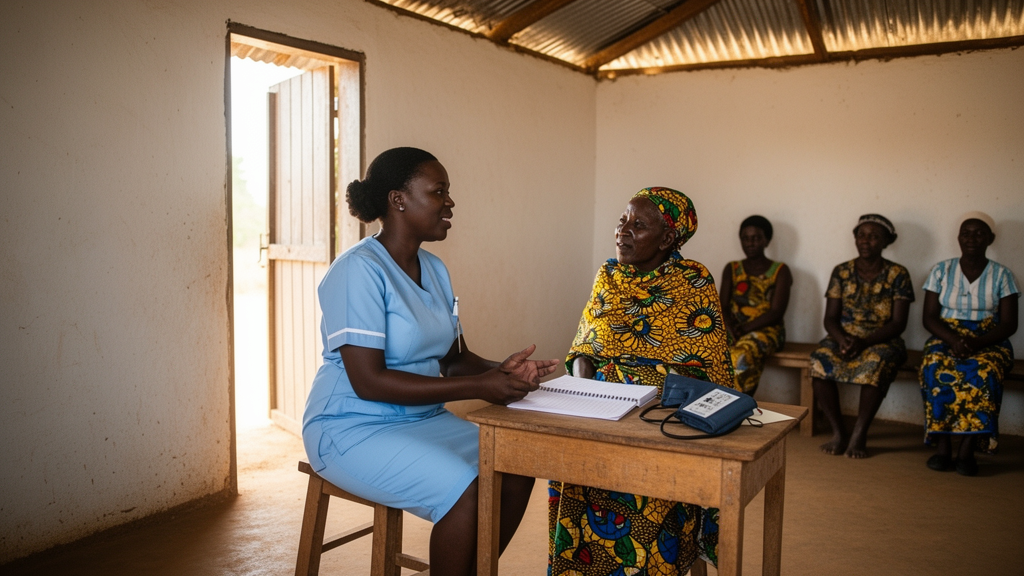
In the busy consultation rooms of Ghana’s Northern Region, the success of a medical visit often depends less on the stethoscope than on the conversation that surrounds it. A new qualitative study published in SN Social Sciences by Issah Salifu, Muhammed Abdulai, and Naazia Ibrahim of the University for Development Studies in Tamale examines how patients and healthcare providers actually talk to one another in this multilingual, resource-constrained corner of West Africa. Drawing on Dialogic Theory, the researchers set out to map the current state of patient-provider dialogic communication, and their findings suggest that effective clinical dialogue in such settings is not a scripted transfer of information but an interactive, negotiated, and deeply contextual process shaped by language, culture, and empathy.
The theoretical backbone of the study is the dialogic principle associated with Mikhail Bakhtin, the Russian philosopher who argued that meaning is never produced in isolation but always emerges between people, in the space of exchange. Applied to healthcare, this framework treats the clinical encounter as a genuine two-way conversation rather than a one-directional lecture from provider to patient. The authors situate their work within a growing body of health communication scholarship showing that patient-centered communication builds trust, improves satisfaction, and can reduce errors. Previous studies, including work on nurse-patient interaction across sub-Saharan Africa and research on language barriers in Ghanaian psychiatric care, have documented how communication failures undermine care; the new study adds a granular, regionally grounded account of what dialogue looks like on the ground.
Methodologically, the researchers adopted a qualitative design centered on in-depth interviews with both healthcare practitioners and patients in the Northern Region. The interview data were subjected to thematic analysis, an approach that systematically codes transcripts to identify recurring patterns of meaning. The team anchored their work in established qualitative research conventions, including criteria for trustworthiness in naturalistic inquiry, and the study received ethical approval from the Institutional Review Board of the University for Development Studies, with all participants providing consent. The authors report no funding and no conflicts of interest, and they declare that all participants’ contributions shaped the final interpretation of the results.
The central analytical result is that dialogic communication in Northern Ghanaian healthcare settings rests on three fundamental dimensions. The first is interpersonal, face-to-face interaction: the physical, embodied encounter in which tone of voice, eye contact, and relational warmth carry as much weight as clinical content. The second is linguistic mediation, the often invisible work of translating, interpreting, and code-switching that allows meaning to move between providers and patients who may not share a first language. The third is patient involvement in mutual decisions, the degree to which patients are invited to participate in choices about their own care rather than simply receiving instructions. Together, these dimensions form an architecture of dialogue that the authors argue should guide both training and policy.
Language emerges as the most visible fault line in these encounters. The Northern Region is profoundly multilingual, with speakers of Dagbani and other local languages frequently meeting providers who communicate primarily in English or Twi. Prior Ghanaian research has shown that such linguistic diversity functions as a social determinant of care, affecting access, comprehension, and outcomes. The new study’s participants described how meaning had to be actively negotiated across these boundaries, sometimes through informal interpreters, sometimes through careful paraphrase, and sometimes through the relational goodwill built up between repeat patients and familiar staff. The authors emphasize that dialogic communication in this environment is not a fixed protocol but a negotiated achievement, contingent on who is in the room and which languages they share.
Cultural conventions form the second contextual force the study identifies. In many Northern Ghanaian communities, norms of respect, deference to authority, and family involvement in health decisions shape what patients feel able to say in a consultation. A strictly transactional, question-and-answer model of clinical communication can collide with these norms, leaving patients silent about symptoms they consider sensitive or decisions they believe belong to elders or relatives. The study’s dialogic lens reframes this not as patient passivity but as a different grammar of conversation, one that providers must learn to read and enter rather than override. The researchers argue that relational and empathetic communication is not a soft skill bolted onto clinical competence but a core component of care itself, particularly when patients are navigating unfamiliar institutional environments.
The findings carry practical weight beyond Ghana. Global evidence consistently links communication quality to patient safety, satisfaction, and adherence, and systematic reviews have shown that communication skills training for healthcare professionals produces measurable improvements, including in cancer care. Studies of patient-centered communication have identified trust in providers as a key mediating mechanism, while analyses of patient complaints repeatedly surface poor communication as a root cause of dissatisfaction and error. The Glasgow Consensus Statement on effective communication in clinical encounters, published in 2024, similarly called for reinforcing the humanity of healthcare. What the Ghanaian study adds is a demonstration of how these principles can be implemented where interpreters are scarce, workloads are heavy, and dozens of languages may pass through a single outpatient department in a day.
The authors translate their findings into concrete policy and practice implications, chief among them a reorientation of professional training toward interpersonal communication and cultural competence. In practice, this means curricula that teach future nurses, doctors, and community health workers to recognize dialogic dimensions in their daily encounters: to check understanding rather than assume it, to invite patient participation in decisions, and to treat linguistic mediation as skilled clinical work deserving time and institutional support rather than an afterthought delegated to whoever happens to be nearby. It also means health system planners in multilingual, low-resource settings should design communication infrastructure, from interpreter arrangements to patient education materials, with the same seriousness they apply to drug supplies and equipment.
For the international health communication community, the study is a reminder that dialogic theory, born in literary criticism, can illuminate the most practical corners of public health. The Northern Region of Ghana carries a heavy burden of persistent poverty, and multidimensional child poverty research has documented how structural inequality shapes health in the region. Against that backdrop, the finding that patients and providers nonetheless construct meaningful, negotiated, and sometimes deeply empathetic conversations is quietly striking. It suggests that dialogue is not a luxury of well-funded hospitals but a resource that communities and clinicians build together, even under constraint. The research, published as volume 6, article 397 of SN Social Sciences, with the DOI 10.1007/s43545-026-01677-1, offers both a diagnostic snapshot and a hopeful template: where systems invest in the relational and linguistic fabric of care, patients are not merely treated but heard.
Subject of Research: Patient-healthcare provider dialogic communication practices in the Northern Region of Ghana
Article Title: The state of patient-healthcare provider dialogic communication practices in the Northern Region of Ghana
Article References: Salifu, I., Abdulai, M., & Ibrahim, N. (2026). The state of patient-healthcare provider dialogic communication practices in the Northern Region of Ghana. SN Social Sciences, 6(9), Article 397. https://doi.org/10.1007/s43545-026-01677-1
Image Credits: AI Generated
DOI: 10.1007/s43545-026-01677-1
Keywords: health communication, dialogic theory, Ghana, patient-provider communication, multilingualism, qualitative research, thematic analysis, patient-centered care, cultural competence, Northern Region, shared decision-making, healthcare training
Cite Scienmag News
Courtney Benton. (October 19, 2026). Talking to Heal: How Dialogue Shapes Care in Northern Ghana’s Clinics. Scienmag. https://scienmag.com/talking-to-heal-how-dialogue-shapes-care-in-northern-ghanas-clinics/
Courtney Benton. "Talking to Heal: How Dialogue Shapes Care in Northern Ghana’s Clinics." Scienmag, 19 October 2026, https://scienmag.com/talking-to-heal-how-dialogue-shapes-care-in-northern-ghanas-clinics/. Accessed 19 October 2026.
Courtney Benton. "Talking to Heal: How Dialogue Shapes Care in Northern Ghana’s Clinics." Scienmag. October 19, 2026. https://scienmag.com/talking-to-heal-how-dialogue-shapes-care-in-northern-ghanas-clinics/


