


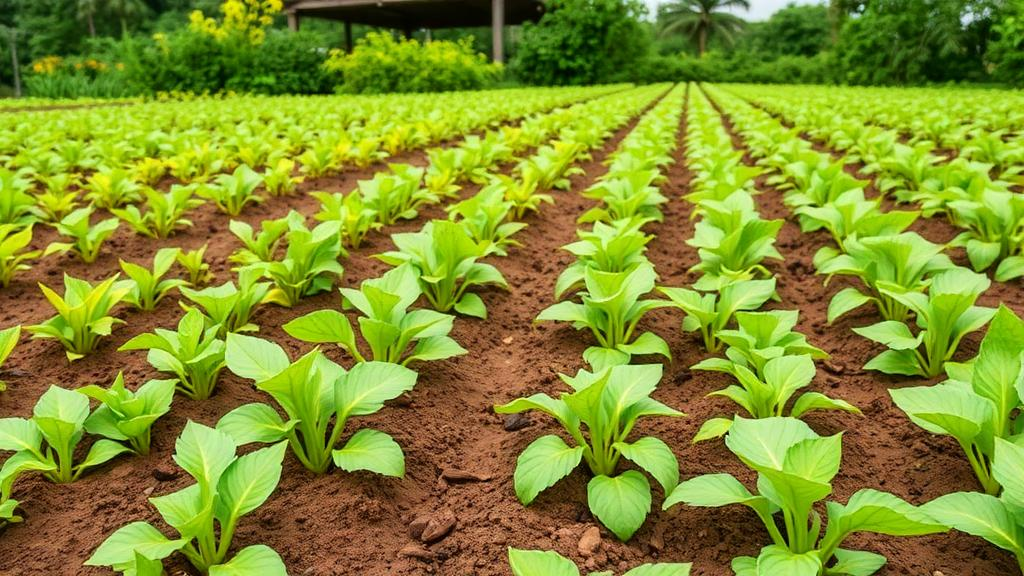
On the semi-arid southern coast of Puerto Rico, commercial vegetable growers face a familiar dilemma: the intensive rotations that keep produce flowing can quietly strip the soil of the organic matter, nutrients, and biological activity that make it productive. A new field study published in Frontiers in Soil Science offers some of the clearest short-term evidence yet that cover crop rotations can begin reversing that decline in tropical vegetable systems, and that the speed and scale of recovery depend heavily on the inherent character of the soil beneath the farm.
The research, led by Mario Pagán and David Sotomayor-Ramírez of the University of Puerto Rico at Mayagüez, together with colleagues at the University of Hawai’i at Manoa and the University of Florida, was conducted on working commercial farms rather than experimental plots. The team compared two municipalities with sharply contrasting soils: Guánica, where vegetables grow on a loamy Typic Calciargids, and Santa Isabel, where the dominant soil is a clayey Typic Haplusterts. Both soils belong to the arid and semi-arid soil orders shaped by Puerto Rico’s dry southern coastal climate, but they differ profoundly in texture, clay content, and organic matter, and those differences turned out to govern how the soils responded to cover cropping.
Conventional vegetable production in the region typically alternates cash crops with periods of volunteer weeds or bare fallow. The researchers replaced that vegetable–fallow pattern with vegetable–cover crop rotations at two levels of complexity. At Guánica, three annual cycles were evaluated under three treatments: conventional management with volunteer weeds, a legume cover crop dominated by sunn hemp (Crotalaria juncea), which supplies nitrogen through biological fixation, and a legume–grass mixture dominated by sorghum (Sorghum × drummondii), which boosts total biomass and carbon returned to the soil. At Santa Isabel, two cycles were evaluated with conventional management and a simultaneously planted legume–grass mix designed to contribute both nitrogen and carbon.
Sixteen soil indicators spanning physical, chemical, fertility, and biological dimensions were measured at baseline and again after each cover crop was terminated and incorporated into the soil. The suite included soil organic matter, permanganate-oxidizable carbon (POX-C), a sensitive measure of the labile carbon fraction that responds quickly to management, extractable phosphorus, effective cation exchange capacity (ECEC), small macroaggregate formation, soil respiration measured as the 24-hour carbon dioxide flush and 3-day respiration, and the activities of the enzymes β-glucosidase and β-glucosaminidase, which track the microbial capacity to break down carbon compounds in the soil.
Across both sites, the headline finding was consistent: cover crop rotations returned more biomass and more carbon to the soil than conventional management with volunteer weeds. That extra carbon input is the engine of soil health improvement, because labile carbon fuels microbial communities, stabilizes soil aggregates, and drives the nutrient cycling processes on which vegetable crops depend. What happened next, however, diverged between the two soils in ways that carry practical lessons for growers throughout the tropics.
At Guánica, where the loamy Calciargids hold relatively low amounts of soil organic matter and clay, cover crops produced significant gains. Both cover crop treatments significantly increased soil organic matter, POX-C, and extractable phosphorus, while the legume–grass mix additionally improved small macroaggregate formation and ECEC, the latter reflecting a greater capacity to hold and exchange plant-available cations. Soil respiration, measured both as the 24-hour flush and 3-day respiration, improved with time under cover crops, and β-glucosidase activity was maintained or improved under cover crops while it declined under conventional management. The response of β-glucosaminidase was brief yet inconsistent, suggesting that this enzyme responds on a different timescale or to different carbon substrates than its better-behaved counterpart.
At Santa Isabel, the clayey Haplusterts told a quieter story. Cover cropping increased the 24-hour flush and β-glucosidase activity, and POX-C and 3-day respiration improved with time, but the overall magnitude of change was smaller than at Guánica. The researchers attribute this contrast to buffering capacity. The clay-rich Santa Isabel soil, with higher clay content and presumably higher existing organic matter, has a greater inherent capacity to absorb additions of carbon and nitrogen without showing large shifts in measured indicators. The loamy Guánica soil, by comparison, had lower buffering capacity and greater responsiveness to cover crop carbon and nitrogen inputs, so the same cover crop treatments produced larger measurable improvements there.
This soil-type dependence is more than an academic footnote. Most of what is known about cover cropping and soil health comes from temperate row crop systems studied over mid- and long-term horizons, and the short-term recovery of soil health in tropical vegetable systems has been far less documented. The Puerto Rico study shows that meaningful improvements in labile carbon, enzyme activity, and respiration can appear within just two to three annual cycles in the tropics, where warm temperatures and adequate moisture accelerate decomposition and microbial turnover. It also shows that growers and advisors should not expect a uniform response across landscapes: a cover crop prescription that transforms a sandy loam may produce only modest indicator changes in a heavy clay, even when the underlying biological recovery is real.
The choice of cover crop species also matters. The legume treatment, anchored by sunn hemp, emphasizes nitrogen supply through biological fixation, which can reduce fertilizer requirements for the following vegetable crop. The legume–grass mix, anchored by sorghum, emphasizes total biomass and carbon inputs, which proved important for building aggregates and cation exchange capacity at Guánica. Blending the two strategies in a simultaneous mix, as done at Santa Isabel, aims to capture both benefits, contributing nitrogen and carbon at once. The results suggest that growers seeking rapid, visible soil health gains on low-organic-matter loamy soils may benefit most from high-biomass legume–grass rotations, while those on clay-rich soils should plan for longer horizons before expecting large indicator shifts.
The study’s authors conclude that cover crops promote short-term soil health improvement in tropical vegetable systems, but that the magnitude of response depends on inherent soil characteristics and time. For an industry under pressure to produce food sustainably on fragile tropical soils, that is a workable prescription: cover cropping works, the biology responds quickly, and the soil itself sets the pace. As commercial farms across the semi-arid tropics weigh the costs of cover crop seed and management against the long-term productivity of their land, the Puerto Rico evidence provides a grounded starting point for matching cover crop rotations to the soils that will carry them.
Subject of Research: Short-term soil health responses to cover crop rotations in commercial tropical vegetable systems on contrasting Puerto Rican soils
Article Title: Cover crop rotations improve soil health in commercial tropical vegetable systems, but responses depend on soil type
Article References: Pagán, M., Sotomayor-Ramírez, D., Deenik, J., Crow, S., McClellan-Maaz, T., & Linares-Ramírez, A. (2026). Cover crop rotations improve soil health in commercial tropical vegetable systems, but responses depend on soil type. Frontiers in Soil Science, 6, Article 1968398. https://doi.org/10.3389/fsoil.2026.1968398
Image Credits: AI Generated
DOI: 10.3389/fsoil.2026.1968398
Keywords: cover crops, soil health, tropical agriculture, soil organic matter, permanganate-oxidizable carbon, soil enzymes, Puerto Rico, sustainable vegetable production, Cover, crop, rotations, improve
Cite Scienmag News
Alan Morgan. (October 19, 2026). Cover Crops Rebuild Tropical Vegetable Soils, but the Payoff Depends on Soil Type. Scienmag. https://scienmag.com/cover-crops-rebuild-tropical-vegetable-soils-but-the-payoff-depends-on-soil-type/
Alan Morgan. "Cover Crops Rebuild Tropical Vegetable Soils, but the Payoff Depends on Soil Type." Scienmag, 19 October 2026, https://scienmag.com/cover-crops-rebuild-tropical-vegetable-soils-but-the-payoff-depends-on-soil-type/. Accessed 19 October 2026.
Alan Morgan. "Cover Crops Rebuild Tropical Vegetable Soils, but the Payoff Depends on Soil Type." Scienmag. October 19, 2026. https://scienmag.com/cover-crops-rebuild-tropical-vegetable-soils-but-the-payoff-depends-on-soil-type/


