


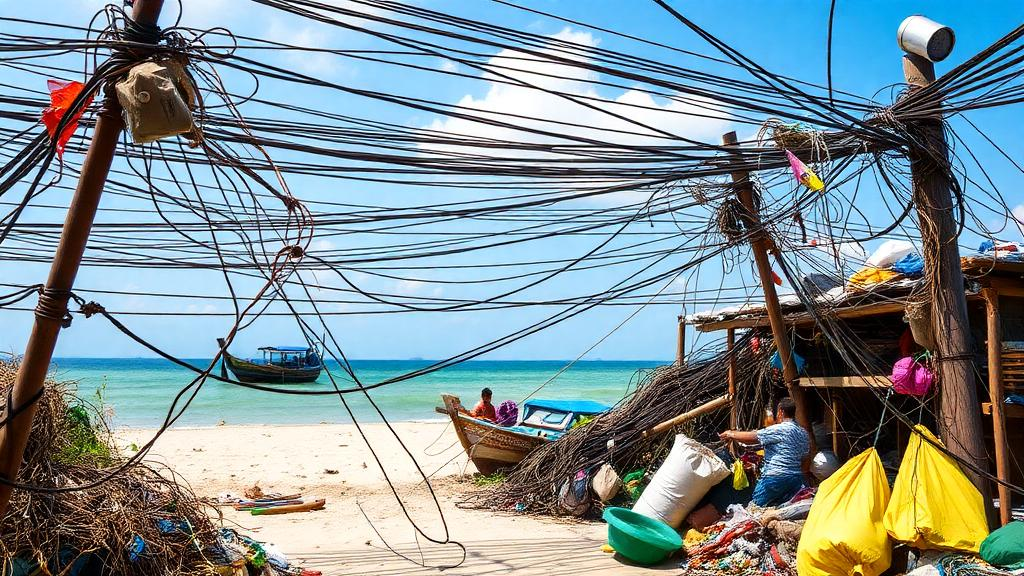
Mu Ko Chang National Park in Thailand’s Trat Province has been ranked the world’s second-best tropical holiday destination, and in 2024 it welcomed more than 1.5 million visitors who generated over 15 billion Thai Baht in tourism revenue. But behind the postcard image of rainforests, mangroves and coral reefs, a new study has found that the park’s scenic quality is being steadily eroded by a problem scientists call visual pollution — and the biggest culprit is not litter or billboards, but something far more mundane: electric poles and tangled overhead wires.
The research, published in the journal Nature Conservation, presents the first systematic, landscape-based assessment of visual pollution in a Thai national park. A team surveyed 63 kilometres of designated routes across the park between November 2024 and January 2025, deliberately covering both the high and low tourism seasons. Using structured observation forms, GPS geotagging and triangulation among field observations, photographic documentation and location data, the researchers recorded eight distinct types of visual disturbance: billboards, graffiti, garbage dumps, abandoned buildings, wastewater discharge points, improper use of public spaces, electric poles and wires, and poorly maintained public utilities.
The scale of the wiring problem is striking. Electric poles and wires averaged 18.43 occurrences per kilometre across the entire survey network, dwarfing every other category. In the low-density tourism zone, the figure reached 28.80 occurrences per kilometre, and in the high-density zone 28.38 per kilometre, while the community zone recorded the lowest density at 12.49 per kilometre. Clusters of utility poles along roadsides, tangled power lines and low-hanging communication cables created what the researchers describe as a visually disordered streetscape that fragments the scenery in every single zone of the park, regardless of how many tourists pass through.
The study’s conceptual framework is notable for its technical rigour. The park was divided into four landscape zones by tourism density: a high-density tourism zone of 13 kilometres covering popular beach areas such as White Sand Beach and Khlong Plu Waterfall; a medium-density zone of 8 kilometres with moderate visitor activity; a low-density zone of 5 kilometres in remote, less-developed areas; and a 37-kilometre community zone dominated by fishing villages and residential settlements. This zoning allowed the team to test whether visual degradation tracks tourism intensity or follows its own spatial logic.
Statistical analysis confirmed that the spatial logic is real. One-way analysis of variance revealed statistically significant differences among zones for five pollution types: billboards (F = 8.468, p < 0.001), graffiti (F = 9.897, p < 0.001), garbage dumps (F = 21.405, p < 0.001), electric poles and wires (F = 21.340, p < 0.001) and poorly maintained public utilities (F = 7.741, p < 0.001). In contrast, wastewater discharge points, abandoned buildings and improper use of public spaces showed no significant differences across zones, suggesting these disturbances occur more uniformly or respond to factors other than tourism density.
Where each disturbance concentrates tells its own story. Garbage dumps peaked in the high-density tourism zone at 2.61 occurrences per kilometre, more than fourteen times the community zone’s rate of 0.18, revealing a clear correlation between visitor density and unmanaged waste. Graffiti followed the same pattern, reaching 1.69 occurrences per kilometre in high-traffic areas while remaining rare elsewhere. Billboards, however, defied expectations: the low-density tourism zone had the highest billboard density at 7.2 per kilometre, likely because weaker regulatory oversight in these quieter areas lets businesses advertise freely to attract scarce visitors, whereas stricter landscape management appears to constrain signage near the park’s flagship attractions.
Some of the most telling findings concern what the researchers call abandoned infrastructure. Abandoned buildings were most prevalent in the low-density tourism zone at 0.80 occurrences per kilometre, a legacy the study links to stalled development projects, seasonal business closures and the lingering effects of the COVID-19 pandemic, which forced many tourism-related businesses to shut down during prolonged travel restrictions. These derelict structures create a sense of neglect, contribute to habitat fragmentation and signal inefficient land management. Improper use of public spaces, including unregulated boat docking, appeared exclusively in the medium-density zone at 2.37 occurrences per kilometre, pointing to a transitional area where regulation and infrastructure have not yet caught up with development.
The authors argue that these patterns reveal visual pollution as a symptom of deeper governance failures rather than a purely aesthetic issue. Uneven infrastructure investment, inconsistent enforcement and poor coordination among park authorities, local governments, tourism operators and utility providers have allowed overhead wiring to proliferate unchecked despite the park’s protected status. The researchers note that local governments and utility companies often prioritise functionality and cost-efficiency over visual harmony, and that upgraded or concealed wiring systems appear disproportionately in high-tourism zones, raising concerns about spatial equity in protected area governance and the neglect of community and low-density zones.
The study proposes zone-specific remedies. High-density tourism areas need stricter enforcement of signage design standards, expanded waste management and anti-graffiti initiatives. Medium-density zones require clear zoning of public spaces and proactive development controls. Low-density zones need landscape-scale planning, rehabilitation or removal of abandoned infrastructure and enforced signage regulations. Community zones would benefit from co-developed aesthetic guidelines built with local stakeholders, integrating traditional livelihoods and local knowledge into visual stewardship. System-wide measures include community-based waste management, ecologically informed visual landscape guidelines and designated, regulated advertising zones near sensitive viewpoints.
Perhaps the study’s most consequential contribution is conceptual: it argues that visual pollution should be treated as a multidimensional conservation concern, absent from most protected area monitoring frameworks such as Limits of Acceptable Change and Visitor Experience and Resource Protection systems. A degraded visual environment, the authors warn, can erode public support for conservation, discourage pro-environmental behaviour and reduce repeat visitation, while visually disruptive elements often signal broader ecological stress including habitat fragmentation, waste mismanagement and unregulated development. As Mu Ko Chang’s tourism rebounds at record pace, the researchers contend that integrating visual quality into protected area monitoring and sustainable tourism planning is essential not only for visitor satisfaction, but for sustaining the ecological integrity and social relevance of the park itself.
Subject of Research: Visual pollution assessment in Mu Ko Chang National Park, Thailand
Article Title: Visual pollution assessment in Mu Ko Chang National Park, Thailand: A landscape-based approach
Article References: Phumsathan, S., Anuruk, K., Kongsila, T., & Sinsup, K. (2025). Visual pollution assessment in Mu Ko Chang National Park, Thailand: A landscape-based approach. Nature Conservation, 60, 151-175. https://doi.org/10.3897/natureconservation.60.164995
Image Credits: AI Generated
DOI: 10.3897/natureconservation.60.164995
Keywords: Visual, pollution, assessment, Chang, National, Park, Thailand, landscape-based, approach, scientific research
Cite Scienmag News
Margaret Porter. (October 19, 2026). Tangled wires and trash: Thailand’s island paradise is quietly losing its scenic soul. Scienmag. https://scienmag.com/tangled-wires-and-trash-thailands-island-paradise-is-quietly-losing-its-scenic-soul/
Margaret Porter. "Tangled wires and trash: Thailand’s island paradise is quietly losing its scenic soul." Scienmag, 19 October 2026, https://scienmag.com/tangled-wires-and-trash-thailands-island-paradise-is-quietly-losing-its-scenic-soul/. Accessed 19 October 2026.
Margaret Porter. "Tangled wires and trash: Thailand’s island paradise is quietly losing its scenic soul." Scienmag. October 19, 2026. https://scienmag.com/tangled-wires-and-trash-thailands-island-paradise-is-quietly-losing-its-scenic-soul/


