


Deep in the primitive forests of the Greater Khingan Mountains in Inner Mongolia, an army of unassuming tents quietly changed what scientists know about one of the world’s smallest and most overlooked groups of flies. Between 2022 and 2024, researchers deployed hundreds of Malaise traps across northern China, hauling in more than half a million insect specimens from two vast surveys. Hidden among them were minute leaf-mining flies of the genus Metopomyza, a group so obscure that before this study began, only a single Chinese record of the entire genus existed. Now, in a paper published in ZooKeys, entomologists have described a brand-new species, added two species never before recorded in China, and delivered the first complete worldwide identification key to all 23 known members of the genus.
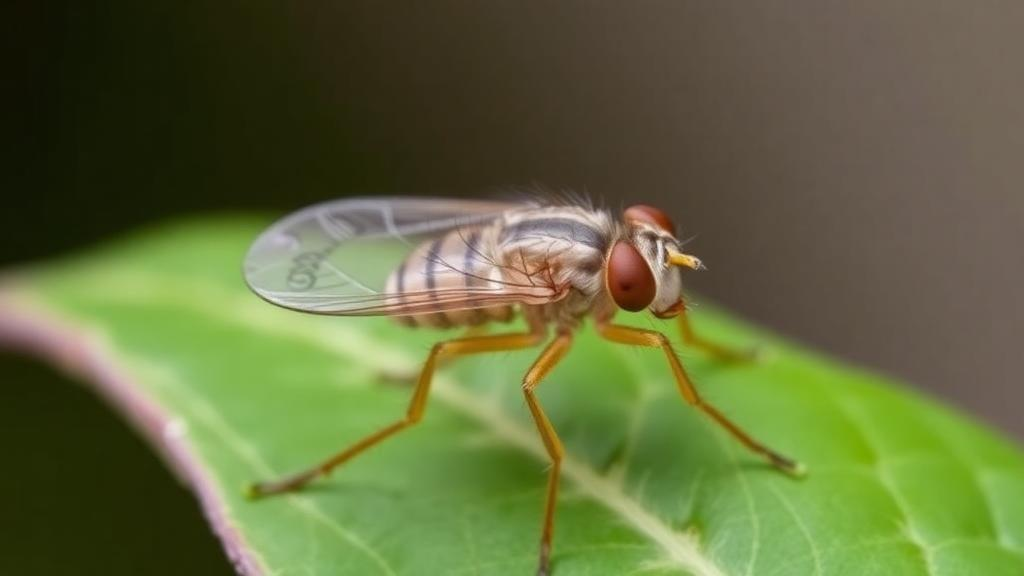
The star of the discovery is Metopomyza hebeiensis, a delicate fly measuring barely 1.5 millimeters long, captured in Saihanba National Forest Park in Hebei Province at an elevation of nearly 1,500 meters among Mongolian pine trees. Its name pays tribute to the province of its birthplace, and its Chinese name, He bei e qian ying, marks its formal entry into the country’s fauna. Like all Metopomyza, it is largely black with distinctive yellow knees on its legs and a partially yellow shield-like scutellum on its back, but its anatomy carries telltale signatures that separate it from every relative: a mesonotum bearing exactly two postsutural dorsocentral bristles, an abdomen of uniform dark brown without yellow edges, and male genitalia whose hypophallus points forward rather than downward, with a distiphallus conspicuously swollen on its outer half.
Genitalia might seem like an arcane focus, but for leaf-miner flies they are the gold standard of species identification. External features can deceive; coloration shifts with age, geography, and even habitat. The researchers dissected abdominal tips and macerated them in warm lactic acid for 20 to 25 minutes before examining the intricate epandrial complexes in glycerin under high-magnification microscopy. In M. hebeiensis, the epandrium carries a row of eight to nine blunt tubercle-like setae along its ventral corner and two rows of five to six more on its inner surface, while the flap-shaped surstylus points inward with stout tubercle-like bristles at its corners. These microscopic armatures, captured in stunning composite montage photographs built from dozens of sequential images, form the decisive fingerprint distinguishing the new species from its closest lookalike, M. scutellata, which sports three postsutural bristles instead of two and yellow-banded abdominal segments.
The two newly recorded Chinese species carry their own biogeographic intrigue. Metopomyza laeta, previously known from Japan, Russia, and parts of Europe, turned up two meters above the ground in a Malaise trap hung near an impounding reservoir in the unburned pine forests of Mangui Town. Metopomyza scutellata, one of the most widely distributed members of the genus across the Palaearctic and Nearctic realms, appeared at multiple sites across the Greater Khingan Mountains, in both areas burned in recent decades and intact forest, and as far south as Hebei’s Saihanba park. Its presence stretches the genus’s known Chinese footprint from a single Xinjiang record of M. xanthaspis in 2007 to four species spanning two provinces, a dramatic expansion of documented diversity in a country whose fly fauna remains stunningly under-sampled.
What makes M. scutellata especially fascinating is a long-standing identity crisis. For decades, taxonomists have debated whether M. scutellata and a near-twin species, M. junci, are truly separate or merely color variants of one biological entity. The only proposed diagnostic character is subtle: M. junci supposedly has broader yellow markings on the sides of its abdomen. Yet earlier specialists warned that abdominal color is unstable and unreliable, a caution later researchers repeatedly ignored. The Chinese team decided to put the question to a molecular test, sequencing a 654-base-pair fragment of the mitochondrial COI barcode gene from their specimens and combining it with 44 publicly available sequences from GenBank and BOLD, spanning nine Metopomyza species and rooted with four outgroup species of related leaf-miner genera.
The phylogenetic results, produced with both Maximum-Likelihood and Neighbor-Joining methods under the GTR model with 1,000 bootstrap replicates, delivered a nuanced verdict. The Chinese specimens, including one individual with broad lateral yellow bands that superficially resembled M. junci, clustered confidently inside the Palaearctic clade of M. scutellata, sharing up to 98 percent sequence identity with verified material. The COI data confirm the Chinese specimens are M. scutellata, but they do not prove that M. scutellata and M. junci are the same species. Intriguingly, M. junci did not nest cleanly with its supposed twin; instead it first grouped with a third species, M. nigriorbita, hinting that the evolutionary story of these lookalike flies is far messier than morphology alone suggests.
Adding another layer, the trees revealed that M. scutellata itself splits into two clades, one Palaearctic and one Nearctic, a genetic rift between Old World and New World populations that echoes patterns seen in many Holarctic insects. The team also notes a striking ecological paradox: the two putative species exploit unmistakably different host plants. M. scutellata larvae mine sedges in the genus Carex, while M. junci is tied to saltmarsh rush, Juncus gerardii. Both plant groups thrive at the Inner Mongolian sampling sites, which harbor four Carex and four Juncus species, but because the flies were collected in general traps rather than reared directly from host plants, the biologists are careful not to overclaim. DNA alone, they stress, cannot settle the question; host-specific rearing and integrated morphological and molecular work will be needed.
Beyond the individual discoveries, the study delivers tools that will accelerate fly research worldwide. The new key to all 23 Metopomyza species, updated from earlier work and illustrated with references to genital figures, walks users through characters ranging from the color of the notopleural triangle to wing venation ratios, such as whether the ultimate section of vein M4 is two or three times the length of the penultimate one. The genus itself is defined by quirky anatomy: adults bear fronto-orbital plates whose inner edges and ocellar triangle form a distinctive M-shaped pattern in dorsal view, the first flagellomere is small and angulate, and males carry rows of blunt tubercle-like setae on the epandrium. Yet much remains unknown, including the larval host plants of most species and the biology of suspected undescribed relatives lurking in the Afrotropical and Neotropical regions, while the Australian realm holds none at all.
The sheer scale of the underlying fieldwork deserves attention on its own. In the northern primitive forests of the Greater Khingan Mountains, 42 Malaise traps at 21 sampling points captured 237,320 insects across 69 families in a single survey, while a second, semi-arid campaign deployed 132 traps that netted more than 282,900 specimens of 186 fly families. Bottles were emptied every 15 days, specimens were preserved in ethanol and frozen for long-term storage, and identification is still underway, with hundreds of Diptera species catalogued so far and more to come. Type specimens of the new species are housed at Inner Mongolia Agricultural University in Hohhot, and the new COI sequence is deposited in GenBank. For a genus that most people will never notice, invisible in the shadows of the world’s forests, Metopomyza has suddenly become one of the best-mapped corners of fly biodiversity, a reminder that some of Earth’s greatest biological frontiers are measured in millimeters.
Subject of Research: Taxonomy and DNA barcoding of Metopomyza leaf-miner flies in northern China, including a new species and a worldwide identification key
Article Title: A new species and two newly recorded species of the genus Metopomyza Enderlein from northern China ( Diptera , Agromyzidae ) with a worldwide key and checklist
Article References: Fu, X.-T., & Shi, L. (2026). A new species and two newly recorded species of the genus Metopomyza Enderlein from northern China (Diptera, Agromyzidae) with a worldwide key and checklist. ZooKeys, 1290, 35-58. https://doi.org/10.3897/zookeys.1290.199747
Image Credits: AI Generated
DOI: 10.3897/zookeys.1290.199747
Keywords: Metopomyza, Agromyzidae, Diptera, new species, leaf-miner flies, China, DNA barcoding, COI, taxonomy, Malaise traps, ZooKeys, phylogenetics
Cite Scienmag News
Gavin Prescott. (October 19, 2026). Tiny Leaf-Miner Flies from China’s Forests Reveal a New Species and Reshape a Genus. Scienmag. https://scienmag.com/tiny-leaf-miner-flies-from-chinas-forests-reveal-a-new-species-and-reshape-a-genus/
Gavin Prescott. "Tiny Leaf-Miner Flies from China’s Forests Reveal a New Species and Reshape a Genus." Scienmag, 19 October 2026, https://scienmag.com/tiny-leaf-miner-flies-from-chinas-forests-reveal-a-new-species-and-reshape-a-genus/. Accessed 19 October 2026.
Gavin Prescott. "Tiny Leaf-Miner Flies from China’s Forests Reveal a New Species and Reshape a Genus." Scienmag. October 19, 2026. https://scienmag.com/tiny-leaf-miner-flies-from-chinas-forests-reveal-a-new-species-and-reshape-a-genus/


