


A wind-scoured stretch of desert between the Iranian cities of Qom and Kashan has yielded an extraordinary snapshot of life from roughly 34 million years ago. In the layered red sandstones of the Lower Red Formation near the small village of Deh Nar, geologists mapping Cenozoic outcrops stumbled upon something remarkable: hundreds of fossilized footprints left by birds and mammals as they crossed muddy flats under a hot, drying sky. The discovery, published in the journal Fossil Record, marks the second Oligocene tracksite ever reported from Iran and the first vertebrate tracks known from the Lower Red Formation of Central Iran, opening a rare window onto terrestrial ecosystems at a pivotal moment in Earth’s climatic and tectonic history.
The story began in September 2023, when geologists of the Geological Survey of Iran encountered the first traces while mapping the Cenozoic rocks of the Kashan area. Follow-up field campaigns in March and April 2024 brought paleontologists and stratigraphers to the site, which lies about three kilometers northwest of Deh Nar village in Esfahan Province. What they found exceeded expectations: more than 160 bird footprints forming well over a dozen trackways, and 19 mammal footprints arranged in eight trackways, all preserved in the lower sandstone layers of the formation. Most of the prints survive as convex hyporeliefs, natural casts formed when sediment filled the original depressions on a softer layer beneath, preserving the shape of each foot in fine detail.
The track-bearing rocks tell their own story. The Lower Red Formation at Deh Nar is a colossal pile of sediment roughly 1,550 meters thick, resting on eroded Eocene volcanic rocks and capped by the marine carbonates of the Qom Formation. Its lower section, where the footprints occur, consists of alternating red to brown sandstones, siltstones and shales, sprinkled with ripple marks, cross-laminations and casts of mud cracks, telltale signs of shallow water that periodically flooded and dried. Interbedded tuffs and basalt lavas record continuing volcanic activity from the nearby Urumieh-Dokhtar Magmatic Arc, while higher up, thick colored marls laced with gypsum and salt speak of harsh, evaporitic playas. The footprints were pressed into the damp sand of fluvial and playa-margin environments, a landscape shaped by both water scarcity and volcanism.
The bird tracks are the stars of the assemblage in sheer numbers. The team identified four ichnogenera: Ardeipeda egretta, Aviadactyla vialovi, Avipeda phoenix and Gruipeda dominguensis, the last being by far the most abundant with more than 140 field-observed prints. The smallest footprints, only two to three centimeters long, were almost certainly made by small shoreline birds with an incumbent anisodactyl foot arrangement, three toes pointing forward and one back, much like modern sandpipers probing the margins of shallow pools. Larger tetradactyl prints with slender, sharply pointed digits and a distinct backward-facing hallux point toward herons, while other forms are attributed to Gruiformes and Ciconiiformes, groups that include cranes and storks. Together they sketch a wetland-commuter scene: wading birds stalking prey along the edges of ephemeral water bodies, leaving crowded trackways in the soft sediment.
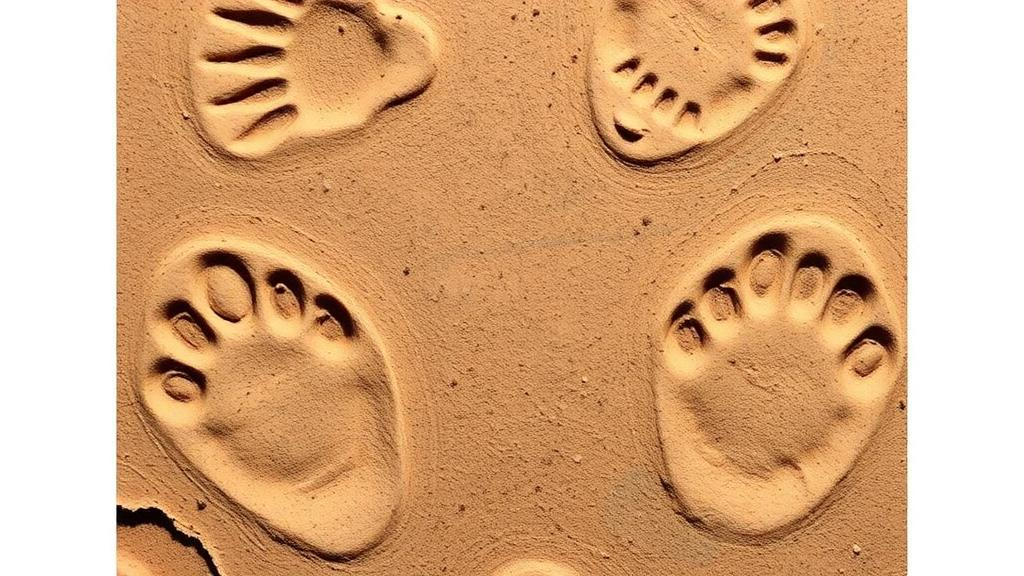
The mammal record is where the site becomes truly special, because it includes brand-new ichnotaxa. The most enigmatic is Dehnaripus incognitus, a newly named ichnogenus and ichnospecies whose name blends the village of Deh Nar with the Latin word for foot, and whose species epithet means, fittingly, unknown. These are large, circular manus and pes imprints exceeding ten centimeters across, marked by unorganized radial wrinkles and frustratingly ambiguous digit impressions. High-resolution photogrammetry, which builds three-dimensional digital models from overlapping photographs, revealed five thick digits on the front feet and three on the hind feet, but the outlines remain clouded. The researchers argue that this odd morphology is not a preservation artifact, since it appears across multiple horizons, but instead reflects genuinely unusual, wrinkled foot pads or cushions, comparable in some ways to the broad, pad-supported soles of proboscideans.
More conventional herbivores also left their mark. Tridactyl, three-toed footprints include Lophiopus isp., known previously from the Eocene of France and here recorded for only the second time in the Tethyan realm, and two species of Moropopus. One of these, Moropopus kashanensis, is new to science and distinguished by a striking feature: the lateral digits of its hand impressions end in sharp, claw-like tips, an oddity in perissodactyls, whose hooves normally produce rounded outlines. The researchers suggest the tridactyl trackmakers were most likely medium to large three-toed terrestrial herbivores, possibly tapiroid perissodactyls, relatives of tapirs that thrived in the Paleogene. Their prints, some over 130 millimeters long with long stride lengths, conjure hefty browsers moving steadily across the floodplain.
Predators patrolled the same ground. Large, plantigrade, five-toed footprints are assigned to Platykopus stuartjohnstoni, an ichnospecies originally described from the Miocene of Texas and generally attributed to bear-like carnivores such as amphicyonids, the so-called bear dogs, or early ursids. Alongside them are tracks referred to Zanclonychopus, a form previously known only from North America, recognizable by strongly clawed, plantigrade prints with sickle-like digital tips that curve inward and outward. This is the first report of Zanclonychopus outside North America, a biogeographic surprise hinting that large carnivorous mammals were more widespread across the early Oligocene world than body fossils alone suggest. The presence of these imposing carnivores, some with manus prints up to 141 millimeters wide, indicates a functioning food web rather than a mere scattering of passing herbivores.
The geological context gives these footprints their broader significance. The Lower Red Formation was deposited during the Rupelian stage of the Early Oligocene, in the aftermath of two major upheavals. The first was the Eocene-Oligocene transition around 33.5 million years ago, when global temperatures plunged in the first great cooling of the Cenozoic, an interval associated with the famous Grande Coupure, a sweeping turnover of mammalian faunas between 33.9 and 33.4 million years ago. The second was the ongoing collision between the Arabian and Eurasian continents, estimated at roughly 35 to 20 million years ago, which closed the Tethyan seaway and lifted continental conditions across Central Iran. The trackmakers of Deh Nar therefore lived under hot, dry terrestrial and evaporitic conditions that followed the cooler, drier start of the Oligocene, just before shallow marine carbonates of the Qom Formation briefly drowned the region again.
Placed in a wider frame, the Deh Nar assemblage helps trace how the Arabian-Eurasian collision created a natural land bridge across the Middle East, allowing the faunas of Gondwana and Eurasia to mingle. Cenozoic tracksites across the Iranian Plateau document a clear trajectory: Eocene and Oligocene bird prints are small to medium in size with low diversity, while Miocene deposits show an explosion of forms, including webbed birds, abundant artiodactyls and the first felid and canid tracks. Mammal ichnogenera rise from eight in the Eocene and Oligocene to fifteen in the Miocene. The team even speculates that the signature of the Grande Coupure may be readable in the Iranian footprint record, with bird tracks growing larger while mammal prints shrink through the interval, echoing a well-documented pattern of decreasing mammal body size after the cooling event.
For now, the footprints of Deh Nar stand as the most complete vertebrate record of the Oligocene on the Iranian Plateau, a time and place otherwise nearly devoid of body fossils. Ten ichnotaxa, four of birds and six of mammals including two brand-new forms, transform a red-bed formation long treated as barren rock into a census of a vanished ecosystem. Every trackway is a moment of behavior frozen in stone: a sandpiper skittering along a muddy margin, a tapir-like herbivore plodding toward water, a bear-sized carnivore planting its clawed feet in the same soft ground. As the Lower Red Formation crops out across much of Central Iran, the researchers suggest it holds further secrets, and the Deh Nar site is likely only the first chapter in the Oligocene story of the Iranian Plateau.
Subject of Research: Oligocene vertebrate ichnology of the Lower Red Formation in Central Iran
Article Title: Oligocene vertebrate footprints from the Lower Red Formation, Central Iran
Article References: Abbassi, N., Salehi Tinooni, M., Ghorbani Dehnavi, M., Shakeri, S., & Eshaghi, A. (2024). Oligocene vertebrate footprints from the Lower Red Formation, Central Iran. Fossil Record, 27(2), 265-287. https://doi.org/10.3897/fr.27.133914
Image Credits: AI Generated
DOI: 10.3897/fr.27.133914
Keywords: ichnology, footprints, Oligocene, Lower Red Formation, Central Iran, paleontology, bird tracks, mammal tracks, Dehnaripus incognitus, Grande Coupure, Arabia-Eurasia collision, Fossil Record
Cite Scienmag News
Gavin Prescott. (October 19, 2026). Ancient Bird and Mammal Footprints Reveal a Hidden Oligocene World in Central Iran. Scienmag. https://scienmag.com/ancient-bird-and-mammal-footprints-reveal-a-hidden-oligocene-world-in-central-iran/
Gavin Prescott. "Ancient Bird and Mammal Footprints Reveal a Hidden Oligocene World in Central Iran." Scienmag, 19 October 2026, https://scienmag.com/ancient-bird-and-mammal-footprints-reveal-a-hidden-oligocene-world-in-central-iran/. Accessed 19 October 2026.
Gavin Prescott. "Ancient Bird and Mammal Footprints Reveal a Hidden Oligocene World in Central Iran." Scienmag. October 19, 2026. https://scienmag.com/ancient-bird-and-mammal-footprints-reveal-a-hidden-oligocene-world-in-central-iran/


