


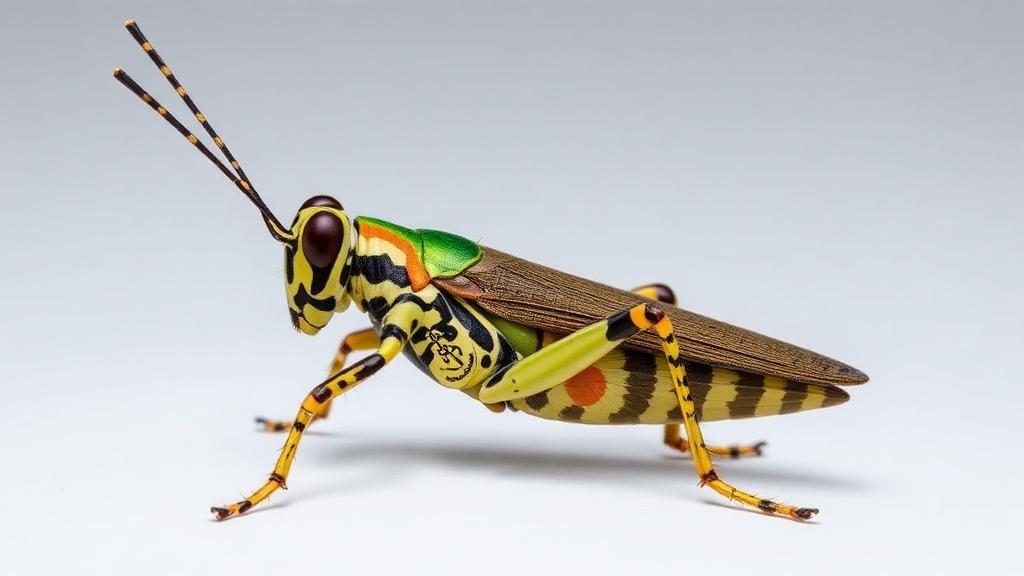
A tangle of names that has confused entomologists for more than a century has finally been untangled. In a new study published in the Deutsche Entomologische Zeitschrift, an international team of researchers has revised two enigmatic groups of African grasshoppers, the genera Parapetasia and Loveridgacris, by combining classical anatomy with modern DNA sequencing. The work formally resurrects one long-dismissed species and describes a brand-new species from the mountains of Tanzania, while also delivering the first molecular family tree for the tribe to which both genera belong.
The grasshoppers in question belong to the family Pyrgomorphidae, often called gaudy grasshoppers because of their strikingly vivid colors. That flamboyance is not decoration: many of these insects feed on toxic plants, sequester poisons such as cardiac glycosides, and advertise their unpalatability to predators through aposematic coloration. The family contains roughly 149 genera and 487 species, most of them concentrated in tropical and subtropical Africa, Asia, and Australia. Within it, the small tribe Dictyophorini includes just five genera, among them Parapetasia and Loveridgacris, both restricted to Africa south of the Sahara.
The taxonomic history of these two genera reads like a long argument. Parapetasia was established in 1884 with the species P. femorata as its type. A second species, P. rammei, was described from Cameroon in 1923. In the 1950s, the entomologist Rehn split the group into two subgenera based on pronotum shape and wing size, and one of those subgenera was later elevated to the genus Loveridgacris. Then, in the 1970s, Kevan argued that the supposedly distinct species were merely wing-length variants of a single species, effectively collapsing everything into one monotypic genus. Some later researchers accepted that view; others continued to treat the old species as valid, leaving the classification in limbo for decades.
To break the deadlock, the team led by Claudia Hemp and colleagues took an integrative approach. They examined freshly collected specimens from five localities in Cameroon, including the Ebo Forest, Mount Manengouba, the western highlands, and the Dja Biosphere Reserve, along with material from Tanzania, and combed through historical collections in Berlin, Hamburg, and Karlsruhe. They measured body proportions with digital calipers, dissected and photographed the intricate male and female genitalia under high-resolution microscopes, and mapped distributions using geographic records from labels and fieldwork.
The genital anatomy proved decisive. In these grasshoppers, the phallic complex is relatively uniform across the family, so subtle differences carry strong taxonomic weight. Parapetasia species have a triangular fastigium of the vertex, small hemispherical eyes, a raised and swollen rear edge on the pronotum, and a narrow epiphallic bridge with subparallel appendices. Loveridgacris species instead show a rounded fastigium, oval eyes, a flat hind-femur margin, strongly reticulated wings, and a broad epiphallic bridge with divergent appendices. Using these characters, the authors provide a formal identification key separating the two genera and the species within each.
The molecular work reinforced the anatomical conclusions. The researchers sequenced fragments of the mitochondrial COI and 16S genes from 47 specimens representing ten pyrgomorphid species and reconstructed a Bayesian phylogeny with Zonocerus elegans as the outgroup. The resulting tree resolved three main tribes and showed strong support for the monophyly of both Parapetasia and Loveridgacris, which emerged as sister genera. Crucially, Parapetasia rammei clustered as the sister species to P. femorata with a substantial interspecific genetic distance of 3.75 percent, contradicting Kevan’s old synonymy. The team therefore formally restored P. rammei as a valid species, leaving Parapetasia with two species: P. femorata from the lowland forests of West and Central Africa, and P. rammei confined to the highlands of Cameroon.
The two genera also turned out to be geographically complementary. Parapetasia occupies western and central Africa, with records from Cameroon, Nigeria, Gabon, and Equatorial Guinea, while Loveridgacris is strictly East African, known from the Eastern Arc Mountains of Tanzania, Zanzibar, and the Shimba Hills of Kenya. The two species also differ ecologically: P. femorata lives in closed-canopy forest near marshy ground, whereas P. rammei favors open highland habitats such as farmland, fallows, and steppe, meaning the two species occupy distinct ecological niches.
The biggest surprise came from Tanzania’s Udzungwa Mountains. There, in disturbed lowland wet forest at the edge of the national park, the team discovered a new Loveridgacris species, which they named Loveridgacris tectiferus, the species name referring to the roof-like, or tectiform, shape of its shortened wings. It can be told apart from its closest relative, L. impotens, by striking color differences: its antennal segments alternate black and orange, its hind tibiae are black with a dull orange middle band, and its wings stand tectiform rather than lying lobe-like against the abdomen. Differences in the epiphallus, including slenderer hooks, support the distinction.
Interestingly, the genetics of the new species tell a subtler story. Although L. tectiferus is morphologically unmistakable, its COI and 16S sequences differ only minimally from those of L. impotens, with a genetic distance of just 0.33 percent, and even complete mitochondrial genomes failed to show strong divergence. The authors interpret this as evidence that L. tectiferus is a young species caught early in the speciation process, possibly isolated in its mountain habitat while its relative remains widespread across eastern Africa. This pattern echoes findings from other Orthopteran groups in the Eastern Arc Mountains, where genera are ancient but individual species are young, likely shaped by climatic fluctuations that repeatedly fragmented and reconnected habitats.
As a bonus, the team assembled the complete mitochondrial genomes of both Loveridgacris species using next-generation sequencing, the first for the genus. The genomes measure 15,592 and 15,737 base pairs and contain the standard set of 37 mitochondrial genes: 13 protein-coding genes, 22 transfer RNAs, two ribosomal RNAs, and one control region. Both are strongly A+T-biased, as is typical for insect mitogenomes. Together with the new species descriptions, the resurrected status of P. rammei, and the first molecular phylogeny of the tribe Dictyophorini, the study transforms a century of confusion into a clear framework: two well-defined genera, each with two valid species, and a roadmap for future sampling across Africa’s forests and mountains.
Subject of Research: Integrative taxonomic revision of the pyrgomorphid grasshopper genera Parapetasia and Loveridgacris, including a new species from Tanzania
Article Title: Integrative taxonomic revision of the grasshopper genera Parapetasia Bolívar, 1884, and Loveridgacris Rehn, 1954 ( Orthoptera , Pyrgomorphidae ), with description of a new species of Loveridgacris
Article References: Yetchom Fondjo, J. A., Husemann, M., Nzoko Fiemapong, A. R., Missoup, A. D., Kenne, M., Tindo, M., Hawlitschek, O., Duressa, T. F., Xu, S.-Q., Zhu, W., & Hemp, C. (2024). Integrative taxonomic revision of the grasshopper genera Parapetasia Bolívar, 1884, and Loveridgacris Rehn, 1954 (Orthoptera, Pyrgomorphidae), with description of a new species of Loveridgacris. Deutsche Entomologische Zeitschrift, 71(2), 265-287. https://doi.org/10.3897/dez.71.125877
Image Credits: AI Generated
Keywords: Pyrgomorphidae, Parapetasia, Loveridgacris, taxonomy, grasshoppers, mitochondrial genome, phylogeny, new species, Tanzania, Cameroon, Dictyophorini, integrative taxonomy
Cite Scienmag News
Juliet Wilcox. (October 19, 2026). Genetic Sleuthing Resolves a Century-Old Puzzle Among Africa’s Gaudy Grasshoppers. Scienmag. https://scienmag.com/genetic-sleuthing-resolves-a-century-old-puzzle-among-africas-gaudy-grasshoppers/
Juliet Wilcox. "Genetic Sleuthing Resolves a Century-Old Puzzle Among Africa’s Gaudy Grasshoppers." Scienmag, 19 October 2026, https://scienmag.com/genetic-sleuthing-resolves-a-century-old-puzzle-among-africas-gaudy-grasshoppers/. Accessed 19 October 2026.
Juliet Wilcox. "Genetic Sleuthing Resolves a Century-Old Puzzle Among Africa’s Gaudy Grasshoppers." Scienmag. October 19, 2026. https://scienmag.com/genetic-sleuthing-resolves-a-century-old-puzzle-among-africas-gaudy-grasshoppers/


