


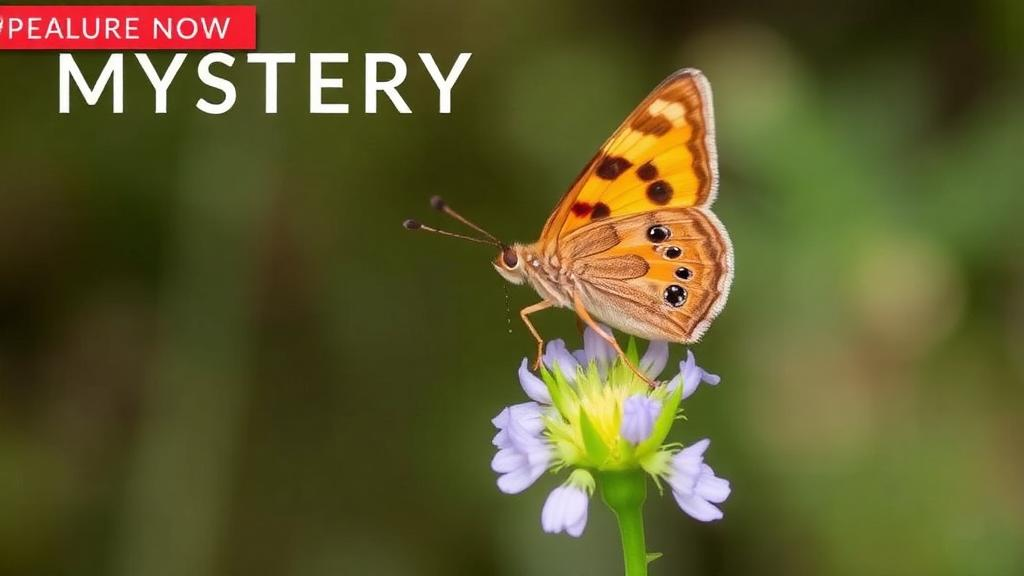
For more than a century, one of Europe’s most elusive butterflies kept its most closely guarded secret: what its caterpillars actually eat. The Spinose Skipper, Favria cribrellum, a small, fast-flying member of the skipper family Hesperiidae, has puzzled lepidopterists across Eastern Europe and Asia precisely because its larval host plant remained unknown despite repeated attempts to identify it. Now, a painstaking multi-year field investigation in the Republic of North Macedonia has finally cracked the case, revealing that this rare butterfly depends on a humble cinquefoil, Potentilla detommasii, and in doing so has delivered unexpected support for a dramatic recent reshuffling of skipper taxonomy.
The Spinose Skipper is no ordinary butterfly. Within Europe it is considered exceptionally localised, known from only a small number of isolated colonies scattered across Serbia, the Republic of North Macedonia, Bulgaria, Romania, Ukraine and southern Russia in the Urals, with more recent discoveries in Greece. Researchers estimate that the species persists at only around 30 sites across its entire European range, a figure that has earned it a designation of Near Threatened on the European Red List of Butterflies. Beyond Europe, its distribution stretches eastwards in a broad arc through Russia’s Altai and Siberia, Kazakhstan, Mongolia and northern China, yet even there it is regarded as uncommon and patchily distributed. This combination of rarity and wide but fragmented range has made every new observation about its biology scientifically valuable.
The mystery centred on the caterpillar’s diet. Because the Spinose Skipper was long classified within the genus Muschampia, and because every other European Muschampia species with a documented lifecycle feeds on plants of the genus Phlomis in the mint family, Lamiaceae, most experts assumed the Spinose Skipper would follow suit. Early fieldworkers in North Macedonia accordingly concentrated their searches on Phlomis plants, inspecting their leaves season after season without success. Over the decades, a confusing scatter of suggestions accumulated in the literature: various authors proposed cinquefoils of the genus Potentilla as likely hosts, while observations from the Volga region of Russia pointed to a species of Marrubium, and a 2019 study in Bulgaria documented eggs and larvae on the wild strawberry Fragaria viridis. The picture was a puzzle with pieces that refused to fit.
Resolving the question required patience of a kind rarely seen in modern ecology. Between 2014 and 2017, researchers conducted repeated field trips to a site near the village of Govrlevo, southwest of Skopje, where healthy populations of the butterfly were known to fly. The surveys spanned early spring to late summer across several years, with visits in May 2014, March and August 2016, and multiple trips in 2017. The breakthrough came on 13 May 2017, when three eggs were finally discovered on a species of Potentilla growing at the site. Crucially, the researchers had not yet seen the Bulgarian findings on Fragaria viridis at the time of their discovery, meaning their independent observation of oviposition on a cinquefoil was untainted by prior expectation, a rare form of scientific replication in field biology.
Identifying the plant itself demanded expert collaboration. A sample collected after females were observed laying eggs was sent to the Faculty of Biology at the University of Belgrade, where Professor Gordana Tomović provisionally identified it as Potentilla detommasii, a cinquefoil species. Notably, several other cinquefoil species grew at the same site, yet the butterfly utilised only this one for oviposition. The chosen plants occupied the driest parts of the habitat, sometimes in large groups and sometimes as isolated individuals, and all three eggs were found on small seedlings bearing just six to eight leaves. This selectivity within a single plant genus hints at a finely tuned chemical or structural relationship between butterfly and host that remains to be explored.
Rearing the immature stages revealed further surprises about the caterpillar’s behaviour. Newly hatched first-instar larvae were placed onto seedlings in carefully constructed rearing containers: plant roots were immersed in water inside plastic bottles, with cotton wool barriers preventing the tiny larvae from drowning, and fine netting over the tops excluding predators while allowing airflow. The plants responded well, producing new roots within a week. Contrary to a previous account from Bulgaria, which described first-instar larvae constructing a characteristic shelter by cutting and folding leaflets, the Macedonian larvae built no shelter at all in their first stage, instead remaining at leaf tips and feeding on small amounts of tissue while leaving the cuticle intact. Only at the second instar did shelter-building begin, with larvae observed folding two leaves together, and later instars went on to construct silken tents.
The caterpillar’s calendar proved equally instructive. As summer heat desiccated the habitat, the host plants entered a summer dormancy that rendered them unsuitable for continued larval development, and the caterpillars responded by entering a summer diapause, a state of suspended development that allows them to survive the inhospitable season. The researchers also attempted to trick the larvae into skipping their winter diapause by exposing them to constant light during later development, but the manipulation failed, confirming that the species is strictly univoltine, producing just one generation per year. This rigid developmental programme, locked to the seasonal rhythm of its host plant, underscores how vulnerable a narrowly specialised insect can be to changes in habitat management and climate.
Perhaps the most far-reaching implication of the discovery concerns butterfly classification. In 2020, a molecular study using nuclear and mitochondrial DNA demonstrated that the Spinose Skipper is not monophyletic with the genus Muschampia, and the species was accordingly moved to the monotypic genus Favria, which sits as sister to the genus Gomalia. The host plant evidence now lines up neatly with the genetics. Every Muschampia species in the Western Palaearctic with a known lifecycle feeds on Phlomis or other Lamiaceae, whereas the Spinose Skipper feeds on plants of the tribe Potentilleae in the rose family, as does its Bulgarian counterpart on Fragaria viridis. Intriguingly, its sister genus Gomalia is morphologically very different, particularly in egg and larval stages, and feeds on Abutilon species in the mallow family, illustrating how quickly host plant associations can diverge even between closely related lineages.
The convergence of independent evidence from two countries makes the conclusion unusually robust. With larvae documented on Potentilla in North Macedonia and on Fragaria viridis, another Potentilleae member, in Bulgaria, the long-standing speculation about the Spinose Skipper’s host plant can finally be laid to rest. The authors suggest that across the species’ vast range, from the Balkans to Mongolia and northern China, different populations likely utilise different Potentilla species or other members of the tribe Potentilleae, a hypothesis that now invites fieldwork across Central Asia. For conservationists, the finding carries practical weight: protecting the Spinose Skipper means protecting its specific cinquefoil host and the dry, drought-prone microhabitats where it grows, knowledge that was simply unavailable before this study.
The story of the Spinose Skipper is a reminder that even in well-studied Europe, fundamental questions about common ecological relationships can persist for generations when species are rare, localised and seasonally fleeting. It took years of targeted searching, a willingness to abandon a plausible but wrong hypothesis about Phlomis, careful plant identification by a specialist botanist, and meticulous captive rearing through every larval instar to close the gap. In the end, the answer was hiding in plain sight on the driest slopes near Skopje, on a seedling cinquefoil with six to eight leaves, and it turned out to be the final piece of evidence confirming that this butterfly never truly belonged in Muschampia at all.
Subject of Research: Host plant and lifecycle ecology of the Spinose Skipper butterfly (Favria cribrellum) in the Republic of North Macedonia
Article Title: The lifecycle and ecology of the Spinose Skipper – Favria cribrellum (Eversmann, 1841) in the Republic of North Macedonia ( Lepidoptera , Hesperiidae )
Article References: Franeta, F., & Gascoigne-Pees, M. (2022). The lifecycle and ecology of the Spinose Skipper – Favria cribrellum (Eversmann, 1841) in the Republic of North Macedonia (Lepidoptera, Hesperiidae). Nota Lepidopterologica, 45, 119-127. https://doi.org/10.3897/nl.45.75723
Image Credits: AI Generated
DOI: 10.3897/nl.45.75723
Keywords: Favria cribrellum, Spinose Skipper, Hesperiidae, Potentilla detommasii, host plant, North Macedonia, butterfly ecology, larval development, diapause, taxonomy, Muschampia, conservation
Cite Scienmag News
Margaret Porter. (October 19, 2026). Mystery Solved: Rare Skipper Butterfly’s Secret Host Plant Revealed in North Macedonia. Scienmag. https://scienmag.com/mystery-solved-rare-skipper-butterflys-secret-host-plant-revealed-in-north-macedonia/
Margaret Porter. "Mystery Solved: Rare Skipper Butterfly’s Secret Host Plant Revealed in North Macedonia." Scienmag, 19 October 2026, https://scienmag.com/mystery-solved-rare-skipper-butterflys-secret-host-plant-revealed-in-north-macedonia/. Accessed 19 October 2026.
Margaret Porter. "Mystery Solved: Rare Skipper Butterfly’s Secret Host Plant Revealed in North Macedonia." Scienmag. October 19, 2026. https://scienmag.com/mystery-solved-rare-skipper-butterflys-secret-host-plant-revealed-in-north-macedonia/


