


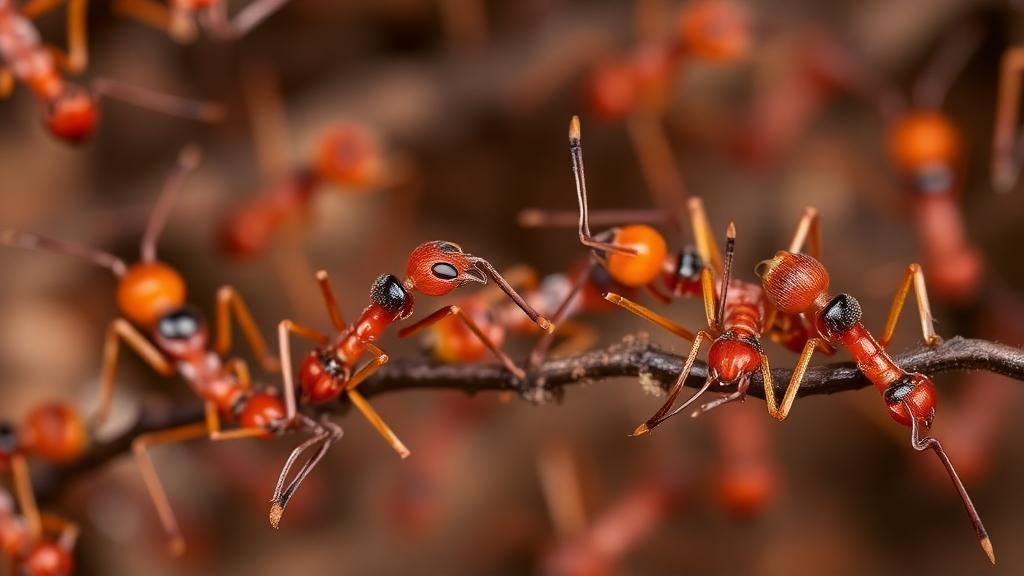
Fire ants are among the most notorious invasive insects on the planet, infamous for their aggressive behavior and painful, venom-laced stings. Now, a team of Brazilian researchers has peered inside the cells of one notorious species, Solenopsis saevissima, and uncovered a cytogenetic curiosity that may help explain why these ants are such successful invaders. By combining classical chromosome staining with quantitative measurements and flow cytometry, the scientists documented an unexpected range of chromosome counts within individual ants and entire colonies, ranging from the normal haploid number of 16 chromosomes all the way up to a staggering 128 chromosomes in a single cell. The finding, published in the journal Comparative Cytogenetics, suggests that polyploid cells, cells carrying more than two complete sets of chromosomes, occur naturally in the immature stages of this species and may represent an adaptive trait linked to the genus’s remarkable capacity for spread and colonization.
The study focused on colonies collected in Ouro Preto, in the southeastern Brazilian state of Minas Gerais, a mountainous region sitting at more than 1,150 meters above sea level. Between October and December 2020, the researchers located fire ant nests by their characteristic mounds of soil in grassy, sunny, open areas, marking four colonies for sampling. Importantly, the team never removed an entire colony; only fractions were collected so the brood could recover. Back in the laboratory, the researchers isolated post-defecating larvae, the developmental stage just before pupation, and dissected out the cerebral ganglion, the brain tissue where dividing cells could be captured for chromosomal analysis.
Preparing the chromosomes required a delicate protocol refined over decades of ant cytogenetics. The dissected ganglia were incubated in a hypotonic colchicine solution, a chemical that halts cells in the middle of division and allows chromosomes to condense into visible, countable structures. The tissue was then gently ruptured on a slide, and a series of acetic acid and ethanol solutions was dropped onto the preparation to spread the cells flat. After staining with Giemsa, the slides were examined under an optical microscope, and a total of 450 metaphase spreads, snapshots of chromosomes at their most condensed state, were photographed and counted across the four colonies.
The chromosome counts revealed a striking picture. Across all colonies, the researchers recorded haploid cells with 16 chromosomes, diploid cells with 32, tetraploid cells with 64, and, in a single remarkable metaphase, an octoploid cell with 128 chromosomes. The modal numbers, those observed most frequently, were the haploid and diploid counts, as expected, while the tetraploid class appeared at lower but consistent frequency. Notably, polyploid cells turned up in every colony examined, at similar frequencies, indicating that the phenomenon is not a random accident in one nest but a regular feature of the species’ biology during its immature stages.
To characterize the fine structure of the chromosomes, the team performed a karyomorphometric analysis, measuring the total length of each chromosome, the lengths of its short and long arms, and the ratio between those arms. These measurements allowed each chromosome to be classified as metacentric, submetacentric, or subtelocentric according to the position of its centromere, the pinched region that separates the arms. The resulting karyotypic formulas were elegantly consistent: the haploid complement comprised 10 metacentric, 4 submetacentric, and 2 subtelocentric chromosomes, the diploid complement doubled that arrangement, and the single tetraploid metaphase analyzed followed the same doubling pattern. The two largest metacentric and submetacentric pairs also displayed secondary constrictions, landmarks on the chromosome that often correspond to nucleolus organizer regions, sites of intense ribosomal RNA gene activity.
Chromosome counting alone cannot confirm true genome multiplication, so the researchers turned to flow cytometry, a technique that measures the DNA content of thousands of individual nuclei by their fluorescence. Brain tissue from larvae was ground in buffer, filtered, and stained with propidium iodide, a dye that binds DNA, with fruit fly Drosophila melanogaster serving as an internal calibration standard. At least 10,000 nuclei per sample were analyzed on a FACSCalibur cytometer, with three independent replicates per colony and strict quality controls rejecting any histogram with excessive variability. The resulting histograms showed not only the expected peaks for unreplicated and replicated diploid nuclei but also additional, evenly spaced peaks corresponding to 8C and 16C DNA contents, a clear signature of endoreduplicated, polyploid cell populations.
The flow cytometry data also yielded the first precise estimate of genome size for this species: 0.51 picograms of DNA per haploid genome, equivalent to roughly 498.78 megabase pairs. This value agrees with earlier estimates for related fire ants and reinforces the consistency of the cytogenetic picture. Polyploidy is, in fact, common in plants but decidedly rare in animals, which makes its regular appearance in fire ant larvae all the more intriguing. Previous surveys of fungus-farming ants, for example, failed to detect polyploid cells even with similar flow cytometry approaches, hinting that the phenomenon may be restricted to particular ant lineages rather than being widespread across the family Formicidae.
What functional advantage might polyploid cells confer on a developing ant colony? The researchers draw an analogy to the salivary glands of dipteran flies, where endoreplication produces giant polytene chromosomes packed with thousands of DNA strands, fueling massive secretory output. In fire ants, the extra gene copies in polyploid cells could accelerate the developmental rate of immature workers, allowing the brood to mature faster. Because fire ant colonies are recruiting species, in which workers signal and recruit nestmates to food resources, a faster-growing workforce means a colony can exploit its environment more rapidly, reach reproductive maturity sooner, and flood the surroundings with the winged sexuals that found new colonies. In evolutionary terms, the faster a colony converts resources into dispersing offspring, the higher its fitness, and ploidy variation in the brood stage may be one cytogenetic lever behind that speed.
The mechanism behind the polyploid cells likely involves endomitosis, a modified cell cycle in which DNA replication proceeds normally but the final step of cell division, cytokinesis, never occurs. Chromosomes accumulate within a single nucleus, generating cells with doubled, quadrupled, or octupled genome complements. Conserved developmental programs control this process in both animals and plants, and a growing body of work suggests that endoreplication provides essential biological functions during development. Intriguingly, earlier doctoral research cited by the team showed that polyploid cells in this species disappear as larvae progress to pupae and adults, meaning the phenomenon is confined to the mutable, rapidly growing immature phase, precisely the stage when accelerated growth would matter most.
Beyond its developmental implications, the study carries weight for taxonomy and invasion biology. Solenopsis is a notoriously difficult genus of more than 190 described species, whose workers lack the morphological features needed for reliable classification, and cryptic species may lurk within the fire ants now spreading across the Americas and Oceania. Karyotyping offers a powerful genetic marker where morphology fails, and the confirmation that n = 16 is the standard haploid number for S. saevissima, matching counts in congeners such as S. invicta, S. geminata, and S. richteri, strengthens the case that this chromosome number is a shared signature of the genus. With only about 7 percent of the world’s more than 16,000 ant species cytogenetically analyzed, studies like this one fill a vast gap, and they hint that chromosomal flexibility, whether through polyploidy or hybridization-driven genome shuffling, may be one of the quiet secrets behind the fire ant’s global conquest. The authors caution that the adaptive role of polyploid cells remains a hypothesis that will require testing in field studies, but the image of a tiny ant larva quietly packing 128 chromosomes into a single brain cell is a vivid reminder that some of invasion biology’s most important answers may be written at the level of the chromosome.
Subject of Research: Polyploidy and karyotype structure in the fire ant Solenopsis saevissima
Article Title: Assessing ploidy levels and karyotype structure of the fire ant Solenopsis saevissima Smith, 1855 ( Hymenoptera , Formicidae , Myrmicinae )
Article References: de Andrade, A. R. M., Cardoso, D. C., & Cristiano, M. P. (2023). Assessing ploidy levels and karyotype structure of the fire ant Solenopsis saevissima Smith, 1855 (Hymenoptera, Formicidae, Myrmicinae). Comparative Cytogenetics, 17, 59-73. https://doi.org/10.3897/compcytogen.17.100945
Image Credits: AI Generated
DOI: 10.3897/compcytogen.17.100945
Keywords: fire ants, Solenopsis saevissima, polyploidy, cytogenetics, karyotype, flow cytometry, endoreplication, invasive species, chromosomes, genome size, Formicidae, Brazil
Cite Scienmag News
Patricia Pace. (October 19, 2026). Fire ants hide a chromosome surprise: polyploid cells revealed in invasive species. Scienmag. https://scienmag.com/fire-ants-hide-a-chromosome-surprise-polyploid-cells-revealed-in-invasive-species/
Patricia Pace. "Fire ants hide a chromosome surprise: polyploid cells revealed in invasive species." Scienmag, 19 October 2026, https://scienmag.com/fire-ants-hide-a-chromosome-surprise-polyploid-cells-revealed-in-invasive-species/. Accessed 19 October 2026.
Patricia Pace. "Fire ants hide a chromosome surprise: polyploid cells revealed in invasive species." Scienmag. October 19, 2026. https://scienmag.com/fire-ants-hide-a-chromosome-surprise-polyploid-cells-revealed-in-invasive-species/


