


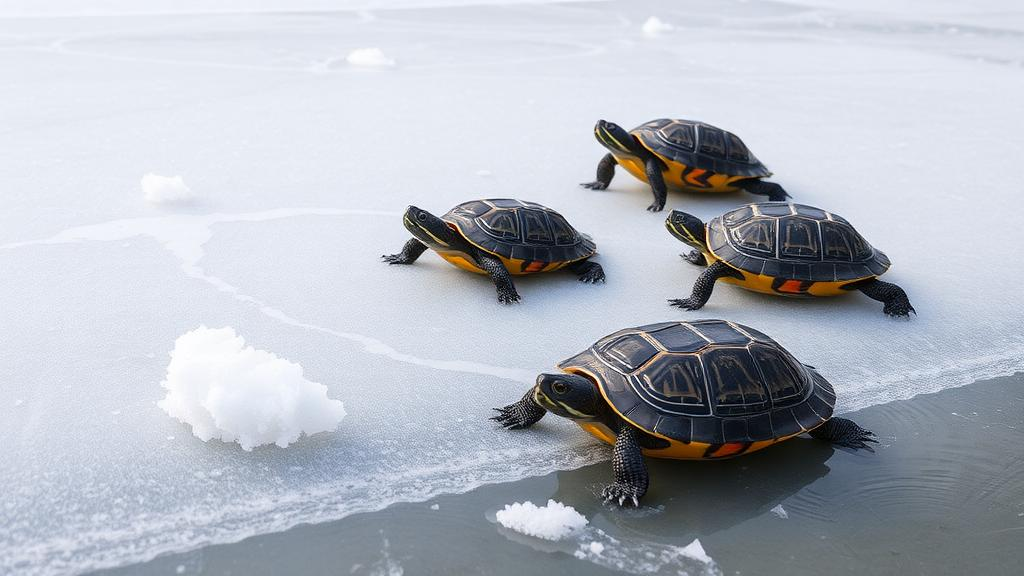
On a cold January afternoon in Bucharest, with thin ice stretching across much of a city park lake, researchers spotted something that turtles are not supposed to do: swim. The animals in question were Pond Sliders, Trachemys scripta, the familiar North American species sold worldwide as pets and routinely abandoned in urban ponds. Rather than lying dormant in the mud as winter physiology would normally dictate, these turtles were actively basking and swimming between cold spells, in some cases within arm’s reach of persisting lake ice. The observations, published in the journal Herpetozoa, document winter activity in a non-native turtle population at the edge of what its physiology should tolerate, and they carry implications for how invasive reptiles may respond to increasingly erratic winters in Europe.
The study focused on two urban park lakes in the Romanian capital: the roughly 8,000-square-meter lake in Morarilor Park, bordered by concrete embankments but retaining patches of reed bed, and the slightly smaller lake in Circului, or State Circus, Park, originally four meters deep but by 2024 much shallower, edged with earth banks, reeds, and Indian lotus vegetation. Both lakes host a mix of native and alien turtles alongside waterbirds and opportunistic fish. The 2023–2024 winter was atypically mild across the region, dominated by positive air temperatures and very little snow, but it was punctuated by short cold spells in January 2024 that brought overnight frosts, occasional snow showers, and ice that formed and persisted into early February. That oscillation between false spring and genuine winter created a natural experiment on turtle behavior.
The researchers conducted periodic visual transects on selected warmer days in January and February, dedicating each observation day to a single lake and concentrating their efforts around mid-day, when insolation peaks and basking activity was expected to be highest. Air temperatures were measured with a Dwyer WT-10 digital thermometer and cross-checked against readings from nearby weather stations. Crucially, the team also ran control observations during cold spells, including January 20, when snowfall fell and thin ice covered the water. On those days, not a single turtle was seen. The pattern that emerged was stark: activity occurred only on warm days, and it stopped entirely when the weather turned.
During the warmer, sunny days, however, even the harshest stretches of January could not keep the sliders down. In Morarilor Park, Trachemys scripta individuals were recorded active on January 5, 19, and 26 and on February 3, 8, and 24; in Circului Park, the species was active on February 4, 7, and 23. Remarkably, much of this activity took place despite partial ice cover on the lakes, and some turtles were observed swimming right at the ice edge. The January 5 count recorded eleven individuals basking and swimming at around 15–16 °C, but even on January 26, when the air was only 6–7 °C and roughly 85 percent of the lake was covered in thin ice, three sliders were seen swimming. The animals involved were mostly large adults, and the observers judged that the same five or six individuals were likely responsible for the sightings through the coldest part of the winter.
The behavior of these cold-hardy individuals revealed deliberate strategies for conserving heat. The researchers noted group basking, in which multiple turtles piled together to share warmth, as well as basking on wood and distinctive heat-conserving postures, in which a turtle draws its limbs in to minimize exposed surface area. These tactics were deployed even though alternative basking sites, mostly at the edges of reed beds, were readily available and predators were absent. Such thermoregulatory finesse suggests that the winter-active sliders were not simply disoriented by warm weather but actively managing a marginal energy budget in conditions their species did not evolve to face this far east in Europe.
The most telling result came by comparison. No other turtle species, native or alien, appeared during the mid-winter observations. Only on February 23 and 24, when temperatures climbed toward 20 °C and the ice had fully gone, did the rest of the lake’s turtle community emerge. Alongside the sliders, the team recorded the native European Pond Turtle, Emys orbicularis; the alien False Map Turtle, Graptemys pseudogeographica; and a possible hybrid of the Chinese Striped-necked Turtle and Reeves’ Turtle, an introgressive Mauremys that hints at further untangling of the park’s introduced menagerie. Counts on those late-February days surged, with 52 sliders recorded at Morarilor Park and 60 to 70 at Circului Park, compared with single digits or low teens earlier in the winter.
The biology behind this split is rooted in the slider’s remarkable but conditional physiology. Trachemys scripta is capable of prolonged anoxic overwintering, surviving roughly 45 days at temperatures of 3–5 °C while submerged and metabolizing without oxygen. Yet the species is sensitive to freezing temperatures, particularly hatchlings that overwinter in the nest, and deviations from optimal overwintering conditions can impair health and survival. Harsher winters can kill adults outright: mass mortality has been reported in Bulgaria, where the slider is likewise alien, and the authors themselves witnessed a comparable event in March 2012 at the Botanical Garden of Bucharest, where at least a dozen sliders died when their aquatic habitat froze deeply and persistently. Notably, no dead European Pond Turtles were found there, underscoring the native species’ superior tolerance of true continental winters.
At the same time, the slider’s metabolism is governed by both temperature and photoperiod, and in its native North American range, which spans temperate latitudes, it is known to emerge on warm winter days and even to remain active along or under ice. In the mild climate of southern Spain, another part of its introduced range, the species has sometimes reduced or skipped hibernation altogether. The Bucharest records now establish that this capacity for sporadic winter activity operates in Romania as well, in a non-native population experiencing a temperate continental climate, provided that unseasonably warm weather opens a window of opportunity in an urban setting. Urban lakes, with their heat-retaining concrete, shallow water, and abundant basking structures, may function as stepping stones that let warm-adapted behavior survive where it otherwise would not.
The findings also challenge a popular hypothesis about invasiveness. It has been proposed that winter activity gives the slider an advantageous early start in competing with native turtles for basking spots, a critical resource for ectotherms that need to raise their body temperature to feed and digest. The Bucharest observations suggest the opposite dynamic. When the native Emys orbicularis and the alien Graptemys pseudogeographica finally emerged in late February, they were seen climbing onto and basking atop the larger, pre-warmed sliders, effectively exploiting them as heated platforms, even though alternative basking sites were plentiful. This echoes earlier European observations and implies that the slider’s winter activity may reflect distinct ecological characteristics that actually reduce, rather than intensify, interspecific competition, a hypothesis the authors note remains to be tested by more detailed study.
What emerges from a winter of watching frozen park lakes is a portrait of an invader testing its limits. The slider population in Bucharest appears small, dominated by a handful of large, long-surviving pets, yet it has already documented reproduction in several Romanian urban settings, and the morphological diversity of the city’s sliders points to multiple introduction events and hybridization among subspecies. As climate change delivers more winters that lurch between deep freezes and spring-like thaws, the physiological windows that allowed these turtles to bask beside the ice in January 2024 may open more often. Whether that flexibility translates into genuine establishment in colder Europe remains uncertain, and a single hard winter can still wipe out an urban population. But the sight of North American turtles swimming at the edge of the ice in a Romanian January is a vivid reminder that the boundaries of invasion are drawn not on maps, but on thermometers.
Subject of Research: Winter activity and cold tolerance of the invasive Pond Slider turtle in urban park lakes in Romania
Article Title: Turtles and ice: winter activity in non-native turtles in Romania
Article References: Iftime, O., & Iftime, A. (2025). Turtles and ice: winter activity in non-native turtles in Romania. Herpetozoa, 38, 1-5. https://doi.org/10.3897/herpetozoa.38.e137934
Image Credits: AI Generated
DOI: 10.3897/herpetozoa.38.e137934
Keywords: Trachemys scripta, Pond Slider, invasive species, turtles, winter activity, hibernation, Bucharest, Romania, urban ecology, thermoregulation, Emys orbicularis, climate
Cite Scienmag News
Patricia Pace. (October 19, 2026). Alien Turtles Break Winter Rules: Pond Sliders Bask Beside Ice in Bucharest Parks. Scienmag. https://scienmag.com/alien-turtles-break-winter-rules-pond-sliders-bask-beside-ice-in-bucharest-parks/
Patricia Pace. "Alien Turtles Break Winter Rules: Pond Sliders Bask Beside Ice in Bucharest Parks." Scienmag, 19 October 2026, https://scienmag.com/alien-turtles-break-winter-rules-pond-sliders-bask-beside-ice-in-bucharest-parks/. Accessed 19 October 2026.
Patricia Pace. "Alien Turtles Break Winter Rules: Pond Sliders Bask Beside Ice in Bucharest Parks." Scienmag. October 19, 2026. https://scienmag.com/alien-turtles-break-winter-rules-pond-sliders-bask-beside-ice-in-bucharest-parks/


