


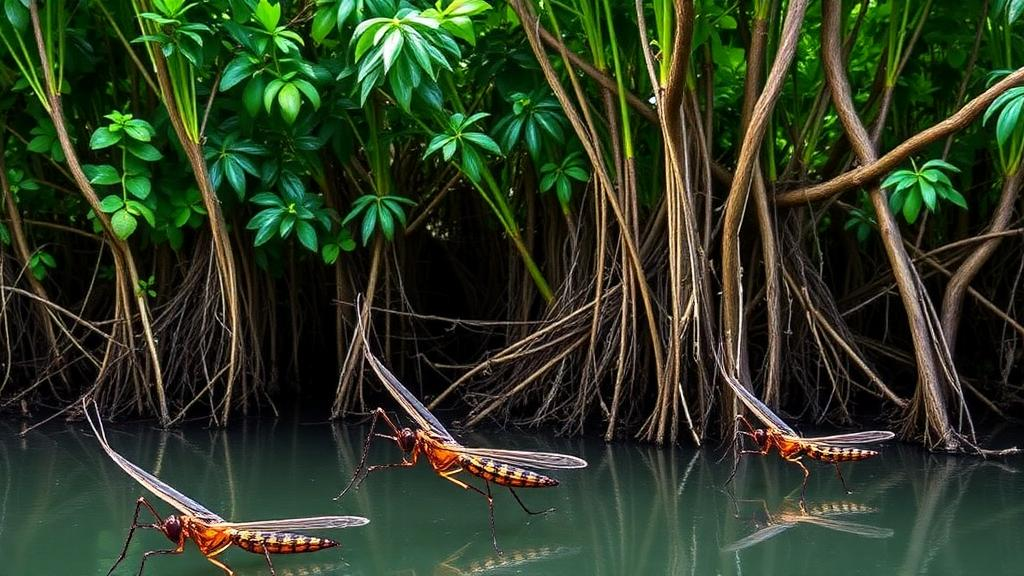
Deep in the mangrove forests of French Guiana, where the Amazon dumps its sediment into the Atlantic and builds the muddiest coastline on Earth, scientists have completed one of the most thorough inventories of tropical mosquitoes ever attempted. A new sampling-event dataset, published in the journal ZooKeys, documents more than 21,700 mosquito specimens collected across 334 collection events in coastal and estuarine mangrove habitats, capturing 62 species from 14 genera. The effort offers researchers an unprecedented window into which mosquitoes live in these waterlogged forests, how abundant they are, and how close they come to the people who share the Guianese coast.
The significance of the work lies in what mangroves represent for public health. Although mangrove forests cover only about 700 square kilometres of French Guiana, less than one percent of the territory, they occupy more than 80 percent of its coastline. That same coastal strip is home to 90 percent of the human population of this French overseas department, including the capital city of Cayenne. Wherever people and mosquitoes overlap, questions about nuisance biting and disease transmission follow, and until now, data on the mosquitoes of these intertidal forests were remarkably sparse.
French Guiana is, in many ways, the right place to look. The territory is recognised as having one of the highest mosquito species richness in the world relative to its surface area, with 250 recorded species. Earlier georeferenced databases, compiled by entomologists in the 1960s and 1970s and updated in 2015, catalogue valuable biodiversity records, but their structure does not allow researchers to analyse how species assemblages and relative abundances vary across space and time. The new dataset was designed precisely to fill that gap, using standardised sampling events so that future comparisons among habitats and seasons become possible.
The fieldwork stretched from October 2023 to July 2025 and covered 14 locations. Most sat on the Island of Cayenne and its surroundings, a stretch of roughly 50 kilometres of coast and 25 kilometres inland that includes six municipalities. A second cluster of sites lay about 100 kilometres southeast, along the lower Oyapock River on the border with Brazil, in a 30-kilometre upstream and downstream transect between the villages of Trois-Palétuviers and Ouanary. The sites spanned young pioneer mangroves barely a year old, mature homogeneous stands dominated by a single tree species, and structurally complex mixed forests, some within sight of Cayenne’s urban centre and others more than 10 kilometres from any human infrastructure.
Sampling relied primarily on two complementary trap types. BG-Pro traps baited with BG-Sweetscent lures, sometimes paired with ultraviolet light, are known to be effective at capturing mosquito species that prefer to feed on humans. CDC light traps, suspended about 1.5 metres above the ground along transects of 30 to 60 metres, sample a broad diversity of nocturnal species. Traps typically ran for 8 to 9 hours during daytime deployments or around 16 hours overnight, with occasional continuous 24-hour sessions when logistics prevented immediate retrieval. Two larval dipping events added 64 immature specimens to the tally, a tiny fraction of the total but a deliberate inclusion, since locating larvae is one of the few ways to identify which parts of the mangrove actually serve as breeding habitat.
Identifying tropical mosquitoes is notoriously difficult, and the researchers went to unusual lengths to get the names right. No single identification key covers all the mosquito species recorded in French Guiana, so the team combined multiple taxonomic keys, one for each genus, following nomenclature updated through the Mosquito Taxonomic Inventory. Most species of the genus Culex simply cannot be identified reliably from external adult features, so the team examined the internal structures of male genitalia for 1,762 male Culex specimens, 98 percent of all Culex males in the dataset. The abdominal segments were cleared in potassium hydroxide, stained with acid fuchsin, and in 100 difficult cases fully dissected and mounted on slides for microscopic examination at up to 1000-times magnification.
Molecular tools provided a further layer of confidence. For uncertain identifications, the researchers removed three legs from selected specimens and stored them for DNA barcoding of the standard 658-base-pair region of the mitochondrial cytochrome c oxidase subunit I gene, the COI barcode widely used in animal taxonomy. A total of 400 female mosquitoes and 50 male Culex were confirmed this way, with sequences compared against an existing DNA reference library dedicated to the mosquitoes of French Guiana. All barcode sequences will be deposited in the Barcode of Life Data System under the ongoing Mosquitoes of French Guiana project, and voucher specimens are preserved in ethanol or mounted in the entomological collection of the Institut Pasteur de la Guyane.
The results reveal a mosquito fauna strongly dominated by a handful of taxa. Unidentified Culex of the subgenus Melanoconion topped the list with 8,580 specimens, or 39.4 percent of the total, followed by Coquillettidia venezuelensis with 4,471 specimens at 20.5 percent, the crab-hole mosquito Deinocerites magnus with 3,354 specimens at 15.4 percent, and Culex portesi with 1,496 specimens at 6.9 percent. Together, these four taxa accounted for 82.2 percent of everything collected and occurred at most of the sampling sites. That a few species so thoroughly dominate the catch, while dozens of others appear only rarely, is itself ecologically informative, hinting at how tightly many tropical mosquito species are adapted to particular microhabitats within the mangrove mosaic.
The authors are candid about the dataset’s limits. Because it combines a standardised repeated survey, a structured but less replicated river transect, and a set of exploratory and opportunistic collections, sampling effort was not homogeneous across all sites. Roughly two-thirds of all collection events came from the standardised design, providing a robust core for comparison, but the team advises that any comparative analysis be restricted to subsets collected under comparable protocols. Trap biases are also acknowledged: light traps and scent-baited traps each miss part of the fauna, and some taxa will inevitably remain underrepresented no matter how diverse the toolkit. Environmental conditions, from tidal flooding and freshwater flushing to stand age and salinity, vary across mangrove habitats and shape which salt-tolerant species thrive where.
Why should the wider public care about an insect inventory in South American swamps? Mangroves worldwide are recognised both as nurseries for pest and arbovirus-carrying mosquitoes and, paradoxically, as sometimes poor larval habitats, since frequent tidal flushing can wash out eggs and larvae before they complete development. Understanding which side of that balance a given mangrove occupies, and which species dominate it, directly informs assessments of public health risk and the design of management strategies for coastal zones under pressure from urbanisation and climate change. By releasing the dataset as fully documented sampling events, complete with georeferenced coordinates, trap metadata, specimen identifiers, DNA barcodes and dissected voucher material, the researchers have transformed a regional entomological campaign into an open, reusable scientific resource. For a territory where 250 mosquito species share a coastline with nearly the entire human population, that kind of traceable baseline is not a luxury. It is the foundation on which every future question about mosquitoes, mangroves and disease in the Guianas will be built.
Subject of Research: Ecology and diversity of Neotropical mosquito assemblages in mangrove habitats of French Guiana
Article Title: A mangrove-based dataset to study the ecology of Neotropical mosquitoes ( Diptera , Culicidae ) in French Guiana
Article References: Collet, M., Proisy, C., Talaga, S., Guidez, A., Vlandis, I., Keovongsack, A., Carinci, R., Gaborit, P., Davy, D., & Duchemin, J.-B. (2026). A mangrove-based dataset to study the ecology of Neotropical mosquitoes (Diptera, Culicidae) in French Guiana. ZooKeys, 1290, 227-239. https://doi.org/10.3897/zookeys.1290.189084
Image Credits: AI Generated
DOI: 10.3897/zookeys.1290.189084
Keywords: mosquitoes, Culicidae, mangroves, French Guiana, biodiversity dataset, DNA barcoding, Culex, vector ecology, Neotropical, entomology, sampling-event data, arboviruses
Cite Scienmag News
Drew Townsend. (October 19, 2026). Massive Mangrove Mosquito Dataset Reveals Hidden Diversity on the Guiana Coast. Scienmag. https://scienmag.com/massive-mangrove-mosquito-dataset-reveals-hidden-diversity-on-the-guiana-coast/
Drew Townsend. "Massive Mangrove Mosquito Dataset Reveals Hidden Diversity on the Guiana Coast." Scienmag, 19 October 2026, https://scienmag.com/massive-mangrove-mosquito-dataset-reveals-hidden-diversity-on-the-guiana-coast/. Accessed 19 October 2026.
Drew Townsend. "Massive Mangrove Mosquito Dataset Reveals Hidden Diversity on the Guiana Coast." Scienmag. October 19, 2026. https://scienmag.com/massive-mangrove-mosquito-dataset-reveals-hidden-diversity-on-the-guiana-coast/


