


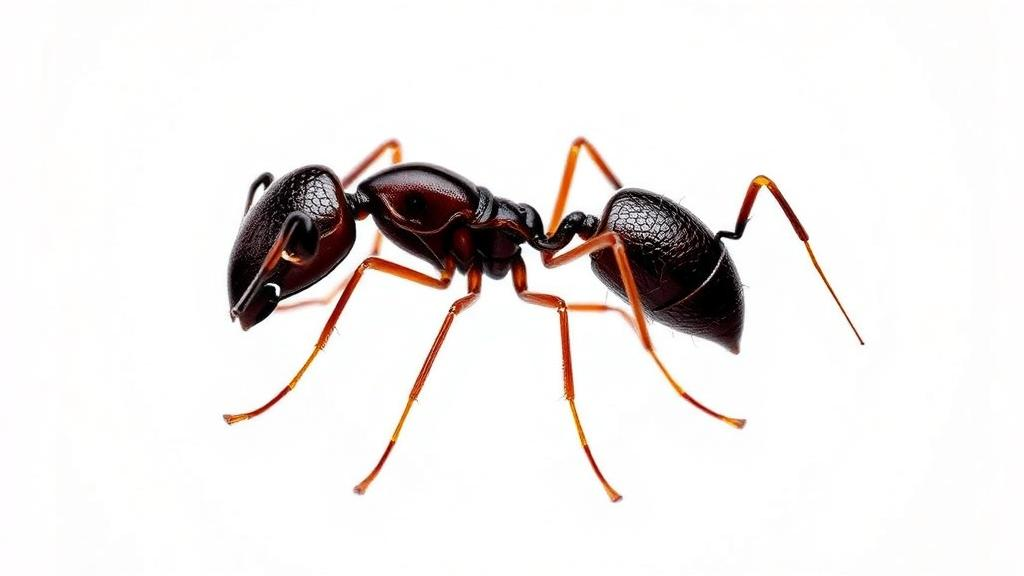
Advancing across the forest floor like a living black carpet, African driver ants are among the most formidable predators in the tropics. Their swarm raids can stretch more than 20 metres wide, flushing out invertebrates, spiders and even small vertebrates as they climb into the vegetation in search of prey. Yet despite their ecological fame, the driver ants of West Africa have long been a taxonomic nightmare, with a tangle of names obscuring which species actually lives where. A new study published in ZooKeys has now cut through more than two centuries of confusion, showing that the region west of the Dahomey Gap is home to just three driver ant species, and formally linking the name Dorylus nigricans, first coined in 1802, to the worker form scientists have long known as Anomma arcens.
Driver ants of the Dorylus nigricans species group are keystone organisms in forests and savannas across tropical Africa. Their colonies can contain as many as nine million adult ants and weigh up to 50 kilograms, roughly the body mass of a female leopard. The queens are the largest ants alive today, reaching six centimetres in total length and producing an estimated three to four million eggs per month in some species. Everything on the menu is fair game: earthworms, termites, snails, freshwater crabs, the carcasses of colobus monkeys, and even cooking oil pilfered from human kitchens. In turn, the ants feed chimpanzees, honey badgers, mongooses and pangolins, host a suite of parasitic and commensal invertebrates, and churn enormous quantities of soil, bringing almost 35 kilograms to the surface during each temporary nest stay at Mount Kenya.
So why has such an ecologically important group been so hard to classify? The answer lies in a perfect storm of biological and historical problems. First, driver ants display some of the most extreme worker polymorphism in the entire ant family. Within a single colony, head width can vary more than six-fold and individual dry mass by a factor exceeding 160, with workers differing dramatically in antennal segmentation, mandibular dentition, head shape and hairiness. A single colony harbours worker morphs more diverse than some entire ant genera, which means small and large workers of the same species can look like entirely different animals. Second, distinguishing genuine species differences from mere variation within a species has proved fiendishly difficult, especially since early taxonomists often named new forms on the basis of minute differences in colour without quantitative evidence.
A third and decisive problem is that most driver ant species were described from a single caste or sex. Males are large, distinctive insects that disperse on the wing at night and are often collected only at lights, while the workers that dominate field observations were frequently described separately, with no established link between the two. The name Dorylus nigricans itself was based on two male specimens from Sierra Leone held in the Museum für Naturkunde in Berlin, and no one had ever convincingly connected those males to any worker form. No fewer than eighteen subspecific and infraspecific taxa have been described or subsumed under this single name, and the possibility of hybridisation between driver ants, documented in western Kenya, adds yet another layer of complexity.
To resolve the West African picture, the researchers conducted extensive surveys from Senegal to Ghana, ultimately examining more than 1,000 worker samples from 21 sites, many collected in collaboration with primatologists studying chimpanzee insectivory. Driver ant workers are recognisable by basisternal spines on the underside of the mesosoma, and morphological comparisons of head shape, sculpture, petiole form and the relative lengths of antennae and legs revealed that only three species occur in the region: Dorylus nigricans, Dorylus burmeisteri and Dorylus mayri. At several sites the sample sizes exceeded 30 colonies, giving the team confidence that the regional fauna was fully covered.
The crucial breakthrough came from the two fragile male syntypes of D. nigricans in Berlin. Despite their poor condition, with broken appendages and glue obscuring parts of one specimen, morphometric analysis of ten measurements showed that the two specimens belong to different species. The larger specimen, with translucent wings, matched modern males collected in Liberia, Ghana and Ivory Coast, while the smaller one, with smoky brown wings, differed substantially. The team designated the larger specimen as the lectotype, fixing the name D. nigricans to a single name-bearing specimen for the first time and formally stripping the smaller paralectotype of its name-bearing function.
But which workers belong to this male? To find out, the researchers turned to DNA. They sequenced fragments of the mitochondrial gene cytochrome oxidase subunit II and two nuclear genes, wingless and long-wavelength rhodopsin, from males and workers of all three species collected in sympatry at Taï National Park in Ivory Coast. Focusing on a single locality where the species coexist maximises the accuracy of DNA barcoding, since intraspecific genetic variation is usually low compared with interspecific differences. The results were unambiguous: the males resembling the lectotype were genetically identical or nearly identical to workers originally described as Anomma arcens by Westwood in 1847, sharing even the same mitochondrial haplotype, while workers of D. burmeisteri were clearly more distantly related. Dorylus mayri workers proved genetically distinct at nuclear loci, and intriguingly, every D. mayri specimen yielded a degenerated mitochondrial pseudogene rather than a normal sequence, a consistent molecular peculiarity that itself supports the species’ distinctness.
Because Dorylus nigricans Illiger, 1802 predates Anomma arcens Westwood, 1847, the older name takes priority, and arcens becomes a junior synonym. Meanwhile, the type specimen of Anomma burmeisteri Shuckard, 1840, described from a single Sierra Leone worker, turned out to be lost from the Natural History Museum in London, forcing the team to designate a neotype collected in 2018 at Outamba Kilimi National Park in Sierra Leone, the same country as the original. Historical records also received a surprising reinterpretation: the celebrated long-term ecological study of Anomma nigricans by Leroux at Lamto, Ivory Coast, in fact covered two different species, D. burmeisteri and D. nigricans, without the author ever knowing. The study also formally described the previously unknown queens of both D. burmeisteri and D. nigricans, based on specimens excavated from nests at Lamto in the 1960s and preserved in the Royal Museum for Central Africa.
To make the results usable in the field, the researchers provided an identification key to the large workers of the three species, based on morphometric measurements rather than qualitative characters, since no single qualitative trait applies across the vast size range of driver ant workers. The key uses a regression-based measure of antennal scape length relative to pronotum width to separate D. nigricans from the other two, and the ratio of petiole width to length to distinguish the trapezoid-petioled D. burmeisteri from the narrow-petioled D. mayri, whose large workers are rare. Because colonies occasionally contain aberrant individuals, the authors recommend measuring at least three workers per nest sample and checking for consistency.
The implications reach well beyond nomenclature. Reliable species boundaries are the foundation for everything ecologists want to know about driver ants: how three swarm-raiding predators coexist in the same rainforests at Taï and Grebo, why D. burmeisteri thrives in drier savannas while D. mayri and D. nigricans appear confined to moist forest, and how these ants sustain the antbirds, snakes and chimpanzees that depend on them. By anchoring a 200-year-old name to a physical specimen and a DNA-verified worker form, the study resolves a centuries-old puzzle and paves the way for a comprehensive revision of the entire driver ant species group across Africa, where the status of many eastern taxa still awaits the same rigorous treatment.
Subject of Research: Taxonomic revision of the Dorylus nigricans species group of African driver ants west of the Dahomey Gap
Article Title: Taxonomy of African driver ants ( Hymenoptera , Formicidae , Dorylus nigricans species group) west of the Dahomey Gap
Article References: Schöning, C., Weniger, R., Gotwald Jr., W., Vilhelmsen, L., Boomsma, J. J., & Kronauer, D. J. C. (2026). Taxonomy of African driver ants (Hymenoptera, Formicidae, Dorylus nigricans species group) west of the Dahomey Gap. ZooKeys, 1290, 185-226. https://doi.org/10.3897/zookeys.1290.192534
Image Credits: AI Generated
DOI: 10.3897/zookeys.1290.192534
Keywords: driver ants, Dorylus nigricans, taxonomy, West Africa, DNA barcoding, ZooKeys, worker polymorphism, lectotype, neotype, Taï National Park, Formicidae, species delimitation
Cite Scienmag News
Gavin Prescott. (October 18, 2026). DNA and Museum Types Untangle a 200-Year-Old Puzzle of Africa’s Driver Ants. Scienmag. https://scienmag.com/dna-and-museum-types-untangle-a-200-year-old-puzzle-of-africas-driver-ants/
Gavin Prescott. "DNA and Museum Types Untangle a 200-Year-Old Puzzle of Africa’s Driver Ants." Scienmag, 18 October 2026, https://scienmag.com/dna-and-museum-types-untangle-a-200-year-old-puzzle-of-africas-driver-ants/. Accessed 18 October 2026.
Gavin Prescott. "DNA and Museum Types Untangle a 200-Year-Old Puzzle of Africa’s Driver Ants." Scienmag. October 18, 2026. https://scienmag.com/dna-and-museum-types-untangle-a-200-year-old-puzzle-of-africas-driver-ants/


