


Atrazine is one of the most heavily used herbicides on the planet, sprayed across maize, sugarcane, and sorghum fields to suppress broadleaf and grassy weeds. Because it dissolves readily in water and persists in the environment, it routinely escapes agricultural land through surface runoff, leaching, and even atmospheric deposition, ending up in the streams, lakes, and reservoirs that anchor freshwater ecosystems. Once there, it can suppress photosynthesis in microalgae, impair reproduction in zooplankton, and disrupt endocrine and developmental processes in fish. Now, a team of Brazilian researchers has put a modern twist on this old contamination story by asking what happens when atrazine is packaged inside a biodegradable polymer nanoparticle before it reaches the water. Their answer, published in Environmental Monitoring and Assessment, is unexpectedly reassuring at one link of the food chain and cautionary at another.
The formulation in question is nanoatrazine encapsulated in poly(ε-caprolactone), or nATZ-PCL, a nanocarrier system designed to make herbicide application more efficient while reducing the total amount of active ingredient released into the environment. Polymer nanoencapsulation is one of the flagship ideas of agricultural nanotechnology: by controlling the release of the herbicide, improving its stability and solubility, and limiting off-target drift and leaching, such formulations promise more sustainable weed control. But the very nanoscale properties that make these carriers attractive in the field also change how they behave once they enter an aquatic ecosystem. Particle size, surface chemistry, and polymer composition all influence how a nanopesticide interacts with water, dissolved organic matter, and living cells, which means its environmental fate cannot simply be inferred from decades of data on conventional atrazine.
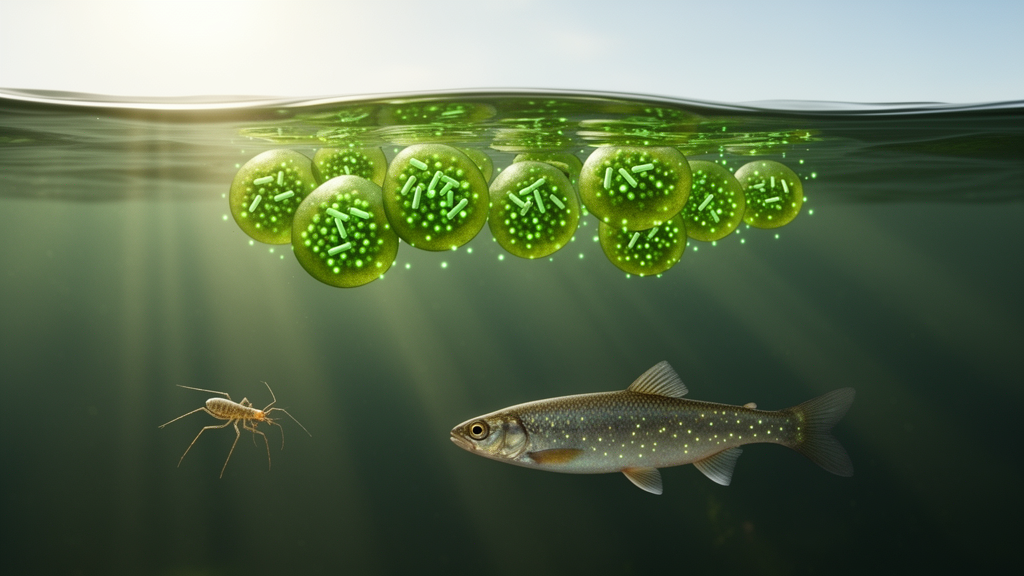
To probe that fate, researchers at Embrapa Environment and São Paulo State University designed a two-step experiment tracing nATZ-PCL through a simplified freshwater food chain, from the microalga Raphidocelis subcapitata, a standard ecotoxicological test species and primary producer, to the water flea Daphnia magna, a grazing zooplankter that feeds on algae. The team first characterized the nanoparticles using dynamic light scattering, finding a mean hydrodynamic diameter of 226 nanometers, a low polydispersity index of 0.12, and a negative zeta potential of about minus 25 millivolts, all signs of a relatively homogeneous and physically stable suspension. Encapsulation efficiency, established in earlier work, was high at roughly 86.7 percent, meaning most of the atrazine was locked inside the polymer matrix rather than floating free in solution.
Stability, however, proved to be matrix-dependent. When the nanoparticles were suspended in the algal culture medium, their hydrodynamic diameter and polydispersity index climbed steadily over seven days, a signature of aggregation or surface interactions driven by the ionic composition of the medium and possibly by the formation of an abiotic eco-corona, a coating of natural organic molecules that adsorbs onto nanoparticle surfaces and reshapes their biological identity. Natural organic matter, or NOM, is ubiquitous in real water bodies, and the researchers included it at an environmentally relevant concentration of 10 milligrams per liter using Suwannee River humic substances. In most other test media the formulation remained comparatively stable, but the progressive growth of particle size in the algal medium hinted that clumping could alter how much herbicide actually reaches algal cells.
Exposure concentrations were anchored to sublethal effect levels determined in previous toxicity work: the EC10 and EC25, the concentrations causing 10 and 25 percent growth inhibition in the alga. Without NOM these were 0.040 and 0.103 milligrams per liter; with NOM they dropped to 0.020 and 0.043 milligrams per liter, indicating that organic matter itself modulates toxicity. Algae were exposed for seven days under controlled conditions, then harvested, washed, freeze-dried, and analyzed for atrazine using a micro-QuEChERS extraction protocol coupled to high-performance liquid chromatography with diode-array detection. Because each two-liter culture yielded only about 100 to 150 milligrams of dry biomass, the team had to repeat the cultures twelve times to accumulate enough material for reliable chemical quantification, a logistical feat that underscores how demanding nanopesticide bioaccumulation studies can be.
The results were clear: Raphidocelis subcapitata did accumulate atrazine. Measured concentrations in exposed algal biomass ranged from 0.25 to 0.89 micrograms per gram, with the highest value, roughly 0.89 micrograms per gram, recorded under the EC25 condition without natural organic matter, significantly above all other treatments. When NOM was present at EC25, accumulation fell to about 0.33 micrograms per gram, consistent with the idea that organic molecules adsorbing onto nanoparticle surfaces form an eco-corona that alters colloidal behavior and reduces bioavailability to algal cells. A control centrifugation assay ruled out a mundane artifact: no visible nanoparticle pellet formed when clean nATZ-PCL suspensions were spun under the same conditions used to harvest algae, so the detected atrazine was not simply co-sedimenting nanoparticles masquerading as cellular uptake, although the authors note the measured residue may include both internalized herbicide and strongly associated particles that washing could not remove.
The critical question came next: would that algal burden travel up the food web? To find out, the researchers fed Daphnia magna with the nATZ-PCL-exposed algae at a standardized density of four million cells per milliliter for 48 hours, followed by a 24-hour depuration period in clean medium. In a parallel experiment, daphnids were exposed directly to nATZ-PCL in reconstituted water at their own species-specific EC10 and EC25 values of 2.05 and 5.69 milligrams per liter. Pooled daphnid samples were analyzed first by liquid chromatography and then, to push sensitivity further, by high-resolution LC-QTOF mass spectrometry targeting the protonated atrazine ion at mass-to-charge ratio 216.1016. The verdict was unambiguous: atrazine was not detected above the method detection limit of 0.373 micrograms per gram in any dietary or direct exposure treatment.
Several non-exclusive mechanisms could explain this apparent decoupling of bioaccumulation from trophic transfer. The aggregation observed in the algal medium may have reduced the bioavailability of the nanoparticles to both producer and consumer. Daphnia’s limited assimilation efficiency for engineered nanomaterials, documented in earlier studies, may have prevented meaningful uptake from the gut. Rapid depuration is another candidate; previous work on conventional atrazine shows that uptake steady states in algae and Daphnia are reached within hours, while elimination occurs within minutes for algae and hours for microcrustaceans, leaving little time for residues to build up. The researchers also suggest that nATZ-PCL particles may simply have adhered to the daphnids’ carapace and swimming appendages rather than being absorbed, and that the small daphnid biomass available limited analytical sensitivity, meaning trace transfer below the detection limit cannot be excluded. The authors are careful to stress that their experiments identify the absence of measurable transfer without pinpointing which mechanism dominates.
The broader significance of the study lies in what it says about how we assess nanopesticide risk. For conventional hydrophobic pollutants and metals, bioaccumulation at the base of a food web is often a red flag for biomagnification up the chain. This work demonstrates that the same logic cannot be automatically applied to nanostructured formulations: accumulation in primary producers does not necessarily translate into efficient transfer to consumers, because aggregation state, eco-corona formation, bioavailability, assimilation efficiency, and toxicokinetics all intervene at each step. Earlier work by some of the same group had already found no significant adverse effects in Daphnia following trophic exposure to nanoatrazine, and the new data reinforce that picture. At the same time, the team cautions that real freshwater food webs involve far more species, greater ecological complexity, and concomitant exposure to transformed nanoparticles and other pollutants, all of which limit generalization from a single producer-consumer pair tested in the laboratory.
There is also a regulatory gap. Despite the rapid growth of nanopesticide products, no internationally accepted framework yet exists for evaluating their environmental risks, and laboratory toxicity data from a handful of model species remain a fragile basis for protecting the enormous diversity of freshwater life. The authors call for longer, more elaborate trophic-chain protocols, in situ physicochemical characterization of nanoparticles throughout exposure, and toxicokinetic studies across multiple trophic levels to determine whether the apparent containment of nanoatrazine at the producer level holds under field-realistic conditions. For now, the message is twofold: nanoencapsulation may genuinely curb the movement of a persistent herbicide through aquatic food webs, but proving that promise will require watching not just where the particles go, but what they become along the way.
Subject of Research: Bioaccumulation and trophic transfer of polymeric nanoencapsulated atrazine in a freshwater algae-zooplankton food chain
Article Title: Decoupling bioaccumulation and trophic transfer: nanoatrazine accumulates in microalgae but shows limited transfer to zooplankton
Article References: Braga, A. P. A., Vallim, J. H., Mendes, M. D. L., Levanteza, V. O., Assalin, M. R., Tavares, M. M., Fraceto, L. F., do Espírito Santo Pereira, A., & de Castro, V. L. S. S. (2026). Decoupling bioaccumulation and trophic transfer: nanoatrazine accumulates in microalgae but shows limited transfer to zooplankton. Environmental Monitoring and Assessment, 198(9), Article 1021. https://doi.org/10.1007/s10661-026-15831-y
Image Credits: AI Generated
DOI: 10.1007/s10661-026-15831-y
Keywords: nanopesticides, atrazine, bioaccumulation, trophic transfer, Raphidocelis subcapitata, Daphnia magna, aquatic food web, nanoecotoxicology, polymer nanoparticles, natural organic matter, freshwater ecosystems, environmental monitoring
Cite Scienmag News
Gavin Prescott. (October 18, 2026). Nanoatrazine Builds Up in Algae but Barely Moves Up the Aquatic Food Chain. Scienmag. https://scienmag.com/nanoatrazine-builds-up-in-algae-but-barely-moves-up-the-aquatic-food-chain/
Gavin Prescott. "Nanoatrazine Builds Up in Algae but Barely Moves Up the Aquatic Food Chain." Scienmag, 18 October 2026, https://scienmag.com/nanoatrazine-builds-up-in-algae-but-barely-moves-up-the-aquatic-food-chain/. Accessed 18 October 2026.
Gavin Prescott. "Nanoatrazine Builds Up in Algae but Barely Moves Up the Aquatic Food Chain." Scienmag. October 18, 2026. https://scienmag.com/nanoatrazine-builds-up-in-algae-but-barely-moves-up-the-aquatic-food-chain/


