


Roughly 20 million years ago, the southern tip of South America was cloaked in dense, humid forests dominated by southern beeches, podocarps and tree ferns. Two million years later, those same forests were being joined by palms, hollies and other warmth-loving plants that had vanished from high latitudes during an earlier cold snap. Now, a detailed analysis of fossil spores and pollen grains from south-western Patagonia has captured this botanical transformation in remarkable detail, revealing that plant diversity rose by nearly 50 percent well before the peak of Miocene warming arrived.
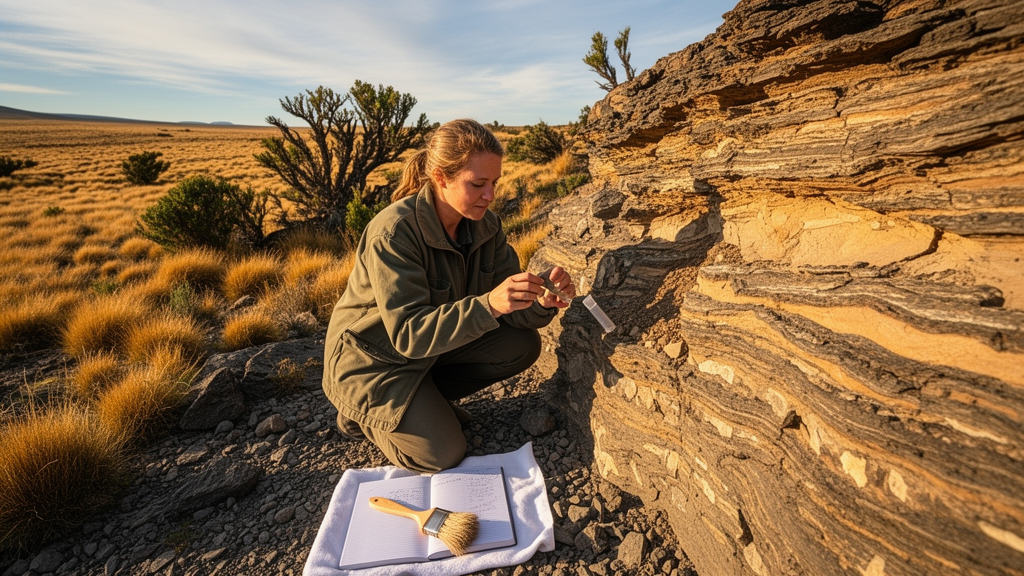
The findings, published in the Swiss Journal of Palaeontology, come from the El Chacay Formation, a roughly 170-metre-thick succession of marine and estuarine sediments exposed along the north-western border of the Belgrano Plateau in Santa Cruz Province, Argentina. The unit was deposited between approximately 20.3 and 18.1 million years ago during the early Burdigalian stage of the Early Miocene, a fact established through strontium isotope dating of calcitic oyster shells. This interval is particularly significant because it sits between two major climatic events: the glaciations of the Oligocene-Miocene Transition around 23 million years ago, and the Miocene Climatic Optimum, a prolonged warm phase between 17 and 15 million years ago.
Lead author and colleagues recovered fossil spores and pollen grains from eighteen samples collected from the El Chacay Formation and the overlying fluvial deposits of the Santa Cruz Formation. Twelve samples proved productive, yielding a total of 73 distinct morphotypes including one bryophyte, 24 pteridophytes, 15 gymnosperms and 33 angiosperms. Of these, 67 could be assigned to extant families, providing a direct link between the ancient vegetation and modern plant lineages. The assemblages were well to moderately well preserved, though some levels contained fewer than 100 specimens.
The lower assemblage, dating to around 20 million years ago, preserved comparable proportions of ferns, gymnosperms and angiosperms. Ferns were dominated by arboreal forms, primarily tree ferns of the families Cyatheaceae and Dicksoniaceae, while terrestrial and epiphytic taxa such as Blechnaceae and Osmundaceae were also recorded. Gymnosperms were predominantly represented by Podocarpaceae, with minor contributions from Araucariaceae. Amongst angiosperms, Nothofagaceae, the southern beeches, were the most abundant family, while numerous other families appeared only in trace amounts. Marine palynomorphs accounted for less than 8 percent of the total counts, primarily including prasinophyte algae and dinoflagellate cysts diagnostic of nearshore to estuarine conditions.
The upper assemblage, corresponding to approximately 19 to 18 million years ago, tells a rather different story. Ferns declined significantly from about 30.5 percent to 13.1 percent, while seed plants increased, particularly angiosperms which rose from 34.5 percent to 50.2 percent. Amongst gymnosperms, Podocarpaceae remained important but Araucariaceae increased notably from less than 3 percent to about 11.2 percent, and Ephedraceae appeared at roughly 4.6 percent. Amongst angiosperms, Nothofagaceae remained dominant but Amaranthaceae emerged as a secondary contributor at about 12 percent. Crucially, numerous other families appeared at low abundances, including Anacardiaceae, Aquifoliaceae, Arecaceae, Asteraceae, Convolvulaceae, Cyperaceae, Fabaceae, Gunneraceae, Malvaceae, Myrtaceae, Onagraceae, Poaceae, Proteaceae, Restionaceae, Sapindaceae, Typhaceae and Violaceae.
To quantify the floristic shift, the researchers applied the Hill numbers framework, estimating richness and diversity using both asymptotic analysis and coverage-based rarefaction standardised to a maximum coverage of 99.6 percent. The results are striking. Asymptotic richness estimates suggest approximately 88 species in the upper assemblage compared to roughly 56 in the lower, while rarefied richness yields 80.34 species in the upper and only 54.40 in the lower. This difference indicates an increase of approximately 48 percent in estimated richness towards the younger strata. Sample completeness for richness was lower in the upper section at 79 percent versus 88 percent in the lower, implying that rarer taxa went undetected in the younger assemblage, with approximately 18 undetected species versus 7 in the older interval.
In contrast, Shannon diversity, which reflects the number and evenness of relatively common species, was remarkably similar between the two assemblages, with asymptotic values of 20.99 in the lower and 21.67 in the upper. Likewise, Simpson diversity, which emphasises dominant taxa, showed minimal change between the two intervals. These findings suggest that while the number of rare taxa increased notably in the upper assemblage, the structure of common and dominant taxa remained relatively stable over time. The increase in richness was therefore primarily driven by the accumulation of low-abundance species, without major shifts in the dominance or evenness of the palynological assemblage.
A non-metric multidimensional scaling analysis of the seven most productive samples further supported the differentiation in floral composition between the lower and upper sections. Samples from the lower part of the formation exhibited tight clustering defined by an exclusive and predominant association of humid-demanding tree ferns, terrestrial ferns, southern beeches and podocarps, indicating wetter palaeoenvironmental conditions. Conversely, the majority of samples from the upper part of the unit clustered separately, indicating a clear floristic association with podocarps and southern beeches augmented by the presence of cycads, Fabaceae, Ilex, Typhaceae, Ephedraceae, grasses, Amaranthaceae and palms, suggesting a transition to warmer, drier and more open conditions.
The re-appearance of warmth-demanding taxa with predominantly tropical and subtropical current distributions, such as Cupania, Ilex and Arecaceae, is particularly significant. These lineages had severely declined from high latitudes during the cooling trend of the Oligocene-Miocene Transition around 23 million years ago. Their resurgence coincides with the rise in standardised richness and mirrors independent isotopic evidence from south-eastern Patagonian marine shells showing that average sea surface temperatures rose from 15 to 20 degrees Celsius across the early Burdigalian, from approximately 19.3 to 17.5 million years ago. A similar ascending trend in richness of about 40 percent has been detected in other Lower Miocene Patagonian sections, from the Río Leona Formation to the slightly younger upper part of the Monte León Formation.
Notably, the researchers observed an increase in Amaranthaceae and Ephedra pollen in the younger assemblage, alongside minor amounts of other drought-tolerant shrubs such as Anacardiaceae. These taxa indicate the local presence of shrubby steppe or dry woodland environments by the late Early Miocene. Their co-existence with abundant forest pollen suggests a mosaic landscape of extensive wet forests interspersed with more open, seasonally dry patches, potentially reflecting increasing rainfall seasonality or the development of rain-shadowed areas due to Andean orogeny. While closed-canopy forests still dominated the region, the Burdigalian marks the early increase of Patagonian open vegetation elements that would later expand. The persistence of core Gondwanan lineages, including southern beeches, podocarps, araucarias and winteraceous shrubs, throughout both sections emphasises their resilience and adaptability. Overall, the record demonstrates that high southern latitudes experienced a warming trend approximately 2 million years prior to the Miocene Climatic Optimum, documenting the southward expansion of plant taxa that today have tropical to subtropical distributions and no longer occur at these southern Patagonian latitudes.
Subject of Research: Palynological evidence for floristic turnover and rising diversity in the early Burdigalian of south-western Patagonia (Argentina)
Article Title: Palynological evidence for floristic turnover and rising diversity in the early Burdigalian of south-western Patagonia (Argentina)
Article References: Tapia, M. J., Cuitiño, J. I., Ottone, E. G., Guler, M. V., Barreda, V. D., & Palazzesi, L. (2026). Palynological evidence for floristic turnover and rising diversity in the early Burdigalian of south-western Patagonia (Argentina). Swiss Journal of Palaeontology, 145, 131-144. https://doi.org/10.3897/sjp.145.179108
Image Credits: AI Generated
Keywords: Palynological, evidence, floristic, turnover, rising, diversity, early, Burdigalian, south-western, Patagonia, Argentina, scientific research
Cite Scienmag News
Gavin Prescott. (October 18, 2026). Patagonian pollen reveals plant diversity surging before Miocene warming peak. Scienmag. https://scienmag.com/patagonian-pollen-reveals-plant-diversity-surging-before-miocene-warming-peak/
Gavin Prescott. "Patagonian pollen reveals plant diversity surging before Miocene warming peak." Scienmag, 18 October 2026, https://scienmag.com/patagonian-pollen-reveals-plant-diversity-surging-before-miocene-warming-peak/. Accessed 18 October 2026.
Gavin Prescott. "Patagonian pollen reveals plant diversity surging before Miocene warming peak." Scienmag. October 18, 2026. https://scienmag.com/patagonian-pollen-reveals-plant-diversity-surging-before-miocene-warming-peak/


