


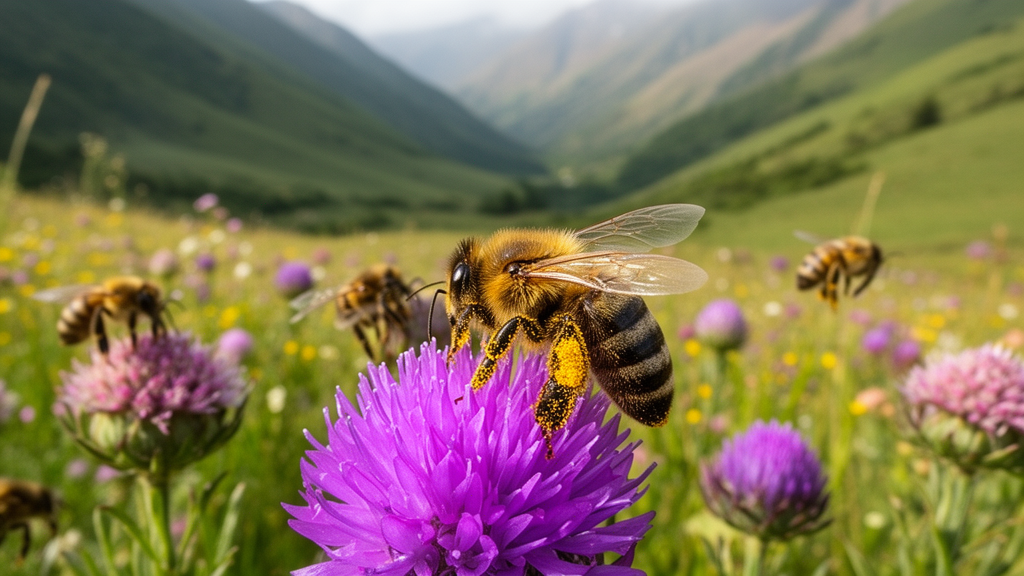
In the mountains and valleys of Chile, a quiet ecological coup has been unfolding for decades. Three introduced bee species — the European honeybee Apis mellifera and two bumblebees, Bombus ruderatus and Bombus terrestris — have woven themselves so deeply into the country’s plant-pollinator networks that they now dominate the recorded interactions between flowers and their insect visitors. A new analysis, published in the journal NeoBiota, draws on more than 2,100 interaction records from scientific literature and citizen-science databases to show that the most recent arrival, Bombus terrestris, accounts for roughly 73 percent of all documented interactions between invasive bees and plants in Chile, and that its spread has measurably restructured the architecture of the country’s pollination networks.
Chile is an unusually good natural laboratory for this kind of study. The Andes Mountains, the Atacama Desert and the Pacific Ocean together isolate the country’s biota much like an island, and island ecosystems are notoriously vulnerable to invaders. The honeybee arrived first, in 1848, brought for honey production and crop pollination. Bombus ruderatus followed in 1982, imported to pollinate red clover. Then, in 1997, Bombus terrestris was introduced for greenhouse tomato pollination; by 2000 it was being deployed in open fields, and it has since spread across Chile and into parts of Argentina. The invasion is actively reinforced: more than 60,000 new individuals are imported every year for pollination services, giving the species a constant demographic boost that few naturalised animals enjoy.
To map the scale of the takeover, the researchers compiled two datasets. The first drew exclusively on scientific literature, cataloguing every bee-plant interaction recorded in central and southern Chile. The second merged that literature database with citizen-science records, including observations from the iNaturalist project Red Chilena de Polinización, in which volunteers across the country were encouraged — and rewarded — for documenting pollinator visits. Combining the two sources yielded 2,164 plant-invasive pollinator interactions spanning 89 plant families, from the sunflower family Asteraceae, which alone accounted for 453 interactions, to Lamiaceae, Fabaceae and Rosaceae.
The numbers tell a stark story of ecological dominance. Bombus terrestris was recorded visiting 301 plant species, more than double the 148 species visited by the honeybee and nearly five times the 64 species visited by Bombus ruderatus. All three bees showed low specialisation, meaning they visit flowers opportunistically rather than co-evolving with particular plants, but Bombus terrestris was the least specialised of all, with a specialisation index of just 0.084 on a scale where zero indicates a pure generalist. Strikingly, about 75 percent of the plant species these bees visited were themselves non-native, suggesting that the invaders and the exotic flora are reinforcing one another — a dynamic ecologists call invasional meltdown, in which introduced species facilitate each other’s establishment and spread.
To assess what changed when Bombus terrestris arrived, the team used 2005 as a temporal dividing line, five years after the species first escaped into open fields and began its nationwide expansion. They built bipartite interaction networks — one for the period before 2005, one for after — and calculated a battery of standard network metrics: nestedness, which measures how specialists interact with subsets of the partners used by generalists; modularity, which captures how the network splits into distinct subgroups; specialisation, which quantifies how selectively species pair up; and core-periphery structure, which distinguishes a densely connected core of species from a sparsely connected periphery. Significance was tested against null models built from 1,000 randomisations that preserved the number of interactions and the overall connectance of each network.
Before 2005, the literature recorded 54 bee species interacting with 109 plant species, and the native bumblebee Bombus dahlbomii — the giant of South American bumblebees — sat at the centre of the web. It had the highest normalised degree, a standardised measure of the number of links per species, at 0.44, and also the highest betweenness centrality, meaning it acted as the primary connector between different parts of the network. After 2005, the network grew to 90 bee species and 112 plant species, but the hierarchy had shifted. The honeybee took over as the most connected and most central species, with a normalised degree of 0.56 and betweenness of 0.348, while Bombus dahlbomii slipped to second place. Bombus terrestris, which before 2005 had been recorded only once and was technically the most specialised pollinator in the dataset by virtue of that single record, saw its normalised degree rise nearly six-fold and its specialisation fall by a factor of three.
The topology of the network itself changed in telling ways. Nestedness and overall specialisation both increased after 2005, although both remained low in absolute terms, while modularity showed no significant change. The core-periphery index, which was 0.760 before the invasion, dropped to 0.680 afterwards — a sign that the tightly organised core of co-evolved interactions was loosening. The most connected plant species also changed hands: early records centred on native species such as Phacelia secunda, Stachys albicaulis and Adesmia conferta, whereas the post-2005 network revolved around Alstroemeria ligtu, the cactus Echinopsis chiloensis and the tree Eucryphia cordifolia. The researchers caution that this shift partly reflects sampling biases, since many Chilean studies focus on native plants and relatively pristine ecosystems, but the overall pattern of restructuring is consistent.
What makes these findings consequential beyond Chile is the mechanism they reveal. Generalist invaders thrive in modified habitats precisely because they are flexible, and their success can crowd out the specialists and endemic species that make biodiversity hotspots distinctive. As the invasive bees increasingly visit non-native plants, they boost the reproduction and spread of those exotics, which in turn offer more resources to the invaders — a feedback loop that pushes the whole system toward biotic homogenisation. The honeybee’s rise to network centrality illustrates the same dynamic at work: a species introduced more than a century and a half ago for agriculture has become, in the researchers’ dataset, the single most influential node in the country’s pollination web, competing for floral resources with native bees whose populations it can depress.
There is an agricultural irony embedded in the story. These bees were brought in to improve crop yields, and they do pollinate commercial crops, but excessive abundance of managed pollinators can ultimately harm plant reproduction more broadly, including in agricultural settings. The net effect is a trade-off that Chile, like many countries, has yet to resolve: the same species that support tomato greenhouses and red clover fields are eroding the mutualistic scaffolding that sustains native flora. The authors argue that safeguarding biodiversity hotspots demands early detection, science-based management, and policies that weigh the full ecological cost of pollinator introductions against their narrow agricultural benefits — and that the continued annual importation of Bombus terrestris deserves particular scrutiny.
The study also demonstrates the growing power of citizen science in invasion ecology. By pooling volunteer observations from iNaturalist with decades of published literature, the researchers achieved a geographic coverage — from the Atacama Desert through the Mediterranean-type region to temperate forests — that no conventional research project could match. That breadth matters, because invasive pollinators do not respect reserve boundaries, and the same generalist species now documented reshaping Chilean networks are established or expanding on every continent except Antarctica. As the authors put it, the takeover has been silent but profound: no single collapse announced the change, yet the cumulative rewiring of who pollinates what has quietly redrawn one of the world’s great biodiversity hotspots from the inside out.
Subject of Research: Impacts of invasive bee species on plant-pollinator interaction networks in Chile
Article Title: Silent takeover: How invasive bees reshaped plant-pollinator interactions in a biodiversity hotspot
Article References: Marinho, R. C., Guimarães, B. M. D. C., Carvallo, G. O., Maruyama, P. K., Murúa, M. M., Rech, A. R., Vieli, L., Oliveira, P. E., & Fontúrbel, F. E. (2026). Silent takeover: How invasive bees reshaped plant-pollinator interactions in a biodiversity hotspot. NeoBiota, 105, 259-274. https://doi.org/10.3897/neobiota.105.174573
Image Credits: AI Generated
DOI: 10.3897/neobiota.105.174573
Keywords: invasive bees, Bombus terrestris, pollination networks, Chile, biodiversity hotspot, biological invasions, Bombus dahlbomii, Apis mellifera, citizen science, ecological networks, biotic homogenisation, network ecology
Cite Scienmag News
Margaret Porter. (October 18, 2026). Invasive bees quietly rebuild pollination networks in Chile’s biodiversity hotspot. Scienmag. https://scienmag.com/invasive-bees-quietly-rebuild-pollination-networks-in-chiles-biodiversity-hotspot/
Margaret Porter. "Invasive bees quietly rebuild pollination networks in Chile’s biodiversity hotspot." Scienmag, 18 October 2026, https://scienmag.com/invasive-bees-quietly-rebuild-pollination-networks-in-chiles-biodiversity-hotspot/. Accessed 18 October 2026.
Margaret Porter. "Invasive bees quietly rebuild pollination networks in Chile’s biodiversity hotspot." Scienmag. October 18, 2026. https://scienmag.com/invasive-bees-quietly-rebuild-pollination-networks-in-chiles-biodiversity-hotspot/


