


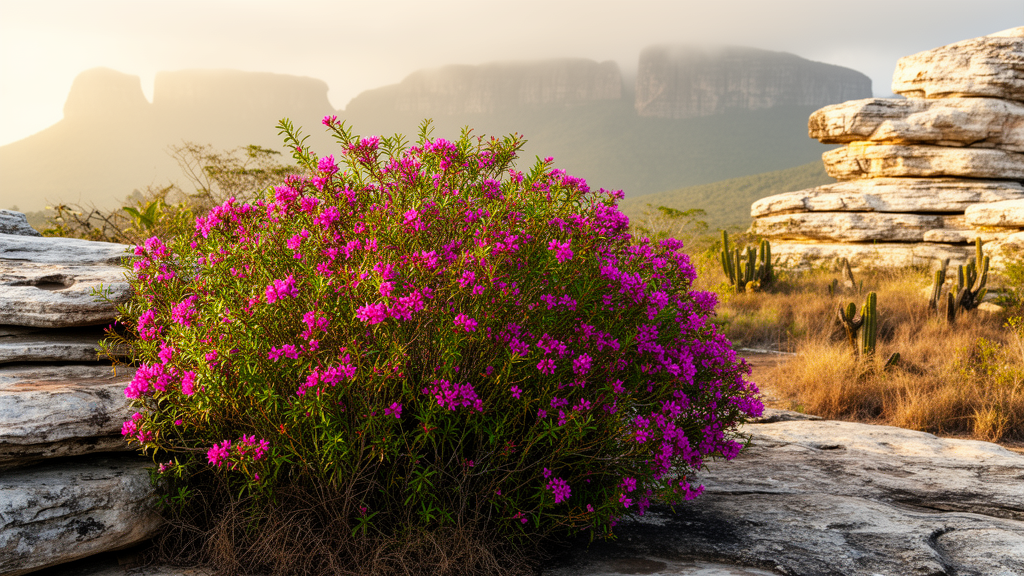
A striking new plant species with vivid magenta petals has been discovered clinging to the quartzite ridges of Brazil’s Chapada Diamantina, and its formal description is shining a fresh spotlight on one of the most botanically rich yet underexplored landscapes in South America. The species, named Microlicia almedae, belongs to the family Melastomataceae and was collected during December 2025 field expeditions to remote corners of the Chapada Diamantina in the state of Bahia. Published in the journal PhytoKeys, the study combines traditional taxonomy with modern shape-analysis methods to demonstrate that the new shrub is genuinely distinct from its closest known relatives, both of which are also confined to this singular mountainous region.
The genus Microlicia, which was recently expanded by phylogenetic analyses to absorb species formerly placed in the genera Chaetostoma, Lavoisiera, Stenodon, and Trembleya, now comprises roughly 300 species. Botanists recognize members of the genus by their woody habit and diplostemonous flowers, meaning the flowers carry two complete whorls of stamens. The stamens range from identical in form to clearly dimorphic, with anthers that may be tetrasporangiate or polysporangiate and that bear short rostra, usually less than one millimeter long. The fruits are capsules that split open from either the apex downward or the base upward, and the genus maintains a base chromosome number of x = 12. Remarkably, more than 90 percent of Microlicia species are endemic to Brazil, where they inhabit the campo rupestre grasslands and Cerrado ecosystems of the Espinhaço mountain chain and the Brazilian Central Plateau. Only a handful of species spill over into Bolivia, Colombia, Guyana, Peru, and Venezuela.
The Chapada Diamantina in central Bahia holds a special place in this story. The region is recognized as a distinct biogeographic province and stands out as a major center of endemism for Microlicia. Intensified research in recent years has yielded a cascade of newly described narrow endemics, and each discovery underscores that the region’s botanical inventory remains incomplete. That incomplete picture, researchers argue, strengthens the case for urgently protecting Bahian campo rupestre sites, which face mounting pressures even within nominally protected landscapes. It was precisely in underexplored areas of the Chapada that the December 2025 expeditions encountered specimens that could not be matched to any previously described taxon, setting in motion the formal description of Microlicia almedae.
The new species is an openly branched, erect shrub standing between 0.6 and 1.5 meters tall. Its branchlets are nearly cylindrical and sparsely glandular-punctate, dotted with tiny resinous glands, with thickened nodes and unwinged stem angles. The sessile, imbricate leaves are ovate to elliptic-ovate, measuring 8.9 to 11.8 millimeters long and 5.9 to 7.3 millimeters wide, light green and concolored when fresh but turning brownish on drying. Both leaf surfaces carry glandular punctations, and the margins are inconspicuously serrulate and fringed with gland-tipped trichomes. The flowers are five-merous and clustered at the branch tips, with campanulate, reddish hypanthia densely clothed in stout gland-tipped trichomes, narrowly lanceolate calyx lobes reaching 7.6 to 9.5 millimeters in length, and showy magenta petals 18 to 25 millimeters long.
Perhaps the most visually captivating features of Microlicia almedae are its dimorphic stamens. The larger, antesepalous stamens bear dark purple, corrugated, polysporangiate anthers with magenta filaments and magenta pedoconnectives tipped with appendages whose apices flash yellow. The smaller, antepetalous stamens carry yellow thecae on magenta filaments with entirely yellow appendages. The superior, three-locular ovaries give way at maturity to subovoid, pale-brown, three-valved capsules that dehisce from the apex to the base, and the columellae, the central columns within the fruit, are deciduous, falling away as the capsule opens. The seeds are minute, roughly 0.6 millimeters long, oblong-reniform, and foveolate in surface texture.
Distinguishing a genuinely new species from its close relatives requires careful comparison, and here the authors laid out a suite of diagnostic characters. Microlicia almedae differs from Microlicia giuliettiana and Microlicia pulchra in leaf shape and size, in the indumentum of the hypanthium, in the shape and size of the calyx lobes, and in petal size. Its hypanthia are covered with gland-tipped trichomes, whereas both relatives have glabrous hypanthia. Its calyx lobes are elongated at 7.6 to 9.5 millimeters, compared with roughly 4 millimeters in M. giuliettiana and 3.5 to 5 millimeters in M. pulchra, and its petals are far larger than those of either relative. Beyond these traits, the new species can be separated from M. giuliettiana by its uniformly magenta petals, in contrast to the pink petals with a red band on the right side seen in that species, and from M. pulchra by its capsules with deciduous rather than persistent columellae.
To put those comparisons on firmer quantitative footing, the team turned to elliptic Fourier analysis, a morphometric technique that converts leaf outlines into series of x–y coordinates and describes their geometry through Fourier coefficients, which are then summarized by principal component analysis. The researchers analyzed high-resolution images of ten fully expanded leaves below the third node from each of the three species, converting the silhouettes to binary format and processing them in the R statistical environment with the Momocs package. Before analysis, they removed asymmetric variation between the right and left sides of the leaves. The approach has been widely applied to quantify leaf shape across many plant groups, including Melastomataceae, making it a well-tested tool for this kind of species delimitation problem.
The results were striking. The first three principal components together explained 97.38 percent of the variation in leaf shape. The first component, accounting for 72.3 percent of the total, captured leaf width from narrow to broad; the second, at 23 percent, captured apex shape from broadly acute to acuminate; and the third, at 2 percent, distinguished leaves that are broader toward the base from those broader toward the apex. When the data were grouped by species in the two-dimensional morphospace, the three taxa showed nearly complete separation. Narrow-leaved M. pulchra was the most distinctive, sharing no area in morphospace with the other two species, while M. almedae occupied an intermediate position between it and the broad-leaved M. giuliettiana, with only a very small zone of overlap between the latter two on the first two components. Plotting the first against the third component separated M. almedae from M. giuliettiana entirely, with the new species broader toward the leaf base and its relative broader toward the apex. The mean shapes told the same story: elliptic-ovate to ovate leaves for M. almedae, broadly ovate to orbicular leaves for M. giuliettiana, and narrowly elliptic leaves for M. pulchra.
The species is known only from three localities, Serra do Barbado, Pico da Lapa Grande, and Campo do Bicota, in the municipalities of Abaíra and Rio do Pires within the Chapada Diamantina. It grows in full-sun campo rupestre at elevations of roughly 1,430 to 1,825 meters and was recorded flowering in November and December with fruiting in December. Using the GeoCAT tool with two-square-kilometer grid cells, the authors calculated an extent of occurrence of 2,511 square kilometers and an area of occupancy of just 12 square kilometers, values that support a preliminary assessment of Endangered under criterion B of the IUCN Red List. All known populations fall within the Área de Proteção Ambiental da Serra do Barbado, an environmental protection area that, while permitting certain land uses and economic activities, still provides an important safeguard for the new species and the many other narrowly endemic plants sharing its dramatic quartzite habitat.
The species name honors Dr. Frank Almeda, Senior Curator Emeritus of the botany department at the California Academy of Sciences in San Francisco, a globally recognized expert on Melastomataceae whose contributions to plant systematics include extensive work on the Brazilian flora and the tribe Lavoisiereae, and who has been a generous mentor and collaborator to researchers worldwide. For the broader scientific community, the discovery carries a double message. It demonstrates how quantitative morphometrics can sharpen the boundaries between superficially similar species, and it reinforces that the campo rupestre of Bahia still conceals undocumented biodiversity in its rocky fastnesses. Every new narrow endemic described from this region adds urgency to conservation planning, because species restricted to a few square kilometers of mountaintop habitat have little margin for error in a changing world.
Subject of Research: Taxonomic description and morphometric delimitation of a new plant species, Microlicia almedae, from the campo rupestre of Chapada Diamantina, Brazil
Article Title: Microlicia almedae ( Melastomataceae ), a new species from the Chapada Diamantina, Bahia, Brazil
Article References: Pacifico, R., & Kriebel, R. (2026). Microlicia almedae (Melastomataceae), a new species from the Chapada Diamantina, Bahia, Brazil. PhytoKeys, 276, 183-195. https://doi.org/10.3897/phytokeys.276.193021
Image Credits: AI Generated
DOI: 10.3897/phytokeys.276.193021
Keywords: Microlicia, Melastomataceae, Chapada Diamantina, campo rupestre, new species, Bahia, Brazil, elliptic Fourier analysis, plant taxonomy, endemism, conservation, biodiversity
Cite Scienmag News
Margaret Porter. (October 18, 2026). New magenta-flowered shrub revealed as hidden gem of Brazil’s Chapada Diamantina. Scienmag. https://scienmag.com/new-magenta-flowered-shrub-revealed-as-hidden-gem-of-brazils-chapada-diamantina/
Margaret Porter. "New magenta-flowered shrub revealed as hidden gem of Brazil’s Chapada Diamantina." Scienmag, 18 October 2026, https://scienmag.com/new-magenta-flowered-shrub-revealed-as-hidden-gem-of-brazils-chapada-diamantina/. Accessed 18 October 2026.
Margaret Porter. "New magenta-flowered shrub revealed as hidden gem of Brazil’s Chapada Diamantina." Scienmag. October 18, 2026. https://scienmag.com/new-magenta-flowered-shrub-revealed-as-hidden-gem-of-brazils-chapada-diamantina/


