


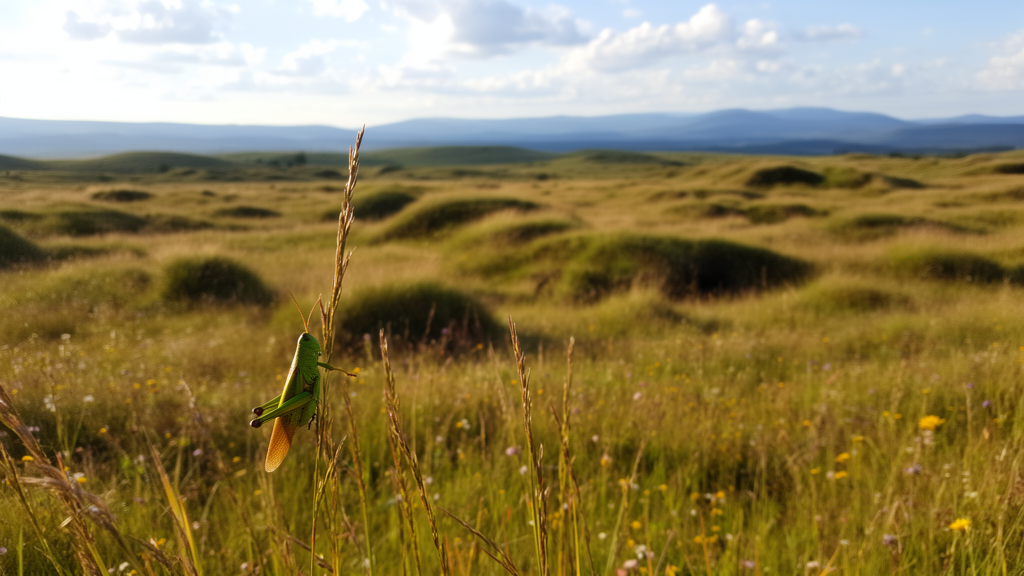
When farmland is abandoned to nature, the insects that move back in are not spread evenly across the land. A new study from southeastern England suggests that the shape of the ground itself — whether a field is flat or carved by slopes — can decide which grasshoppers and bush-crickets thrive, and how many of them there are. The research, published in the Journal of Orthoptera Research, monitored Orthoptera across rewilded arable fields at Arger Fen nature reserve in Suffolk and found that species diversity was significantly higher on steeper slopes, while individual species sorted themselves according to their own topographic preferences.
Rewilding, a conservation approach that gained its name in the 1980s, aims to restore self-willed ecosystems in which natural processes — including stochastic disturbance and the activity of wild grazers — operate with minimal human control. The classic formulation proposed by Soulé and Noss emphasized large protected cores, connecting corridors, and keystone carnivores, but modern European projects have broadened the idea to include the passive reversion of farmland. At Arger Fen, fields taken out of arable production between 2004 and 2014 were simply left alone: no fertilizer, no livestock during the study period, no active conservation management. Succession was allowed to run its course, converting former cropland into a mosaic of rough grassland and scrub.
The four study fields differed sharply in their terrain. Two were almost perfectly flat, with mean slope gradients of just 0.6 percent, while the other two sloped from very weak to moderately steep, reaching gradients of up to 10.9 percent and a vertical relief of 27 meters. All had been plowed and cropped before 2014, producing maturing grassland swards comparable to other ex-arable rewilding sites in Suffolk. The researchers walked 400-meter W-shaped transects through each field three times between May and August 2021, recording adult Orthoptera both visually and by ear, since stridulating males of most local species call at frequencies within human hearing range.
Six species were recorded, all widespread in Suffolk: the meadow grasshopper Pseudochorthippus parallelus, Roesel’s bush-cricket Roeseliana roeselii, the long-winged conehead Conocephalus fuscus, the field grasshopper Chorthippus brunneus, the lesser marsh grasshopper Chorthippus albomarginatus, and the dark bush-cricket Pholidoptera griseoaptera. Overall density reached 1,221 adult grasshoppers per hectare — more than five times the 234 adults per hectare recorded at Black Bourn Valley, a flatter rewilding site 30 kilometers to the north. The comparison hints that topographic variety itself may boost carrying capacity for these insects.
The statistical patterns were striking. There was strong evidence that C. brunneus, the field grasshopper, was far more abundant on slopes — it made up 27 percent of adult detections in sloping fields but only 1 percent in flat ones. The long-winged conehead showed the opposite pattern, strongly preferring flat ground, where tall coarse grasses such as cock’s-foot grow in the moist soil at the base of slopes. Species diversity, measured with the Shannon-Wiener index, was significantly higher in the sloping fields, and linear regression confirmed that species richness and diversity both increased with slope gradient, with very strong evidence for the diversity relationship.
What makes slopes so attractive to some species? The answer appears to lie partly in the activities of wild lagomorphs. Brown hares and rabbits grazed the sloping fields far more heavily than the flat ones — droppings and burrow excavations were both significantly denser on slopes, and regression showed very strong positive relationships between slope gradient and rabbit excavations. This grazing and digging created patches of exposed soil, which the field grasshopper needs for egg-laying and basking. Bare ground warms quickly in sunshine, offering the hot microclimates that grasshopper eggs and nymphs require for development.
The study also suggests an intriguing movement pattern. Nymphs of all species were more abundant in flat fields, yet adult C. brunneus concentrated on slopes. The authors propose that nymphs hatch on flatter ground and then move uphill as they mature, seeking out the lagomorph-grazed bare soil patches for oviposition — a lifecycle choreography shaped by the interaction between topography and wild grazing. Early-instar grasshoppers are known to favor short grassland near hatching sites before dispersing into taller swards as they develop.
Not every finding pointed the same way. The meadow grasshopper and Roesel’s bush-cricket showed moderate evidence of preferring flat ground, and the two bush-crickets that have expanded their British ranges northward with climate change — R. roeselii and C. fuscus — were early colonists of the flat post-arable grassland, where tall vegetation offers shelter and oviposition sites. Meanwhile, an unexpected player entered the story: ash dieback disease. In Hullback’s Grove, a small stand of ash saplings killed back by the fungus Hymenoscyphus fraxineus maintained an open mosaic of grass and scrub that would otherwise have shaded out as the canopy matured. All six Orthoptera species were detected in this diseased hillside patch, illustrating how stochastic natural disturbances — even devastating ones — can generate habitat heterogeneity that conservation managers would struggle to replicate.
The authors acknowledge limitations. Only two fields of each type were studied, the surveyor’s ear cannot detect the conehead’s ultrasonic 30-kilohertz call without equipment, and dropping counts may have been easier to spot in short grazed vegetation than in tall moist sward. Still, the combined visual-acoustic method detected all six species, and the technique is considerably less time-intensive than automated acoustic detectors for low-frequency callers.
The broader message is one for anyone planning a rewilding scheme: topography matters. Flat ex-arable land tends toward an open layer of fine-leaved grasses with a warm microclimate, but limited coarse grasses for feeding, whereas undulating terrain with slopes creates a patchwork of microclimates, soil drainage regimes, and vegetation structures. The authors postulate that rewilding schemes on arable land may be particularly effective when they incorporate topographic undulations — both flat areas and hillsides — to promote the greatest diversity of Orthoptera. At Arger Fen, the heathy acid grassland of the historic Leavenheath common, enclosed after 1817, appears to be re-establishing on the slopes, with the near-threatened annual common cudweed already returning. If that trajectory continues, the field grasshopper populations there — currently 542 to 700 adults per hectare on slopes — may climb toward the 1,500 to 3,100 adults per hectare seen on long-established heathland, a quiet testament to what happens when the land is simply allowed to be itself, bumps and all.
Subject of Research: Influence of topographic heterogeneity on Orthoptera diversity and abundance in a rewilding scheme on former arable land
Article Title: Topographic heterogeneity influences diversity and abundance of Orthoptera in a rewilding scheme
Article References: Gardiner, T., & Casey, D. (2024). Topographic heterogeneity influences diversity and abundance of Orthoptera in a rewilding scheme. Journal of Orthoptera Research, 33(2), 255-266. https://doi.org/10.3897/jor.33.119897
Image Credits: AI Generated
Keywords: rewilding, Orthoptera, grasshoppers, bush-crickets, topography, slope gradient, Arger Fen, Suffolk, lagomorph grazing, ash dieback, biodiversity, habitat heterogeneity
Cite Scienmag News
Margaret Porter. (October 18, 2026). Hills and hollows: why bumpy ground makes rewilded farmland buzz with grasshoppers. Scienmag. https://scienmag.com/hills-and-hollows-why-bumpy-ground-makes-rewilded-farmland-buzz-with-grasshoppers/
Margaret Porter. "Hills and hollows: why bumpy ground makes rewilded farmland buzz with grasshoppers." Scienmag, 18 October 2026, https://scienmag.com/hills-and-hollows-why-bumpy-ground-makes-rewilded-farmland-buzz-with-grasshoppers/. Accessed 18 October 2026.
Margaret Porter. "Hills and hollows: why bumpy ground makes rewilded farmland buzz with grasshoppers." Scienmag. October 18, 2026. https://scienmag.com/hills-and-hollows-why-bumpy-ground-makes-rewilded-farmland-buzz-with-grasshoppers/


