


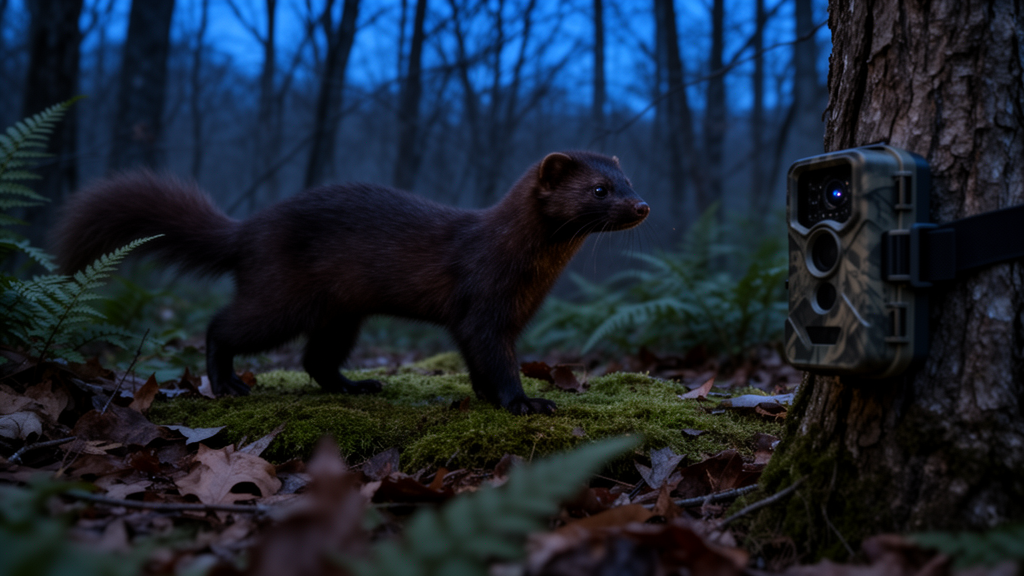
The fisher, a cat-sized forest mustelid once trapped nearly out of existence across North America, has long been treated as a conservation success story. After protective legislation, closed trapping seasons, and a series of reintroductions, the species reclaimed much of its historical range in the northeastern United States, and wildlife managers came to regard it as common and widespread. A new study from Connecticut, published in the journal Nature Conservation, challenges that comfortable assumption at the state level. Using an intensive network of motion-triggered cameras deployed across five winter field seasons between 2018 and 2023, researchers found that fishers occupy only a small fraction of the habitat they appear to roam, and that the population is strikingly thin in the western half of the state.
The research team, working with the Connecticut Department of Energy and Environmental Protection, laid out 59 hexagonal sampling units of 5 square kilometers each, studding the landscape with 354 cameras. Each unit held six cameras mounted 1.5 to 2 meters up on trees, aimed at bait trees lured with sardines, skunk essence, and a peppermint-anise curiosity scent. Surveys ran for 15 days in each unit, divided into three consecutive five-day periods, with cameras active around the clock and set to fire three-shot bursts. Every image was reviewed independently by at least two people and archived in a standardized photo database, producing rigorous detection histories that could feed directly into statistical models.
The results were sobering. Fishers turned up in 27 of the 59 sampled units, or 46 percent, but the detections were heavily skewed. In eastern Connecticut, fishers were recorded in 18 of 27 units, with cameras triggering in a third of all eastern camera locations. In the west, they appeared in only 9 of 32 units, and just 9 percent of total cameras registered a fisher. Most tellingly, the southwestern corner of the state produced no fisher detections at all. When the researchers mapped the findings using International Union for Conservation of Nature Red List guidelines, the extent of occurrence, the convex hull around all detection points, covered 7,069 square kilometers, or 77 percent of the sampled study area. But the area of occupancy, calculated on the standard 2 by 2 kilometer grid, amounted to just 176 square kilometers, meaning fishers were actually using only a small slice of the landscape their range map suggested.
To move beyond simple presence or absence, the team applied an occupancy modeling framework that separates two distinct questions: whether a species occupies a site, and how likely it is to be detected there if it does. The single-season analysis, run in program MARK with covariates standardized and models ranked by Akaike’s Information Criterion adjusted for small sample size, identified region as the best-supported covariate on occupancy. The model-averaged estimate of occupancy for the entire state was 0.546, but the regional split was dramatic. Eastern Connecticut showed an occupancy probability of 0.694, while western Connecticut lagged at 0.329. Detection rates followed the same pattern, at 0.657 in the east versus 0.475 in the west. In practical terms, fishers were 5.75 times more likely to occupy eastern units and 4.76 times more likely to be detected there.
The study also compared Connecticut’s fishers against a reference population in southern Vermont, where the species is considered abundant based on long-term harvest data. Using the Royle-Nichols model, which accounts for abundance-induced heterogeneity in detection probability, the researchers estimated mean density in 5 square kilometer units. Connecticut’s statewide estimate was 0.72, more than four times lower than Vermont’s 3.13. Within Connecticut, the east again outpaced the west, with density estimates of 1.31 versus 0.42. Because these estimates represent a single snapshot in time and rest on assumptions that can be strained by multi-year sampling, the authors interpreted them as relative comparisons rather than absolute counts, but the regional and interstate contrasts were consistent across every metric examined.
Why is the west so empty? The answer appears to be a combination of geography, history, and habitat. Fishers recolonized eastern Connecticut naturally from Massachusetts in the late twentieth century, and that connectivity presumably persists. Western Connecticut, by contrast, was cut off from natural recolonization routes. The Connecticut River and the Interstate 91 corridor, flanked by dense human development, form a barrier running through the center of the state, and fishers were absent from southern New York until a reintroduction into the Catskills between 1977 and 1979, limiting movement from the west. State biologists reintroduced 34 fishers to northwestern Connecticut between 1989 and 1991, but preliminary camera data from ongoing surveys in western Massachusetts hint at a latitudinal gradient of decreasing detection intensity from southern Vermont down through Massachusetts and into northwestern Connecticut, suggesting that even the northern connection may be weak.
Habitat variables added further texture. Percent conifer cover had a positive effect on occupancy, consistent with evidence that fishers preferentially use coniferous stands for resting and maternal denning when available, though conifer abundance could not explain the east-west divide because western Connecticut actually holds more conifer forest. Human disturbance, by contrast, had a negative effect, aligning with the lower occupancy in the developed southwest. Detection rates were also higher on public lands than private ones, which the authors attributed to the larger, more contiguous habitat blocks that public properties tend to contain, rather than to any behavioral avoidance of private land.
The study also probed how fishers interact with the other carnivores sharing Connecticut’s forests. Two-species co-occurrence models found no statistically supported spatial segregation between fishers and coyotes, bobcats, red foxes, or black bears; the species interaction factors clustered near one, indicating independent site use. Daily activity patterns told a different story. Fishers, foxes, and coyotes were strongly nocturnal, while bobcats and bears were more active in daylight, and overall activity overlap among the carnivore community was generally low, ranging from 0.344 to 0.629 on the Dhat4 overlap coefficient. The higher overlap between fisher and fox, fisher and coyote, and fox and coyote, at 0.774 to 0.787, reflects shared nocturnal habits, but the temporal separation between fishers and bobcats may reduce competition or predation risk in ways that occupancy models alone cannot capture.
The broader significance of the work lies in what it says about how wildlife agencies assess furbearer status. Connecticut opened a statewide trapping season for fishers in 2005, and harvests were initially high. Over the following 12 years, harvest dropped by 92 percent, catch per unit effort fell from four to less than one, and sighting and roadkill reports declined by 89 percent after the season began. Bag limits were raised to four in 2010, cut back to two in 2019, and lowered to one in 2022. Yet all available indices of relative abundance point downward, and the new density and occupancy estimates confirm that the decline is real rather than an artifact of trapper participation. The authors argue that harvest data and sighting metrics, which lack an underlying sampling design, are simply insufficient to characterize the fine-scale distribution of species like fishers, and that standardized, repeated surveys are essential.
The path forward, the researchers suggest, combines targeted management with sustained monitoring. A short-term closure or reduction in the length of the trapping season in western Connecticut could aid recovery, and history offers precedent: a closed trapping season in New York between 1936 and 1948 allowed fisher populations to rebound, with harvest resuming by 1949. Fishers in Connecticut are currently listed as Imperiled by NatureServe, and a proposal to elevate their status to a Species of Greatest Conservation Need has been included in the state’s latest Wildlife Action Plan. The authors also call for investigation into two emerging stressors, anticoagulant rodenticides, which have been detected in harvested fishers across Vermont, New Hampshire, and Maine, and canine distemper, recently reported in Connecticut raccoons and skunks. For a species that once seemed safely recovered, the message from 354 cameras is clear: looking common on paper is not the same as being common on the ground.
Subject of Research: Occupancy modeling of fisher distribution and density in Connecticut using camera-trap surveys
Article Title: Occupancy modeling confirms management concerns for Connecticut (USA) fisher, highlighting the importance of monitoring furbearer distributions
Article References: Hapeman, P., & Gillis, K. (2026). Occupancy modeling confirms management concerns for Connecticut (USA) fisher, highlighting the importance of monitoring furbearer distributions. Nature Conservation, 61, 133-158. https://doi.org/10.3897/natureconservation.61.168852
Image Credits: AI Generated
DOI: 10.3897/natureconservation.61.168852
Keywords: fisher, Pekania pennanti, occupancy modeling, Connecticut, camera traps, mustelids, wildlife conservation, furbearer management, Royle-Nichols model, habitat fragmentation, trapping harvest, mesocarnivores
Cite Scienmag News
Margaret Porter. (October 18, 2026). Camera traps reveal Connecticut’s fishers are far scarcer than harvest records suggested. Scienmag. https://scienmag.com/camera-traps-reveal-connecticuts-fishers-are-far-scarcer-than-harvest-records-suggested/
Margaret Porter. "Camera traps reveal Connecticut’s fishers are far scarcer than harvest records suggested." Scienmag, 18 October 2026, https://scienmag.com/camera-traps-reveal-connecticuts-fishers-are-far-scarcer-than-harvest-records-suggested/. Accessed 18 October 2026.
Margaret Porter. "Camera traps reveal Connecticut’s fishers are far scarcer than harvest records suggested." Scienmag. October 18, 2026. https://scienmag.com/camera-traps-reveal-connecticuts-fishers-are-far-scarcer-than-harvest-records-suggested/


