


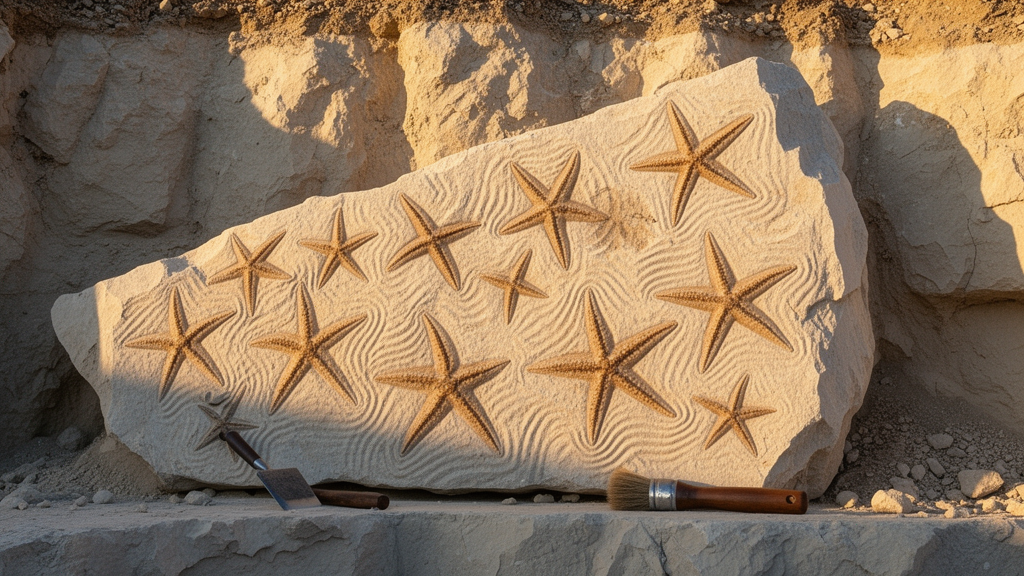
Beneath the sunlit waters of an Early Miocene sea, some 16 to 17 million years ago, a sudden storm swept across a shallow gulf in what is now southeastern France. The surge scoured the seabed, lifted entire communities of marine invertebrates, and buried them so quickly that even the most delicate skeletons stayed perfectly in place. Today, those victims of an ancient catastrophe are rewriting what scientists know about one of the most poorly documented chapters in the fossil history of sea stars. In a study published in the Swiss Journal of Palaeontology, researchers describe an exceptionally well-preserved starfish fauna from the Apt basin, in the Rhodano-Provençal gulf of southeastern France, revealing two brand-new genera and species and offering the first detailed snapshot of asteroid diversity during the Miocene of Western Europe.
The fossils come from the Calcaire de Ménerbes Formation, a roughly 30-meter-thick lens of bioclastic limestone that stretches from the village of Oppède to Lacoste, resting on Cretaceous limestones or Eocene sands. Quarries around the villages of Ménerbes and Lacoste, on the plateau above the Apt basin, have long yielded accumulation lenses packed with invertebrates: giant pectinid bivalves, sea urchins, feather stars, brittle stars and sea stars, many with their skeletal elements still in articulation. An earlier paleoecological study by Madelaine Bongrain suggested that these fossil-rich lenses resulted from the very rapid displacement and burial of two main benthic communities, one dominated by the enormous scallop Gigantopecten restitutensis and the other by the regular sea urchin Tripneustes planus. But while the sea urchins and feather stars had received dedicated taxonomic attention, the starfish had only ever been assigned brief, preliminary identifications. The new study changes that, describing sixteen asteroid individuals preserved on fifteen limestone slabs, most of them extracted from the Soubeyran quarry.
What makes this assemblage so remarkable is preservation quality that is genuinely rare in the fossil record. Starfish skeletons are built from hundreds of tiny calcitic plates called ossicles, connected by soft tissue that decays within days of death. Once the tissue is gone, the skeleton falls apart into isolated elements that are scattered by currents and rarely recognizable as a species. Only a handful of fossil assemblages in Western Europe have yielded starfish with their ossicles still connected: Jurassic sites such as Schinznach-Dorf in Switzerland, La Voulte-sur-Rhône and Cerin in France, and the Cretaceous Chalk of southern England. A few exceptionally preserved Miocene asteroids were known from Florida, Japan and Romania, but nothing comparable had ever been described from the Miocene of Western Europe. The Ménerbes material, with plates showing both their abactinal (upper) and actinal (lower) faces, sometimes obliquely so that both are visible, now fills that gap.
The team, led by Travers and Fau, identified four taxa, each belonging to a different family: an undetermined species of Astropecten (Astropectinidae), twelve specimens of Lacosteaster lauerorum (Solasteridae), and two new genera and species, Cruciformaster pedicellarius (Oreasteridae) and Menerbesaster bongrainae (Echinasteridae). This four-family spread is itself extraordinary, because these families occupy ecologically distinct habitats today and rarely overlap in their distributions. The co-occurrence of oreasterids, solasterids, astropectinids and echinasterids in a single Burdigalian assemblage is a combination that scientists would normally only encounter in places like the Caribbean Sea, where Oreaster reticulatus lives in shallow water while solasterids such as Solaster carribaeus range from 64 to 649 meters deep.
Cruciformaster pedicellarius carries particular weight, because it is the first fossil species belonging to the Oreasteridae to be described with an unambiguous taxonomic treatment. The family’s fossil record was previously murky, resting on two debated occurrences whose placements remain uncertain. One was Goniodiscus ferrazii from Tertiary deposits of Italy, a specimen whose taxonomic affinities have never been resolved because the genus Goniodiscus is now considered a junior synonym of Culcita and its species have been redistributed across 14 genera in five different families. The other was a specimen from the Eocene of Mexico attributed to Goniodiscaster, whose family placement has been argued over for more than a century, with recent work reaffirming its position in the Goniasteridae rather than the Oreasteridae. Upon re-examination, the researchers found no conical abactinals or mesh-like organization that would suggest oreasterid affinities, effectively confirming the Mexican specimen as a goniasterid. That leaves Cruciformaster pedicellarius, with its cone-shaped abactinals typical of the family, as the first properly documented fossil oreasterid.
The new genus takes its name from a distinctive feature: its superomarginal plates are cruciform, or cross-shaped, around the disc, rather than rectangular as in other oreasterid genera. The species name pedicellarius refers to the notches on its actinals and adambulacrals, corresponding to the insertion of alveolar bivalve pedicellariae, tiny pincer-like structures that modern oreasterids use for defense and cleaning. The holotype, an almost complete individual with a broad pentagonal disc and five short tapering arms, was found on the same slab as a smaller paratype showing part of an arm in abactinal view. To confirm the identification, the researchers compared the fossil’s abactinal skeleton with scanning electron microscope images of the extant Caribbean species Oreaster reticulatus, dissected at the Smithsonian Institution, showing how larger spine-bearing abactinals are connected together by smaller ones to form a mesh, exactly as in the fossil.
Lacosteaster lauerorum, first described in 2024 by Gale and Ward from a nearly complete holotype held at the Lauer Foundation in Illinois, is now represented by twelve additional specimens, eight of them from the Soubeyran quarry. These new individuals are large, with small radii of 3 to 5 centimeters and large radii reaching 10 to 17 centimeters, and they display eight to eleven long tapering arms on a broad circular disc. Crucially, four of the new specimens show the abactinal face, which was not visible on the holotype, providing the first description of the species’ upper skeleton. The abactinals form an irregular, dense mesh covered in spinelets, much like in extant solasterids, but unlike modern members of the family they are not paxilliform, and some are enlarged and surmounted by a large spine. The species belongs to the Solasteridae, a family previously represented in the fossil record by only a single Jurassic species, Plesiosolaster moretonis, known from England and Switzerland.
The second new genus, Menerbesaster bongrainae, named after the village of Ménerbes and dedicated to Madelaine Bongrain for her pioneering paleoecological work on the formation, belongs to the Echinasteridae. Its holotype, from the Soubeyran quarry, shows a disc and five incomplete arms with abactinals arranged in a regular mesh and marginals so inconspicuous that they cannot be morphologically differentiated from the surrounding plates, a hallmark of the family. Only one echinasterid species was previously known from the fossil record, Echinaster jacobseni from the Eocene of Denmark, making Menerbesaster the second. The Astropecten specimen, held in Grenoble, is large with a broad disc, angular interbrachial areas and five long narrow arms, and it resembles the extant Mediterranean species Astropecten irregularis, though it lacks key features needed for species-level identification.
The paleoecology of the assemblage is as revealing as its taxonomy. The fauna is composed of megathermal invertebrates, large species or those currently living in shallow tropical waters, consistent with the thermal maximum reached at the Burdigalian-Langhian boundary. Extant oreasterids inhabit warm, very shallow environments down to about 100 meters, while in tropical areas solasterids occur primarily below 200 meters. Astropectinids are predominantly cold-water species that burrow in soft sediments, while echinasterids tolerate cold, temperate and tropical settings. The coexistence of these four families, each with distinct depth and substrate preferences, at such high densities indicates that the organisms were transported and concentrated by episodic storms, a reinterpretation of Bongrain’s original sudden-mortality hypothesis, supported by herringbone cross-stratifications indicative of tidal currents and erosional surfaces suggesting storm waves observed in the abandoned quarries.
The feeding relationships inferred from modern analogues add another layer of drama. Extant oreasterids and echinasterids are mainly deposit feeders and predators of small prey, whereas solasterids and astropectinids are predators of large prey. Cruciformaster pedicellarius may have predated Tripneustes planus, just as the modern Oreaster reticulatus attacks Tripneustes ventricosus in the Caribbean today. Astropecten sp. may have fed on juveniles of Gigantopecten restitutensis, given that bivalves constitute one of the two main food sources of modern Astropecten. The rapid burial is also supported by the posture of the starfish themselves: they are preserved extended and parallel to the slabs, whereas slow burial would have allowed them to escape thin sediment layers and fold in on themselves, as asteroids are known to do. The bivalves retain both valves connected, the sea urchins keep their Aristotle’s lantern and spines, and the comatuloids, asteroids and ophiuroids have their skeletal parts in articulation, all evidence that these animals were buried during their lifetime or shortly after death. The result is a fossil window into a warm Miocene sea, one that shows Western Europe’s starfish fauna was far richer and more ecologically varied than anyone had suspected, and one that has no modern equivalent in the Mediterranean, where oreasterids and solasterids are now absent entirely.
Subject of Research: An exceptionally well-preserved starfish fauna from the Early Miocene of southeastern France
Article Title: An exceptionally well-preserved starfish fauna ( Asteroidea , Echinodermata ) from the Early Miocene of southeastern France
Article References: Travers, A., Fau, M., Roux, M., Coster, P., & Lefebvre, B. (2026). An exceptionally well-preserved starfish fauna (Asteroidea, Echinodermata) from the Early Miocene of southeastern France. Swiss Journal of Palaeontology, 145, 157-177. https://doi.org/10.3897/sjp.145.180374
Image Credits: AI Generated
Keywords: exceptionally, well-preserved, starfish, fauna, Asteroidea, Echinodermata, Early, Miocene, southeastern, France, scientific research
Cite Scienmag News
Margaret Porter. (October 18, 2026). Ancient storm buried a Miocene starfish paradise in southern France. Scienmag. https://scienmag.com/ancient-storm-buried-a-miocene-starfish-paradise-in-southern-france/
Margaret Porter. "Ancient storm buried a Miocene starfish paradise in southern France." Scienmag, 18 October 2026, https://scienmag.com/ancient-storm-buried-a-miocene-starfish-paradise-in-southern-france/. Accessed 18 October 2026.
Margaret Porter. "Ancient storm buried a Miocene starfish paradise in southern France." Scienmag. October 18, 2026. https://scienmag.com/ancient-storm-buried-a-miocene-starfish-paradise-in-southern-france/


