


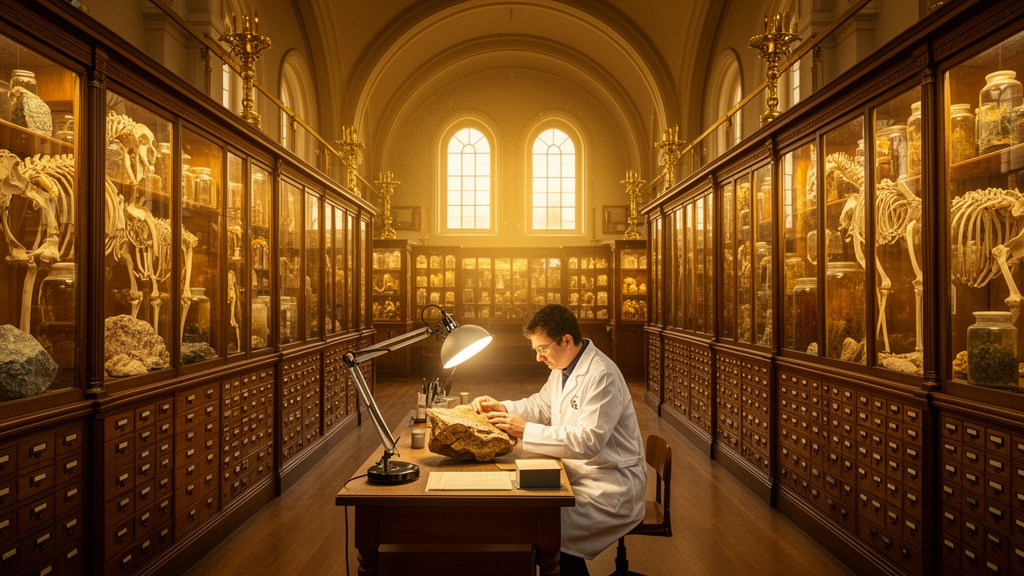
Natural history museums and herbaria have long been regarded as bastions of knowledge, conservation and education, but the scientific collections locked inside their storerooms are now stepping into the spotlight like never before. The launch of a new open-access journal, Natural History Collections and Museomics, marks a deliberate effort to give these institutions, the collections they curate and the skilled professionals behind them a dedicated scholarly platform. The journal’s founding editorial, published in November 2024, celebrates the birth of the venue and outlines its ambition: to explore the roles and functions of natural history museums, address their opportunities and challenges, and investigate the applications of the scientific collections they steward in an era of rapid environmental change.
Within the walls of natural history museums, including independent herbaria, sit vast arrays of materials known as voucher specimens. These include fossils, minerals, preserved animals, plants and fungi, human artefacts, photographs, acoustic recordings and tissue samples. Each element helps narrate the story of Earth’s evolution, adaptation and bio- and geodiversity, painting a detailed picture of the past while offering tools for understanding the present and interpreting the future. Collections assembled at different times and across different geographical areas, preserved with methods tailored to their specificity, are proving crucial in investigating contemporary threats such as climate change, the introduction and diffusion of invasive exotic species, pollution and other anthropogenic impacts. They are also vital for tracking the spread of emerging diseases, including zoonoses, and for documenting extinction processes.
The scale of what remains unknown is staggering. To date, only about 2 million species have been formally described out of an estimated 12 million species of animals, plants and fungi living on the planet, according to widely cited estimates. Further estimates push the figure far higher, ranging from 563 million to as many as 2.2 billion species if insect parasites, commensals and other species-specific organisms, including bacteria, apicomplexan protists, microsporidian fungi, nematodes and mites, are taken into account. The taxonomic activity carried out through the study of museological collections is a crucial process for reducing this so-called discovery and description gap, and museum collections provide relevant material for molecular studies and other cutting-edge analyses that allow a better comprehension of the living world.
Curators and collections managers, the editorial notes, usually wear many hats. They are responsible for the continued preservation of collections, for delivering and exposing them to the world, and they act as global diversity scholars and policy-makers, bringing together fundamental and critical expertise. It is they who ensure the care, cataloguing, conservation of and access to collections, often managing teams of equally skilled collection technicians and students. These professionals collectively steward collections data and care for FAIR data, meaning data that are Findable, Accessible, Interoperable and Reusable. Their work also involves scientific research aimed at discovering and documenting new species, better understanding existing ones and studying natural phenomena.
Beyond research, curators and collections managers serve as people’s educators, committed to disseminating scientific knowledge to the general public through exhibitions, conferences and publications. They are also the main experts of often neglected disciplines, taxonomy and nomenclature, which serve as the basis to describe and name new species and eventually re-assess the known ones. Their work extends to the frontline of learning and implementing new techniques for long-term storage and preservation of collections, which is crucial for promoting biodiversity and data curation actions, because these allow more accurate and comprehensive data collection and interpretation for future scenarios.
The methods developed for and using natural history collections data not only improve the quality of the data collected and shared, but also their interpretation and application, making land management and conservation actions, as well as collection management, more effective and sustainable. Collections of non-biological materials, such as minerals, geological specimens and meteorites, alongside fossilised organisms, give scientists valuable resources for interpreting the history of the planet. They offer a unique window into the past, allowing researchers to study Earth’s formation, its natural resources and the climatic changes that have occurred over millions of years. Through the study of these natural materials, museums are unique institutions that can contribute to a better understanding of geological and environmental dynamics, providing essential data for the conservation and management of natural resources.
Despite this enormous potential, resourcing often tells another story. A chronic lack of staff and a shortage of funds in many facilities, coupled with the economic difficulties particularly of small institutions, can seriously undermine their effectiveness. The problem is especially evident in countries where a centralised museum was never created and where small museums and annexed collections are often part of local administrations not particularly apt at managing scientific collections and research activity, although worrying concerns are also reported for larger institutions. The growing shortage of funding for curators means that many collections remain uncatalogued and unstudied, and that voucher specimens do not receive the best care necessary for their preservation. Lack of funding limits the ability of museums to update their facilities, acquire new exhibits and fund scientific research, while a parallel lack of interest often results in budget cuts and a failure to appreciate the educational and cultural potential of museums.
The editorial argues that when natural history museums are primarily considered tourist attractions instead of research institutions, their educational mission may be compromised. Governments and civil society, the authors contend, must recognise the importance of these institutions and invest more in the resources needed for their operation. Natural history museums need visible allies, and the editorial calls for other disciplines, university departments, industry and governments to stand up and actively support the care and development of collections and the collective expertise and data connected across them. Voucher specimens, in this framing, are a precious treasure that need to be adequately conserved and valorised, not least because they underpin research reproducibility around the world.
Modern technologies and the rapid development of science make it possible to apply transformative methods to the study of collection materials, which may reveal important information from innovative and evolutionary points of view. Museomics, a term coined by Stephan Schuster and Webb Miller, refers to the large-scale survey of DNA from museum collections and is one such approach. For the clarification of various systematic, phylogenetic and evolutionary questions, it is sometimes important to examine the DNA of verified voucher specimens, including, where feasible, type specimens, or to use other non-destructive analyses such as CT-scans, 3D imaging and radiographs. At the same time, collections are subject to gradual obsolescence and sometimes even destruction as a result of force majeure, which makes digitisation increasingly important. Digitising collections increases their exposure, allows greater accessibility and demonstrates their value, making them more accessible to the wider scientific community in line with FAIR principles.
A prominent example of such modern approaches is the Extended Specimen Approach, a method that goes beyond the physical specimen to include the historical information stored in the collection, linking to new research metadata and digital data such as images and thereby value-adding to voucher specimens. The new journal, Natural History Collections and Museomics, positions itself as one tool to explore and advance this extended specimen concept, serving as a scholarly platform for the publication and dissemination of knowledge based on new approaches to natural history research and collection management. Its editorial board brings experience as collections staff, conservationists and multidisciplinary scientists, with skills spanning several disciplines, enabling an integrated and innovative view of collections. The journal will host research articles, reviews, case studies, methods, letters and perspectives on topics related to natural history institutions, their collections and associated expert roles. Thanks to an open access model at no cost to authors or readers, published research is accessible to a global audience, promoting inclusivity and international collaboration in the field of natural history, and by promoting the exchange of knowledge, ideas and best practices between museum professionals, researchers, allies and enthusiasts, the journal aims to contribute to a deeper understanding, a strategic voice and greater appreciation of natural history and its impact on society.
Subject of Research: The role of natural history museum collections and museomics in biodiversity research and conservation
Article Title: Enlighten the Marvels: a new journal dedicated to natural history museums, collections and their role in interpreting a changing world
Article References: Andreone, F., James, S. A., Li, S., Paul, D. L., Stoev, P., & Penev, L. (2024). Enlighten the Marvels: a new journal dedicated to natural history museums, collections and their role in interpreting a changing world. Natural History Collections and Museomics, 1, 1-7. https://doi.org/10.3897/nhcm.1.142018
Image Credits: AI Generated
Keywords: natural history museums, museomics, voucher specimens, biodiversity, taxonomy, FAIR data, Extended Specimen Approach, digitisation, conservation, open access, curators, climate change
Cite Scienmag News
Margaret Porter. (October 18, 2026). New Journal Shines a Light on Natural History Museums and Their Scientific Collections. Scienmag. https://scienmag.com/new-journal-shines-a-light-on-natural-history-museums-and-their-scientific-collections/
Margaret Porter. "New Journal Shines a Light on Natural History Museums and Their Scientific Collections." Scienmag, 18 October 2026, https://scienmag.com/new-journal-shines-a-light-on-natural-history-museums-and-their-scientific-collections/. Accessed 18 October 2026.
Margaret Porter. "New Journal Shines a Light on Natural History Museums and Their Scientific Collections." Scienmag. October 18, 2026. https://scienmag.com/new-journal-shines-a-light-on-natural-history-museums-and-their-scientific-collections/


