


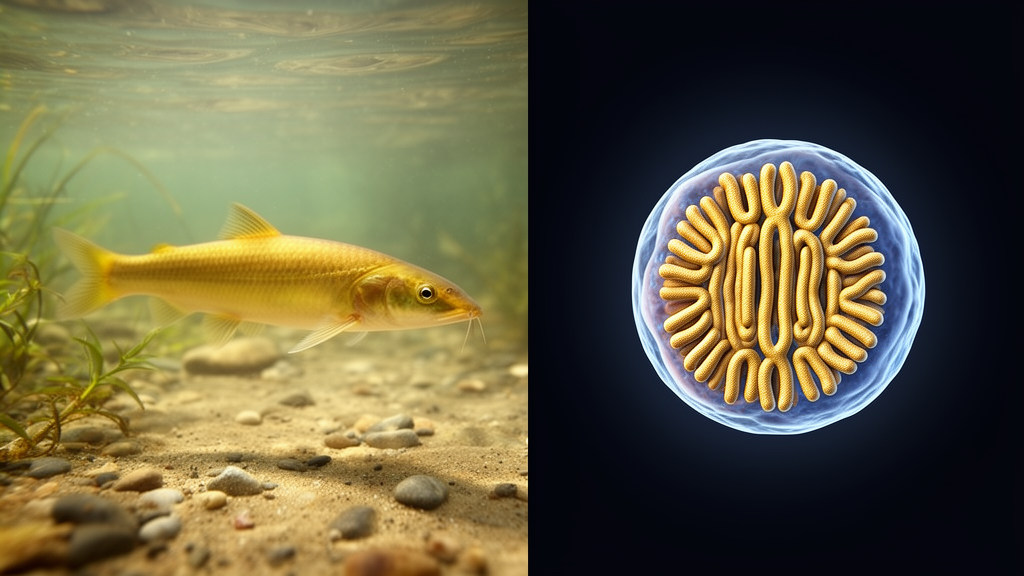
Deep in the channels of the Danube Delta, a small, bottom-dwelling fish has quietly handed scientists a piece of a long-standing puzzle. Researchers have now described, for the first time, the complete karyotype of Sabanejewia bulgarica, the Bulgarian golden loach, a slender freshwater fish that spends its life hugging the riverbed of one of Europe’s great waterways. The findings, published in the journal Comparative Cytogenetics, add a crucial data point to the cytogenetic record of a genus whose chromosomes have remained largely unexplored.
Sabanejewia loaches are diminutive fish, rarely exceeding 15 centimeters in total length, and they lead a secretive benthic existence in river habitats across a vast swath of Eurasia. Their range stretches from northern Italy to the Aral Sea basin, touching tributaries of the Black, Caspian, Baltic and Mediterranean Seas. What sets them apart from all other members of the loach family Cobitidae is a peculiar sexual dimorphism: males develop distinctive lateral body swellings. Despite this clear signature, the taxonomy of the group has been anything but settled, with the highest diversity long assumed to reside in the Danube basin itself.
That assumption has been shaken in recent decades. Phylogenetic studies have revealed that several phenotypes within the Danube region are so closely related that they belong to what researchers call the Sabanejewia balcanica species complex, meaning the exact species composition in the area is still unknown. Sabanejewia bulgarica itself was originally described in 1928 by Drensky as a species of the genus Cobitis, occurring in the lowest Danube basin including the Danube River proper. For many years it was treated as merely a subspecies within the polytypic Balkan golden loach complex, but later analyses of geographical variation showed that bulgarica is quite distinct from all other populations and deserves full species rank.
The distinguishing features are subtle but telling. Sabanejewia bulgarica differs from its relatives in overall body coloration, the character of Gambetta’s zone, pigmentation patterns, and the character of spots at the end of the caudal peduncle and the base of the caudal fin. Perhaps most strikingly, it is the only deep-water riverine form within the genus. More recently, researchers examining individuals from the type localities of both S. balcanica and S. bulgarica have argued that Danubian golden loaches are genetically closer to S. bulgarica, and that S. balcanica proper should be restricted to the drainage of the Vardar River.
Against this backdrop of taxonomic uncertainty, chromosome studies offer an independent line of evidence. Yet the chromosomes of Sabanejewia loaches remain poorly studied. Before this new work, only a handful of species had been karyotyped: S. larvata, S. caspia and S. kubanica in earlier summaries, followed by reports on S. caspia and S. aurata from other locations, and S. baltica from the Bug River in Poland. All of these studies documented an invariable diploid chromosome number of 2n = 50 and remarkably small karyotype variability across the genus, making each new species description a valuable test of that pattern.
The new study examined five specimens of S. bulgarica, all females, collected in July 1997 from the Saint George Branch of the Danube Delta in Romania. The fish arrived at the laboratory of the Danube Delta Institute in Tulcea in poor condition and subsequently died, but not before yielding the material needed for chromosome preparation. One female displayed the color pattern and high body described in Drensky’s original 1928 account, while the other four showed different color patterns, a reminder of how variable these fish can appear even within a single sample.
Using conventional Giemsa staining and the C-banding technique, with chromosomes classified according to the widely used system of Levan and colleagues, the researchers determined that the diploid chromosome number was 2n = 50 in all five individuals. The detailed karyotype analysis was carried out on a single specimen whose morphological characters matched the original description. The karyotype comprised two pairs of metacentric chromosomes, with the first pair much larger than the second, six pairs of submetacentric chromosomes, and seventeen pairs of subtelocentric to acrocentric chromosomes.
The C-banding procedure, which stains constitutive heterochromatin, revealed conspicuous pericentromeric blocks of heterochromatin in most of the chromosome pairs, with particularly prominent blocks in the largest metacentric chromosome and the first submetacentric element. These heterochromatic regions, clustered around the centromeres, provide a fingerprint that can be compared across species and populations, offering clues about how genomes are organized even when chromosome counts and shapes appear similar.
When the researchers compared the new karyotype with those of all karyologically studied Sabanejewia species, the similarities were striking. Every species examined so far shares the same diploid number of 2n = 50, a low number of metacentric chromosomes, and comparable proportions of submetacentric and subtelocentric-to-acrocentric elements. The karyotype phenotype of S. bulgarica proved to be essentially the same as that found for S. balcanica from the Northern Carpathian Mountains in Slovakia. Some apparent differences in karyotype structure among published accounts, the authors note, may stem from methodological choices rather than biology: some researchers distinguished subtelocentric from acrocentric chromosomes while others combined them, and the gradual range of centromere positions in small acrocentric-like chromosomes makes precise assignment difficult. The contraction of chromosome arms during mitosis, influenced by the timing and dose of colchicine treatment, further complicates comparisons between studies.
The conclusion is clear: the karyotype of S. bulgarica from the Danube Delta is very similar to those of other Sabanejewia species in chromosome number and morphology, and nearly identical to that of S. balcanica from the Northern Carpathian range. Whether this chromosomal conservatism reflects genuine evolutionary stasis or simply masks differences too subtle for conventional staining to detect remains an open question. The authors suggest that further detailed cytotaxonomic and genetic surveys of Sabanejewia populations throughout the genus’s distribution will be needed to resolve the systematics of the Danubian golden loaches, a group whose true diversity may still be hiding in the murky depths of Europe’s rivers.
Subject of Research: Karyotype analysis of the Bulgarian golden loach Sabanejewia bulgarica from the Danube Delta, Romania
Article Title: Karyotype of Sabanejewia bulgarica (Drensky, 1928) ( Teleostei , Cobitidae ) from the Danube Delta, Romania
Article References: Hnátková, E., Majtánová, Z., Bohlen Šlechtová, V., Bohlen, J., & Ráb, P. (2023). Karyotype of Sabanejewia bulgarica (Drensky, 1928) (Teleostei, Cobitidae) from the Danube Delta, Romania. Comparative Cytogenetics, 17, 157-162. https://doi.org/10.3897/compcytogen.17.103152
Image Credits: AI Generated
DOI: 10.3897/compcytogen.17.103152
Keywords: Sabanejewia bulgarica, Cobitidae, karyotype, C-banding, Danube Delta, cytogenetics, chromosomes, heterochromatin, freshwater fish, cytotaxonomy, golden loach, Sabanejewia
Cite Scienmag News
Juliet Wilcox. (October 18, 2026). Golden loach from the Danube Delta reveals a remarkably stable chromosome blueprint. Scienmag. https://scienmag.com/golden-loach-from-the-danube-delta-reveals-a-remarkably-stable-chromosome-blueprint/
Juliet Wilcox. "Golden loach from the Danube Delta reveals a remarkably stable chromosome blueprint." Scienmag, 18 October 2026, https://scienmag.com/golden-loach-from-the-danube-delta-reveals-a-remarkably-stable-chromosome-blueprint/. Accessed 18 October 2026.
Juliet Wilcox. "Golden loach from the Danube Delta reveals a remarkably stable chromosome blueprint." Scienmag. October 18, 2026. https://scienmag.com/golden-loach-from-the-danube-delta-reveals-a-remarkably-stable-chromosome-blueprint/


