


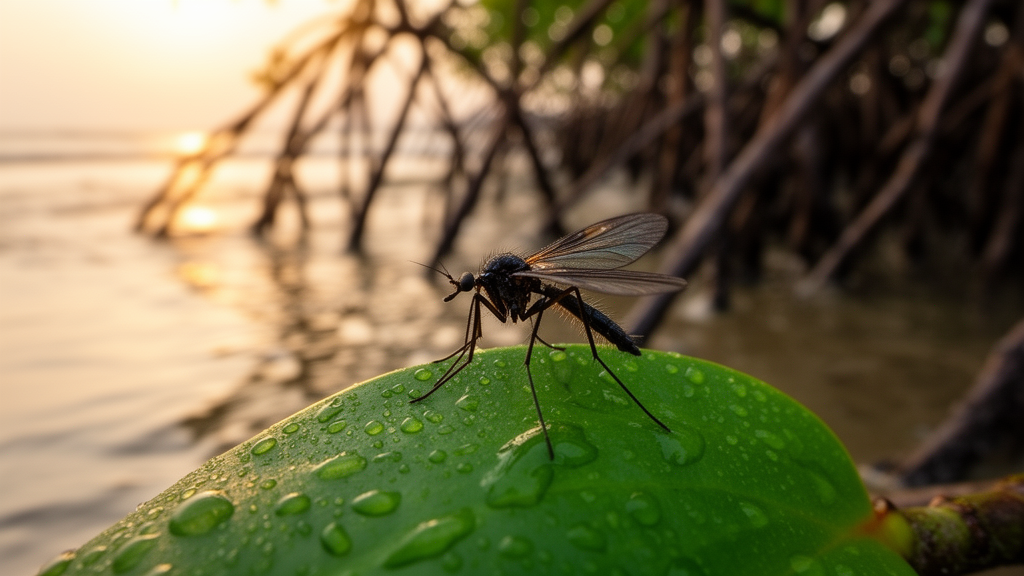
A tiny predator with a taste for blood has quietly joined the catalogue of life. Entomologists working on the sandy shores of Digha, a popular seaside resort town in the Purba Medinipur district of West Bengal, India, have described a previously unknown species of biting midge, naming it Leptoconops (Holoconops) beccus. The discovery, published in the journal Evolutionary Systematics, is based on both male and female specimens collected with light traps in October 2023, and it comes with something rarer than the insect itself: DNA barcode data and a completely revised identification key for the entire subgenus across the Oriental region.
Biting midges belong to the family Ceratopogonidae, one of the largest and most diverse families within the superfamily Chironomoidea of the infraorder Culicomorpha. The family is divided into three living subfamilies, Ceratopogoninae, Forcipomyiinae and Leptoconopinae, and encompasses roughly 6,300 living species arranged in 109 genera worldwide. Despite their minuscule size, many of these flies have an outsized reputation. All the blood-feeding species in the family are concentrated in just a few lineages: the genera Leptoconops, Culicoides and Austroconops, together with the subgenus Lasiohelea of the genus Forcipomyia. Members of these groups are well known for their medical and veterinary importance, because the blood-sucking habits of the females can transmit infections to humans and animals.
The genus Leptoconops is a particularly notorious member of this cast. These midges are described as extremely nasty biters, and they show a strong preference for coastal habitats. Worldwide, the genus contains 174 species distributed among seven subgenera. The Oriental realm, the biogeographic region covering South and Southeast Asia, has so far registered 17 species across four subgenera: Leptoconops sensu stricto, Holoconops, Proleptoconops and Styloconops. The immature stages of these flies develop in sandy banks, saline marshlands, protected sandy beaches and depressions adjacent to the coast, where the larvae feed on the organic material within the sand, including a diverse range of microorganisms. That ecological tie to shoreline sediments explains why beach towns like Digha, sitting just six metres above sea level near the Bay of Bengal, can become hotspots of midge activity.
The nuisance factor is more than a minor irritation. Swarms of Leptoconops engage in aggressive diurnal biting, and their activity can affect the tourism industry in coastal areas. Only the females take blood meals, and their bites can cause intense itching that persists for months, sometimes leading to secondary infection and serious outcomes. Curiously, the immediate effects of a bite are generally considered less severe than the lesions that may develop later, a delayed reaction that has been documented since early studies of these flies. Beyond the itch, there is a genuine public health dimension: the genus is a vector of Mansonella, a human filarial nematode that also relies on Culicoides midges. The resulting disease, mansonellosis, has been reported from Bihar in India and primarily affects underprivileged communities in tropical and subtropical regions. Although mansonellosis is not currently a focus of India’s National Filaria Control Programme, the authors note that its potential expansion in endemic areas could become a concern in the near future.
Against this backdrop, documenting the midge fauna of India’s coasts is not merely an academic exercise. The new species was collected using a battery of light traps, including a 27-watt ultraviolet trap, a 40-watt CFL bulb and a 60-watt filament bulb, all deployed in October 2023. Specimens were preserved in 70 percent ethanol, and the type series comprises a holotype male together with five male and three female paratypes, all from the same locality and date. The types are currently held at the Biosystematics and Entomology Division of the Department of Zoology at the University of Burdwan, with plans to deposit them in the National Zoological Collections in Kolkata.
What sets this description apart from many traditional taxonomic papers is the molecular component. The researchers extracted DNA from a fragment of thoracic tissue and a set of legs from one male specimen using a Qiagen DNeasy Blood and Tissue kit, then amplified a region of the mitochondrial cytochrome c oxidase subunit I gene, the standard DNA barcode marker, with the universal Folmer primers LCO1490 and HCO2198. The amplified products were checked on a one percent agarose gel and sequenced by bidirectional Sanger sequencing on a 3730xl DNA Analyzer, and the resulting sequence was deposited in NCBI GenBank under accession number PP358259. The COI barcode provides a molecular fingerprint that can be matched against future collections, an increasingly important tool for species that are otherwise identified through painstaking microscopic comparison.
On the morphological side, the description is a masterclass in detail. Specimens were slide-mounted following established protocols, photographed with a Leica DM 1000 fluorescent microscope under bright-field conditions, and illustrated with a Camera Lucida attached to a compound microscope, with the inked drawings scanned at 1200 dpi and digitally edited. The male of L. beccus is distinguished by a combination of genital characters: the gonocoxite is wider at the base and narrower toward the apex, the gonostylus is short and stout with two apical spines, and most tellingly, the parameres are jointed at the middle with a beak-like distal shape that gives the species its name. The aedeagus is elongate and rod-shaped, slightly swollen at the tip. The female, meanwhile, has bare eyes, a mandible armed with 12 to 13 teeth, palpomere III bearing four to five well-developed protruding capitate sensilla, and two unequal, well-sclerotised spermathecae lacking any hyaline punctation. Measurements were taken in micrometres, with standard ratios such as the antennal ratio, palpal ratio and proboscis-to-head ratio recorded to allow direct comparison with related species.
Those comparisons matter, because the new species must be separated from a suite of close relatives scattered across Asia. The Indian species L. brevistylus differs in having separate parameres and a nearly U-shaped aedeagus in the male, along with double rows of clypeal setae and three-spined hind tibial combs in the female. L. fortipalpus and L. tenebrostigmatus, also Indian, are distinguished by clypeal setation, palpal structure and eye separation. Beyond India, the Nepalese L. amplifemoralis has a rhomboid aedeagus and recurved parameral spines, the Chinese L. menglaensis has separate parameres and a club-shaped aedeagus, the Thai L. xuthosceles shows swollen parameres with a pointed recurved spine, and the Chinese L. yunhsienensis has hairy eyes. To make these distinctions accessible to future workers, the authors constructed a revised identification key to all adult males and females of the Oriental species of the subgenus Holoconops, modified from an earlier key published in 2010. In the male key, the beak-like paramere tips of the new species separate it cleanly from the triangular-tipped L. ascius; in the female key, eyes separated by 11 facets distinguish it from the 10-faceted L. xuthosceles.
Perhaps the most intriguing aspect of the discovery is biogeographic. The authors compiled the elevations and habitats of all known Holoconops species in the Oriental realm and found a striking pattern: the previously described species come from inland and montane sites, including the Chota Nagpur Plateau in Jharkhand at around 50 metres, Burdwan Town at 30 metres, Kathmandu at 1,300 metres, Chiang Mai at 310 metres, Yunnan localities between 580 and 2,000 metres, and a Mekong-side site in Laos at 1,800 metres. The new species is the only member of the subgenus reported from a coastal area anywhere in the Oriental region, a fact that underscores how much unexplored habitat remains along tropical shorelines. On the molecular front, the authors add a note of caution: only three species of the entire genus Leptoconops currently have publicly available COI sequences, and none belong to the subgenus Holoconops, so a meaningful molecular phylogenetic analysis is not yet feasible. Each new barcode, therefore, helps build the foundation for future evolutionary studies.
For beachgoers, the discovery is a reminder that some of the most consequential animals on the shore are nearly invisible. For scientists, L. beccus represents both a new entry in the catalogue of biting midges and a small but concrete step toward understanding the diversity, distribution and disease potential of a group whose bites can outlast a summer vacation by months. As coastal development and tourism continue to expand along the Bay of Bengal, knowing exactly which midge is biting, and what it might carry, has never been more relevant.
Subject of Research: Taxonomic description of a new haematophagous biting midge species from coastal West Bengal, India
Article Title: On a new haematophagous species of the genus Leptoconops ( Holoconops ) Kieffer ( Diptera , Ceratopogonidae ) from the coastal region of West Bengal, India
Article References: Ghosh, L., Pal, G. S., & Hazra, N. (2025). On a new haematophagous species of the genus Leptoconops (Holoconops) Kieffer (Diptera, Ceratopogonidae) from the coastal region of West Bengal, India. Evolutionary Systematics, 9(1), 33-38. https://doi.org/10.3897/evolsyst.9.138575
Image Credits: AI Generated
DOI: 10.3897/evolsyst.9.138575
Keywords: biting midges, Ceratopogonidae, Leptoconops, new species, West Bengal, India, DNA barcoding, COI gene, taxonomy, Oriental region, mansonellosis, coastal entomology
Cite Scienmag News
Gavin Prescott. (October 18, 2026). New Blood-Sucking Midge Species Discovered on India’s Bay of Bengal Coast. Scienmag. https://scienmag.com/new-blood-sucking-midge-species-discovered-on-indias-bay-of-bengal-coast/
Gavin Prescott. "New Blood-Sucking Midge Species Discovered on India’s Bay of Bengal Coast." Scienmag, 18 October 2026, https://scienmag.com/new-blood-sucking-midge-species-discovered-on-indias-bay-of-bengal-coast/. Accessed 18 October 2026.
Gavin Prescott. "New Blood-Sucking Midge Species Discovered on India’s Bay of Bengal Coast." Scienmag. October 18, 2026. https://scienmag.com/new-blood-sucking-midge-species-discovered-on-indias-bay-of-bengal-coast/


