


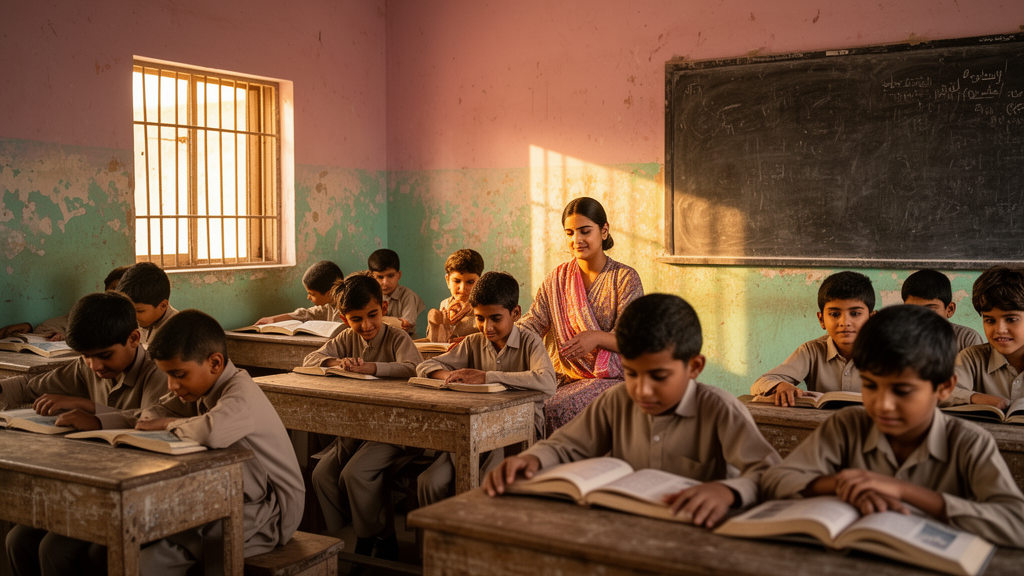
In the crowded streets of Rawalpindi, Pakistan, a quiet revolution in education is unfolding, one that has divided academics and policymakers for decades. Low-fee private schools, or LFPS, have emerged as the default providers of education for millions of poor children in a country where public spending on education has fallen to just 2.4 percent of GDP. Now, a pioneering study published in SN Social Sciences has shattered the one-size-fits-all narrative surrounding these contested institutions, revealing that no single type of low-fee private school can simultaneously deliver access, equity, and quality. The findings, drawn from an unprecedented comparison of six distinct school types in Punjab province, suggest that quality comes at the expense of access and equity, and vice versa, forcing a radical rethink of blanket policies targeting the sector.
The research, conducted by Wajeeha Hazoor of Florida State University, addresses a fundamental flaw in the existing literature: the tendency to treat low-fee private schools as a homogeneous entity. Proponents, including influential scholars such as James Tooley, have long argued that these schools succeed in providing affordable education through concessions and state vouchers to the poorest families. Opponents counter that they reproduce educational inequalities by deliberately excluding the poorest through fee-charging practices, regardless of how low the fees are. In terms of quality, critics maintain that student performance at these schools does not exceed that of children in public schooling, and that gains are marginal even when found. Hazoor’s study reveals that positive findings on quality derive from better-resourced schools, whereas negative findings on access and equity stem from underfunded or hyper-commercial versions, making overarching claims problematic.
To overcome this limitation, the study applies a typology of low-fee private schools in Pakistan, differentiating among types based on ownership and fee range. The framework identifies two structural modalities: Independent schools, developed by community members for philanthropic or entrepreneurial purposes, and Chain schools, franchisees of national elite private schools, higher educational institutes, or philanthropies. These are further bifurcated by fee structure into three categories emerging from the urban research site of Rawalpindi: roughly $4.44 to $5.33, $8.89 to $11.11, and $24 per month. Notably, the cheap independent and chain schools, along with medium-range independent schools, were predominantly found in low-income neighborhoods, while costly independent and chain schools appeared only in mixed-income areas, indicating that the economic baseline of neighborhoods determines the fees charged.
The methodological design was equally innovative. A holistic case study approach was implemented with 17 purposively selected schools serving as units of analysis, permitting cross-case synthesis in a context where the boundaries between the phenomenon and its socioeconomic context were unclear. At each school, surveys were administered and key informant interviews took place with principals, teachers, school owners, an administrator, and a coordinator, engaging a total of 40 participants. In a methodological first for researchers operating in data-poor contexts, the study relied on Facebook data as an indigenous source of knowledge to fill gaps and triangulate findings. A staggering 19,320 pictures posted on school pages were iteratively open-coded, with thematic saturation reached at 120 inductive codes relying on 1,343 picture families. Facebook was selected because websites require financial investment that cash-strapped schools may lack, whereas the social media platform serves as a free marketing tool in the Pakistani context.
Access and equity were conceptualized as affordability and its gendered nature, examining how these interact with families’ socioeconomic status to inform enrollment decisions for boys and girls. Quality was measured through structural and infrastructural proxies rather than the performative, neoliberal measures that dominate the literature, such as student test scores. The study examined teacher qualifications, teacher training, willingness to provide extra assistance to struggling students, and the provision of extracurricular activities. This fills a critical gap, as empirical evidence has confirmed that increased exposure to extracurricular activities has positive effects on academic achievement and other transferable skills, including socialization. The economic construct of contract failure, rooted in principal-agent theory, was operationalized by examining how schools skim on aspects of operations that do not directly inform higher profit margins, capitalizing on parents’ lack of information to distinguish between a holistic educational experience and market-facing proxies such as school averages.
The findings reveal stark variations across school types. The poorest integration of access and equity was found at cheap, medium-range, and costly independent schools in low-income and mixed-income neighborhoods, yet the medium-range and costly independent schools were among the strongest performers in terms of educational quality, along with costly chain schools in mixed-income areas. Conversely, cheap chain schools in low-income neighborhoods were the most likely to integrate access and equity into their operations, yet they were among the poorest performers in terms of quality. The data confirm that schools unable to integrate access and equity by design unless they have access to extraneous financial support, relying on the generosity of strong philanthropic networks or owner resources. Low fees, by design, limit longevity if not augmented by additional resources.
Cream-skimming, the practice of enrolling high-performing students and rejecting those who do not pass admissions tests to preserve class averages, was prevalent across nearly all school types, with only two exceptions. Exclusionary practices included rejecting overaged or disabled children, with one popular cheap chain school reporting rejection of new admissions when class capacity of 33 students was reached. A common approach was to exclude students who performed poorly on admissions tests, with exclusion or demotion more prevalent at costly independent and chain schools in mixed-income neighborhoods. Parents were found to game the system by hiding students’ previous report cards, prompting one costly independent school to demote poor performers to classes below their age group rather than outright rejecting admission. Demotion thus emerges as a unique form of cream-skimming to maintain class averages.
The exclusion of students with disabilities proved particularly complex. Six schools explicitly stated they had no policy of enrolling disabled children, with responses appearing to be a product of the neighborhood context. Better-resourced schools in mixed-income areas were more able and likely to accommodate students with disabilities, while low-income neighborhood schools could not do so, even when claiming disability inclusion, due to inaccessible buildings. One medium-range independent school owner replied in an irritated tone that disabled children should go to their own school, while a costly chain school owner explained that the Government of Punjab has a full department of disability, so people prefer to avail that option. This indicates that while these schools position themselves as substitutes for the state educational system, they are quick to hand off responsibility for students who may bear additional costs or threaten school averages.
Teacher quality revealed a clear market orientation, with schools prioritizing teachers of subjects deemed important for profit-making, particularly English, which is a major reason parents send their children to these schools as opposed to public institutions where the medium of instruction is the local language. Master’s-qualified teachers were hired at six of the 12 schools providing data, predominantly at medium-range chain schools and costly independent and chain schools in mixed-income neighborhoods. In low-income areas where profit margins are lower, high school-educated teachers were hired to teach mathematics, with one medium-range independent school employing a single high school-educated instructor to teach all subjects to Grade 4 students. Teacher training programs were rare at cheap and medium-range independent schools, with only two better-resourced medium-range independent schools found to have such programs. Chain schools had uniform access to training as a result of franchising conditions, though teacher poaching was reported as common in the sector, explaining why poorly resourced independent schools do not uniformly invest in building their teaching staff’s capacity.
Without exception, all schools prioritized student performance, providing additional academic assistance before, during, or after school hours to ensure children were absorbing lessons, suggesting that remedial assistance is not optional but a requirement for competitiveness in the local market. Cheap independent school teachers provided tutoring on school premises before or after hours or during the midday break, while a medium-range chain school offered additional Saturday classes for what they term weak students. The shadow educational system, encompassing private tutoring, was found prevalent, with tuition academies commonly situated in buildings right next to or within school premises. Even a school whose owner actively discouraged tutoring was found to have established a tutoring academy on its own premises during fieldwork. The affordability critique holds for costly independent and chain schools, which are affordable only for middle-class families according to recent figures from the Pakistan Bureau of Statistics, which put average household monthly income at approximately 188 USD. With the poorest households having approximately five children under the age of 10, it is difficult for families living below the international poverty line of 2.15 USD per day to enroll all children without discounts, fee flexibility, or waivers for each additional child. The findings demonstrate that policy toward low-fee private schooling must be calibrated to specific types, fee structures, and regulatory contexts, rather than implementing irrevocable, blanket actions against a sector that remains the sole form of schooling for many poor children in the context of documented public educational supply gaps.
Subject of Research: Low-fee private schooling in Punjab, Pakistan: revisiting debates on access, equity, and quality
Article Title: Low-fee private schooling in Punjab, Pakistan: revisiting debates on access, equity, and quality
Article References: Hazoor, W. (2026). Low-fee private schooling in Punjab, Pakistan: revisiting debates on access, equity, and quality. SN Social Sciences, 6(8), Article 346. https://doi.org/10.1007/s43545-026-01629-9
Image Credits: AI Generated
DOI: 10.1007/s43545-026-01629-9
Keywords: Low-fee, private, schooling, Punjab, Pakistan, revisiting, debates, access, equity, quality, scientific research
Cite Scienmag News
Courtney Benton. (October 18, 2026). Cheap private schools in Pakistan trade equity against quality, study finds. Scienmag. https://scienmag.com/cheap-private-schools-in-pakistan-trade-equity-against-quality-study-finds/
Courtney Benton. "Cheap private schools in Pakistan trade equity against quality, study finds." Scienmag, 18 October 2026, https://scienmag.com/cheap-private-schools-in-pakistan-trade-equity-against-quality-study-finds/. Accessed 18 October 2026.
Courtney Benton. "Cheap private schools in Pakistan trade equity against quality, study finds." Scienmag. October 18, 2026. https://scienmag.com/cheap-private-schools-in-pakistan-trade-equity-against-quality-study-finds/


