


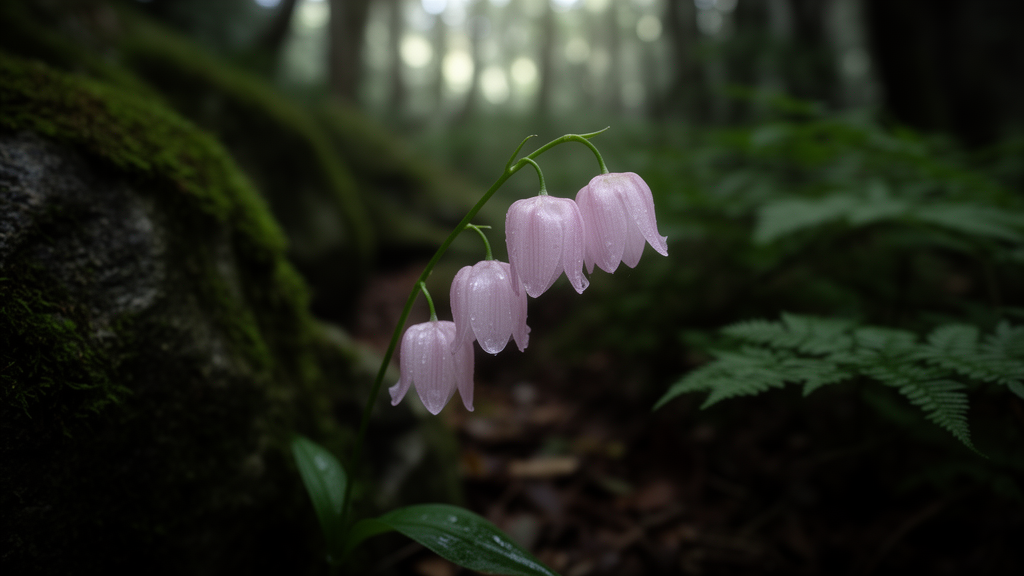
Deep in the grassy forest understories of Gengma County in China’s Yunnan Province, botanists have identified a striking new member of one of the plant kingdom’s most architecturally elaborate flower genera. The species, formally named Ceropegia gengmaensis, belongs to the dogbane family Apocynaceae and joins a lineage of plants famous among botanists and horticulturists alike for their lantern-shaped, often insect-trapping blossoms. Described in the journal PhytoKeys, the discovery brings the count of recognized Ceropegia species in China to 26 and adds a new branch to the evolutionary story of a genus that has undergone one of the most dramatic taxonomic expansions in modern botany.
The new species was collected during a floristic survey at roughly 1,200 meters elevation, where researchers encountered a small, erect to sprawling herb rising from a cluster of white, fleshy, fusiform roots. Its slender stems, no more than one to two millimeters thick and uniformly covered in minute hairs, reach up to 30 centimeters in length. The elliptic leaves, arranged in opposite pairs, measure between 2.0 and 5.5 centimeters long and 1.0 to 2.5 centimeters wide. But it is the flower that commands attention: a tubular corolla 30 to 50 millimeters long, reddish-purple on the outside, striped within, with an ovoid basal swelling that narrows and then widens toward the mouth, where a distinct ring of white hairs marks the entrance to a cage formed by the petals.
That cage is the signature of the genus. Ceropegia flowers are renowned for their intricate pollination biology, in which small flies and other insects are lured into the tubular blossom, temporarily detained by inward-pointing hairs, and released only after pollinia—compact pollen packages characteristic of the Apocynaceae—have been attached to their bodies. In C. gengmaensis, the corolla lobes are ligulate, red on the outside and white inside with reddish-purple tips, their margins strongly reflexed so that the white inner surface is exposed. The lobes form a cage about 1.5 times as wide as the basal inflation of the tube, a proportion that proved decisive in separating the new species from its closest relatives.
Distinguishing a new species in a genus this large requires both careful morphology and molecular evidence, and the research team, led by P.R. Luo, A. Liu and H. Sun, pursued both lines. On the morphological side, they examined fresh material and herbarium specimens using stereomicroscopy, high-resolution extended depth-of-field imaging, and precision vernier calipers. They cross-checked their material against collections housed at the herbaria KUN and PE, reviewed additional specimens through the Chinese Virtual Herbarium and JSTOR Global Plants, and consulted original species descriptions digitized in the Biodiversity Heritage Library.
The closest comparisons were Ceropegia salicifolia, C. mairei and C. dolichophylla, all members of the section Chionopegia. Each relative differs in ways that are subtle on paper but unmistakable in the hand. C. salicifolia is a twining plant with glabrous stems and much longer, lanceolate leaves of 6 to 15 centimeters, producing cymose inflorescences bearing 13 to 20 flowers, whereas C. gengmaensis bears usually solitary flowers beside the leaf axils on finely puberulent stems. C. mairei has a corolla tube strongly inflated in its basal third to two-thirds, its inner surface densely clothed with long white hairs; the new species has a much less inflated base and confines its white hairs to an annular ring at the mouth of the basal inflation. C. dolichophylla, meanwhile, is a climbing vine whose glabrous stems can stretch to 1.5 meters, with linear-lanceolate leaves and corolla lobes that are pilose inside and often fringed with conspicuous white or purple vibratile hairs—features entirely absent in the Gengma plant.
To test whether these visible differences reflect genuine evolutionary separation, the team turned to chloroplast genomes, the circular DNA repositories in plant cells that have become workhorses of plant phylogenetics. Eleven Ceropegia plastomes were newly sequenced and assembled for the study, joined by additional chloroplast genome sequences retrieved from GenBank, with C. nilotica serving as the outgroup. The final dataset spanned 16 representative species from three closely allied sections: Chionopegia, Callopegia and Tiloris. Sequences were aligned in MAFFT v7.490 with default settings, and poorly aligned regions were pruned with trimAl v1.4 before analysis.
Phylogenetic reconstruction employed two complementary statistical frameworks. Maximum likelihood analysis was run in RAxML-NG v1.2.2 under the GTR+G substitution model, while Bayesian inference was performed in MrBayes using the HKY85+G model. The Markov Chain Monte Carlo search ran for 1,100,000 generations across four chains with a heated chain temperature of 0.2, sampling every 200 generations and discarding the first 100,000 as burn-in. The two approaches yielded highly congruent topologies, and the authors applied a strict standard for confidence: only nodes with Bayesian posterior probabilities of at least 0.95 and maximum likelihood bootstrap support of at least 75 percent were considered strongly supported.
The molecular verdict was unambiguous. Ceropegia gengmaensis sits firmly within section Chionopegia, and it forms a strongly supported sister relationship with C. salicifolia, with posterior probability of 1.00 and bootstrap support of 100 percent. That pair is in turn grouped with C. mairei, confirming a close three-way affinity. Yet the new species resolves as an independent lineage with strong statistical support, a separation that, combined with the consistent morphological differences in stem indumentum, leaf shape and floral architecture, justified its recognition as distinct.
The placement of the new species within a redefined genus is itself part of a larger taxonomic saga. Traditionally, Ceropegia was considered to comprise about 240 species worldwide, but molecular phylogenetic work published over the past decade demonstrated that this circumscription was not monophyletic—it excluded descendants of a common ancestor. To restore monophyly and nomenclatural stability, the botanist Bruyns proposed a broadened genus that absorbs the traditional Brachystelma and all stapeliad genera, swelling Ceropegia to 63 sections and more than 700 species. Under this expanded concept, World Flora Online currently recognizes 863 species, including 424 species traditionally treated as Ceropegia and Brachystelma, making it the largest genus in the Apocynaceae.
China’s Ceropegia flora has been reshaped by the same upheaval and by the country’s complex geological evolution and climatic diversity, which recent taxonomic studies have linked to striking patterns of species diversification across Eurasia. Five new species have been described in recent years, one name has been sunk into synonymy, and another previously synonymized species has been reinstated. The current tally of 26 Chinese species includes 22 in section Chionopegia and 4 in section Tiloris, with two species formerly placed in Brachystelma now incorporated. C. gengmaensis, which flowers from June to September and carries the Chinese vernacular name geng ma diao deng hua, meaning the Gengma lantern flower, is the newest addition.
For now, the species is known from a single population of around five individuals, ascending around stones in grassy areas of the forest understory near its type locality in Lincang City. That restricted range, while not unusual for newly described plants, underscores how much undocumented diversity may persist in the fragmented habitats of southwest China. The holotype, collected on 11 May 2025 and deposited at KUN under the specimen number KUN1643961, anchors the name in the botanical record, and a detailed line drawing accompanies the description. Whether more populations await discovery in the surrounding hills remains an open question—but for a genus whose members have evolved some of the most sophisticated pollination traps in the plant world, every new species is a reminder of how much evolutionary invention still hides in plain sight.
Subject of Research: Description of a new Ceropegia species from Yunnan, China, using morphology and chloroplast phylogenomics
Article Title: Ceropegia gengmaensis ( Apocynaceae ), a new species from Yunnan, China
Article References: Luo, P.-R., Liu, A., Tong, R., Zhang, X.-J., Wang, Z.-Y., Deng, T., Goyder, D. J., & Sun, H. (2026). Ceropegia gengmaensis (Apocynaceae), a new species from Yunnan, China. PhytoKeys, 276, 217-228. https://doi.org/10.3897/phytokeys.276.197333
Image Credits: AI Generated
DOI: 10.3897/phytokeys.276.197333
Keywords: Ceropegia gengmaensis, Apocynaceae, new species, Yunnan, China, chloroplast phylogenomics, taxonomy, section Chionopegia, Gengma County, plant diversity, PhytoKeys, corolla morphology
Cite Scienmag News
Gavin Prescott. (October 18, 2026). New Lantern Flower Species Discovered in Yunnan’s Forest Understories. Scienmag. https://scienmag.com/new-lantern-flower-species-discovered-in-yunnans-forest-understories/
Gavin Prescott. "New Lantern Flower Species Discovered in Yunnan’s Forest Understories." Scienmag, 18 October 2026, https://scienmag.com/new-lantern-flower-species-discovered-in-yunnans-forest-understories/. Accessed 18 October 2026.
Gavin Prescott. "New Lantern Flower Species Discovered in Yunnan’s Forest Understories." Scienmag. October 18, 2026. https://scienmag.com/new-lantern-flower-species-discovered-in-yunnans-forest-understories/


