


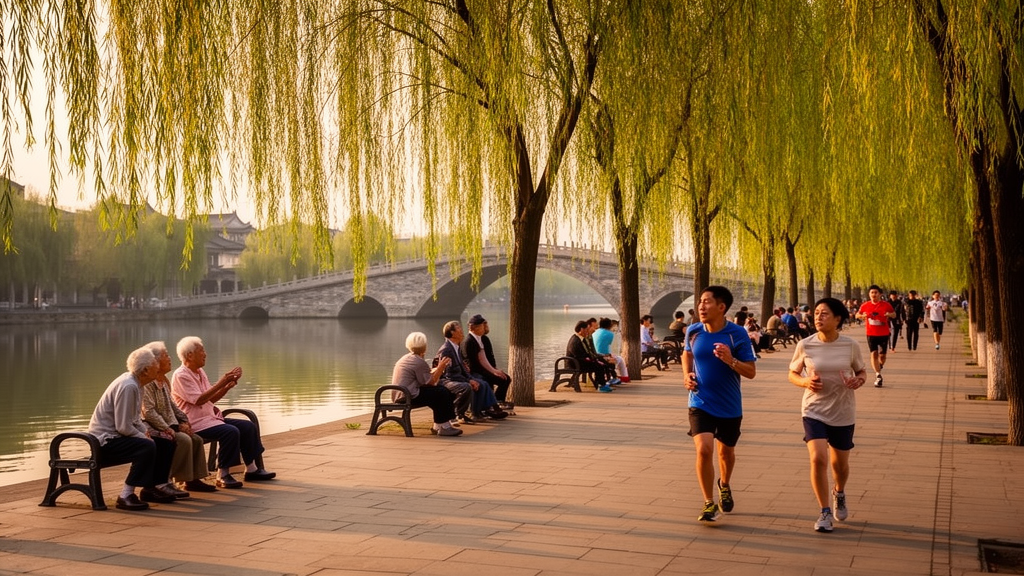
The Grand Canal of China stretches across more than two thousand kilometres of the eastern part of the country, linking Beijing in the north with the Yangtze River delta cities in the south, and it carries a documented history of well over two millennia. When the World Heritage Committee inscribed the Grand Canal on the World Heritage List in 2014, the recognition covered not a single monument but a sprawling network of canal sections, locks, sluices, granaries, bridges, and associated historic settlements distributed across multiple provinces. This distributed character is precisely what makes the Grand Canal a paradigmatic case of linear cultural heritage, a category of heritage in which the resource is defined less by any individual structure than by the continuity of a route and the accumulated relationships between that route and the communities along it. Managing such heritage therefore raises questions that conventional monument-centred preservation frameworks were never designed to answer, because the canal lives simultaneously as an engineering artefact, a functioning waterway, an ecological corridor, and a sequence of everyday public spaces.
The study by Jiang, Zhang, Shen, Sun, and Zhao at Beijing Forestry University’s School of Landscape Architecture addresses this problem through the lens of green open spaces, the parks, riverside promenades, gardens, and vegetated buffers that line the canal and its branches. These spaces matter because they are where most people actually encounter the canal today. Few residents interact with the canal as a hydraulic system or as a listed monument, but large numbers of them walk, exercise, picnic, photograph, socialise, and consume within the green spaces that abut it. If the canal’s contemporary cultural significance is being produced anywhere, it is being produced in these everyday landscapes, which makes them a strategic site for understanding how heritage value is sustained or eroded in the decades after inscription.
The theoretical foundation the researchers draw upon combines two strands of thinking that have become influential in international heritage practice. The first is the Historic Urban Landscape approach, adopted by UNESCO in its 2011 Recommendation, which reframes urban heritage as the layered product of natural and cultural, tangible and intangible values interacting over time, rather than as a set of discrete protected objects. The second is the Cultural Values Model, which treats heritage as an assemblage of forms, practices, and relations, insisting that the meaning of a place emerges from the dynamic interplay among its physical attributes, the activities performed there, and the bonds people form with it and with each other. By fusing these frameworks, the authors construct an interpretative indicator system in which the green open spaces along a linear heritage corridor can be read as configurations of form, practice, and relation, and in which relational value becomes something that can be observed, classified, and measured rather than merely asserted.
Relational value, as operationalised in this research, unfolds across four observable dimensions: historical value, aesthetic appreciation, sense of place, and social interaction. This decomposition is analytically important. Historical value captures the extent to which a space communicates the canal’s past and anchors collective memory of it. Aesthetic appreciation registers the sensory and scenic experience of landscape. Sense of place concerns the emotional attachment and identity that individuals invest in a location. Social interaction describes the interpersonal life that a space supports, from casual encounters to organised group activity. Because these four dimensions can be inferred from the language people use when they write about a place, they lend themselves to computational analysis at a scale that interviews and site observation alone could never achieve.
The methodological engine of the study is natural language processing applied to social media content. The authors collected 85,244 posts referencing 61 green open spaces distributed along the Grand Canal, then trained and applied the Chinese-BERT-wwm model to classify the relational values expressed in those posts. BERT, which stands for Bidirectional Encoder Representations from Transformers, is a language model architecture that reads text in both directions, allowing it to grasp context on either side of each word, and the wwm variant, whole word masking, is a pre-training strategy particularly well suited to Chinese, in which word boundaries are not marked by spaces and multi-character words must be recognised as wholes. The model achieved an average classification accuracy of 91.20 percent across the value categories, a level of performance that the authors treat as sufficient for the downstream spatial and statistical analyses. The choice of social media data also carries an ethical logic: the analysis involved only secondary use of publicly available comments in de-identified form, with usernames removed, so no informed consent or participant recruitment was required.
The scale of the dataset deserves emphasis. Eighty-five thousand posts is far beyond what any coding team could process manually with consistency, and the 61 sites span the full length of the corridor, from canal-side parks in dense metropolitan districts to greener reaches in smaller historic towns. This breadth allows the study to make claims about the canal as a system rather than about a handful of celebrated showcase sites, which is a persistent weakness in much heritage research that concentrates on flagship locations while ignoring the ordinary spaces where the majority of visitation occurs.
The first headline finding concerns the relative prominence of the four relational values. Aesthetic appreciation emerged as the most frequently expressed value across the corridor, confirming that scenic quality remains the dominant currency through which the public engages with canal-side green space. Yet the more consequential finding may be the behaviour of historical value over time. Historical value displayed the strongest spatial heterogeneity among the four dimensions, varying sharply from site to site, and it increased overall during the decade following the 2014 World Heritage inscription. This temporal trajectory is encouraging for heritage managers because it suggests that inscription did not simply freeze the canal’s meaning at the moment of listing; rather, the intervening decade appears to have deepened the historical resonance that people perceive in canal spaces, plausibly through interpretive investment, media attention, and the gradual accumulation of commemorative practice.
The second finding organises the 61 sites into three spatial typologies derived through hierarchical clustering, an unsupervised statistical method that groups observations by similarity without imposing predefined categories. The Heritage Identity and Memory Category comprises spaces where historical value and sense of place dominate, typically locations with direct physical connections to canal history. The Eco-Aesthetic Appreciation Category gathers spaces where scenic and natural experience leads, often sites where vegetation and water dominate the sensory field. The Social Interaction Engagement Category contains spaces where interpersonal activity and consumption are the primary draw, generally more urbanised settings with commercial frontage. The practical implication of this typology is that a single management prescription applied uniformly along the corridor would misfire; a space whose value lies in memory requires different care from one whose value lies in sociability.
The third strand of findings dissects the mechanisms behind value formation at two levels. At the level of the green open spaces themselves, viewing activities were found to enhance historical value, which suggests that the act of looking at canal features, whether from viewing platforms, bridges, or waterfront edges, is itself a vehicle through which historical meaning is transmitted. Social interaction, by contrast, was driven by consumption activities, indicating that cafes, markets, and commercial amenities function as social catalysts rather than as mere commercial intrusions. Vegetation and water bodies generally fostered aesthetic appreciation, but with a notable exception: canal-related water bodies, meaning water surfaces directly associated with the canal itself, exhibited an inhibitory effect on aesthetic appreciation. The authors’ interpretation points to the canal’s working-water character, in which shipping traffic, engineered banks, and water quality issues can detract from the picturesque qualities that people seek in green space.
At the individual level, however, the picture reverses. Canal-related water bodies serve as core anchors for historical value and sense of place, meaning that the very waterway that suppresses scenic appreciation in some contexts is the element that binds people emotionally and historically to the canal. This duality is one of the study’s most transferable insights. The water is not simply an aesthetic asset or an aesthetic liability; it is a polyvalent element whose contribution depends on which relational value is at stake. Management that optimises for one dimension, for instance by screening the working waterway behind ornamental planting to improve views, may inadvertently weaken the authentic connection to the canal that anchors memory and identity.
For the broader field of linear heritage, the study demonstrates that relational values can be operationalised into observable dimensions and measured computationally, creating a framework the authors describe as robust and transferable. Linear cultural heritage exists worldwide in many forms, from railways and pilgrimage routes to irrigation systems and trade corridors, and each faces the same post-inscription challenge of keeping public relationships alive across vast distances. The Grand Canal case shows that the green open spaces threading along such corridors are not peripheral amenities but the primary arenas where heritage, public, and environment interact, and that reading those arenas through the forms, practices, and relations they embody can convert the abstract aspiration of sustainable heritage development into concrete, evidence-based management practice.
The research also contributes to a methodological conversation about how heritage scholarship can harness the vast textual traces that contemporary visitation leaves behind. Social media posts are imperfect proxies for experience, skewed toward certain demographics and certain kinds of expression, yet their volume and geographic coverage make them an indispensable complement to field methods. The 91.20 percent classification accuracy reported here indicates that large language models fine-tuned for Chinese can discriminate among value categories with enough fidelity for spatial analysis, and the approach of combining machine classification with clustering and spatial statistics offers a template that other corridors could replicate with their own corpora of public expression.
Finally, the study’s framing of heritage as continuous construction of symbiotic relationships, rather than as isolated preservation of physical vestiges, aligns with a decade of international practice that has progressively widened what counts as heritage and who counts as its stewards. The Grand Canal’s green open spaces, in this account, are where the canal’s future meaning is being negotiated daily, one walk, one photograph, and one conversation at a time, and the evidence assembled here gives managers along this corridor and beyond a vocabulary for shaping that negotiation deliberately.
Subject of Research: Shaping relational value in linear cultural heritage through green open spaces: insights from the Grand Canal
Article Title: Shaping relational value in linear cultural heritage through green open spaces: insights from the Grand Canal
Article References: Jiang, M., Zhang, S., Shen, Z., Sun, H., & Zhao, J. (2026). Shaping relational value in linear cultural heritage through green open spaces: insights from the Grand Canal. Humanities and Social Sciences Communications. https://doi.org/10.1057/s41599-026-09468-y
Image Credits: AI Generated
DOI: 10.1057/s41599-026-09468-y
Keywords: Shaping, relational, value, linear, cultural, heritage, green, open, spaces, insights, Grand, Canal
Cite Scienmag News
Courtney Benton. (October 18, 2026). How Green Spaces Along China’s Grand Canal Shape People’s Bonds With Heritage. Scienmag. https://scienmag.com/how-green-spaces-along-chinas-grand-canal-shape-peoples-bonds-with-heritage/
Courtney Benton. "How Green Spaces Along China’s Grand Canal Shape People’s Bonds With Heritage." Scienmag, 18 October 2026, https://scienmag.com/how-green-spaces-along-chinas-grand-canal-shape-peoples-bonds-with-heritage/. Accessed 18 October 2026.
Courtney Benton. "How Green Spaces Along China’s Grand Canal Shape People’s Bonds With Heritage." Scienmag. October 18, 2026. https://scienmag.com/how-green-spaces-along-chinas-grand-canal-shape-peoples-bonds-with-heritage/


