


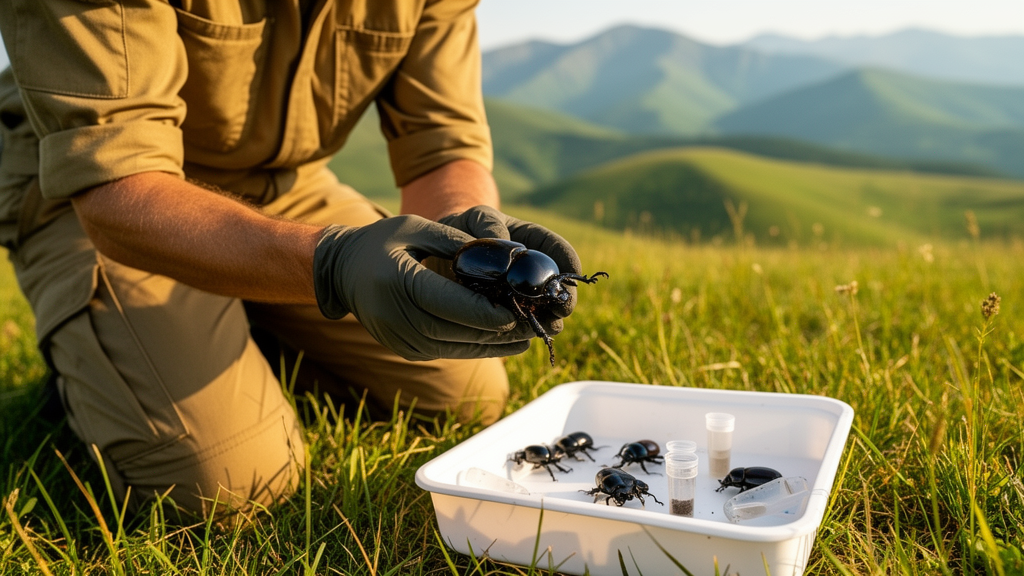
A comprehensive new catalog of earth-boring dung beetles in Georgia has been published, offering the first detailed assessment of the conservation status for these often-overlooked insects. The study, appearing in the journal Caucasiana, provides a summarized list of species within the family Geotrupidae, accompanied by proposed Georgian names, updated distribution data, and evaluations based on the International Union for Conservation of Nature (IUCN) Red List categories. This work represents a significant step forward in understanding the entomofauna of the Caucasus biodiversity hotspot, where Georgia is situated at the center. By compiling data from historical records, modern databases, and recent field collections, researchers have been able to map the presence of these beetles across the country’s diverse landscapes, from lowland valleys to high mountain passes.
The earth-boring beetles, or Geotrupidae, are a distinct group within the order Coleoptera, with approximately 350 species described worldwide. In Georgia, only the subfamily Geotrupinae is represented, a fact that simplifies the taxonomic scope of this particular study. The entomofauna of Georgia has been studied for centuries, with one of the first lists of beetles in the Caucasus published by Radde in 1899. However, the most significant foundational work on Georgian earth-boring dung beetles was conducted by Yason Dzambazishvili, whose comprehensive data on their distribution in 1979 and 2000 remains a cornerstone for current research. Since those seminal works, new distributional data have emerged from public databases such as the Global Biodiversity Information Facility (GBIF) and the Georgian Biodiversity Database, as well as from social media platforms that have proven to be valuable tools for gathering citizen science data.
The methodology for this catalog involved a rigorous compilation of occurrence data from multiple sources, including the papers of Dzambazishvili and Japoshvili et al., various web-databases, and dry collections deposited in institutions such as the Agricultural University of Georgia and the Zoological Institute of Ilia State University. Additionally, previously unpublished original material collected under the Caucasus Barcode of Life (CaBOL) project was included to ensure the most up-to-date representation of species presence. For occurrence data lacking exact geographic coordinates, researchers geo-referenced sampling locations using Google Earth Pro with an estimated precision of 100 meters. Conservation statuses were evaluated using IUCN guidelines, with the area of occupancy (AOO) calculated based on a 10 km² grid cell count overlaid on the country’s territory, and the extent of occurrence (EOO) estimated specifically for Georgia.
Among the species cataloged, Geotrupes molestus stands out as a candidate for further investigation, currently listed as Data Deficient (DD) for the national red list. This species is generally distributed in the Caucasus and is known from Armenia and Turkey, but in Georgia, it has only been recorded from a single locality in the Samtskhe-Javakheti region at the Zekari pass. The limited data available suggests that while the species may occupy a larger area, current information is insufficient to assess its conservation status confidently. Field data from the Goderdzi Pass through the Javakheti Highland to the Armenian border is needed to better understand the distribution range of G. molestus in Georgia, highlighting the gaps in current knowledge regarding this particular taxon.
In contrast, Geotrupes mutator is evaluated as Least Concern (LC) for the national red list, reflecting its widespread distribution across Georgia. With an area of occupancy of 180 km² and an extent of occurrence of 31,370 km², this species is found in numerous localities, including Khevsha, Lisi Lake, and the highlands around Kazbegi. The population trend is not known, and no direct threats have been indicated, supporting its classification as a species of low conservation concern. Similarly, Geotrupes (stercorarius) olgae is also classified as Least Concern, with an even larger area of occupancy of 620 km² and an extent of occurrence of 56,893 km². This species is widespread and common throughout the country, with records from diverse habitats ranging from the surroundings of Paravani Lake to the high altitudes of the Svaneti region.
Geotrupes spiniger presents a more complex conservation picture, being classified as Data Deficient (DD) despite its broad global distribution in Europe and Western Asia. In Georgia, the species has been recorded in several locations, including Tbilisi, Pasanauri, and Mestia, but the area of occupancy is relatively small at 21.175 km², with an extent of occurrence of 180 km². The lack of comprehensive data prevents a confident evaluation of its status, and while no threats or population changes have been reported globally, local assessments remain uncertain. This highlights the importance of continued monitoring and data collection to accurately assess the conservation needs of species with fragmented or poorly documented distributions within the country.
Trypocopris caspius, formerly known as Geotrupes caucasicus, is evaluated as Least Concern (LC) for the national red list. This species is distributed across the Central Caucasus and is recorded in various parts of Georgia, including Guria, Imereti, and Adjara. With a large area of occupancy of 190 km² and an extent of occurrence of 47,299 km², and no known population declines or threatening factors, it is considered secure in its current range. The study also clarifies taxonomic issues, noting that G. caucasicus Weise, 1879, listed by Dzambazishvili, is now known as Trypocopris caspius, while other homonyms have never been reported from Georgia, ensuring clarity in the nomenclature used in the catalog.
The most concerning finding in the catalog is the status of Trypocopris inermis, which is evaluated as Vulnerable (VU) for the national red list. This species is endemic to the western part of the Greater Caucasus, and Georgian populations represent the southern margin of its distribution. With a relatively small area of occupancy of 70 km² and an extent of occurrence of 3,121 km², the species faces potential risks due to its limited range. The study suggests that additional studies are needed to delineate the southern border of its distribution, particularly in the Svaneti region, where its presence cannot be excluded. The endemic status of the species, combined with its marginal populations in Georgia, underscores the need for targeted conservation efforts to protect this unique component of the region’s biodiversity.
The catalog also notes the recent report of Odonteus armiger from Lagodekhi Protected Areas and south-western Georgia, based on citizen science data. However, these records require further confirmation, and no conservation status can be evaluated at any level of uncertainty. The study emphasizes that many places within Georgian territory remain unobserved for earth-boring beetles, indicating that the current catalog is a starting point rather than a complete picture. By providing updated distribution maps and conservation evaluations, this work serves as a vital resource for future research and conservation planning, ensuring that the intricate web of life in the Caucasus is better understood and protected for generations to come.
Subject of Research: Conservation status and distribution of Geotrupidae beetles in Georgia
Article Title: Catalog of Georgian Earth-boring dung beetles ( Coleoptera : Geotrupidae )
Article References: Japarashvili, S. (2023). Catalog of Georgian Earth-boring dung beetles (Coleoptera: Geotrupidae). Caucasiana, 2, 83-90. https://doi.org/10.3897/caucasiana.2.e96388
Image Credits: AI Generated
DOI: 10.3897/caucasiana.2.e96388
Keywords: Geotrupidae, dung beetles, Georgia, Caucasus, conservation status, IUCN Red List, entomology, biodiversity, distribution mapping, Coleoptera, Catalog, Georgian
Cite Scienmag News
Margaret Porter. (October 18, 2026). Georgian Dung Beetle Catalog Reveals Conservation Status. Scienmag. https://scienmag.com/georgian-dung-beetle-catalog-reveals-conservation-status/
Margaret Porter. "Georgian Dung Beetle Catalog Reveals Conservation Status." Scienmag, 18 October 2026, https://scienmag.com/georgian-dung-beetle-catalog-reveals-conservation-status/. Accessed 18 October 2026.
Margaret Porter. "Georgian Dung Beetle Catalog Reveals Conservation Status." Scienmag. October 18, 2026. https://scienmag.com/georgian-dung-beetle-catalog-reveals-conservation-status/


