


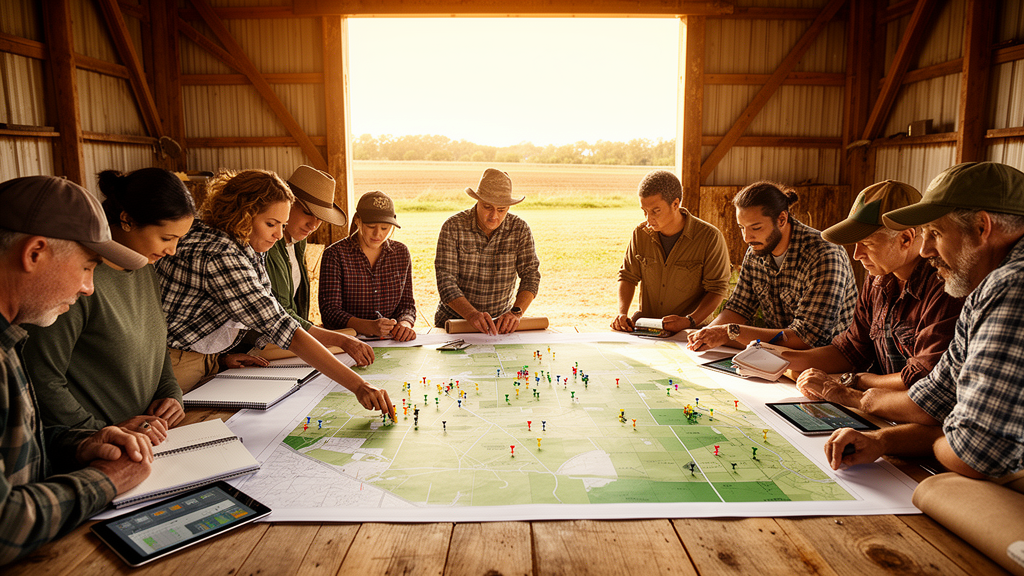
Participatory modelling has emerged as a critical transdisciplinary approach in environmental science, fundamentally altering how researchers interact with the communities they study. By actively involving stakeholders in the development or improvement of qualitative and quantitative models, this method seeks to bridge the gap between academic theory and practical agricultural application. A new systematic mapping dataset published in the journal One Ecosystem provides a comprehensive overview of this evolving field, detailing 78 distinct case studies from peer-reviewed literature. The research, conducted by Klemm, Piorr, and Ewert, aims to clarify the potential uses of participatory modelling within the emerging domain of agroecology living lab research. This dataset serves as a foundational resource for understanding how diverse groups collaborate to solve complex agri-environmental challenges, offering insights that extend beyond traditional academic boundaries into the realm of practical policy and farm management.
The systematic search conducted for this dataset was rigorous, adhering to established guidelines for evidence synthesis in environmental management. The researchers utilized a transparent methodology outlined by the ROSES flow diagram for systematic maps, ensuring that the selection process was reproducible and unbiased. An online search was performed across six major databases, including Web of Science, Scopus, Agricola, AGRIS, Dimensions, and Livivo. The search strategy focused on English-language, peer-reviewed publications, using specific search strings that combined terms related to participatory or collaborative modelling with various agricultural contexts. This included a wide range of agricultural activities such as farming, cultivation, husbandry, viticulture, horticulture, and hydroponics, as well as specific crops like wheat, rye, oats, rice, and various livestock categories. The breadth of the search ensured that the dataset captured a diverse array of agricultural settings and modelling approaches.
The screening process involved multiple stages to ensure the quality and relevance of the included studies. Initially, duplicates were automatically removed using EndNote, followed by a manual screening of titles and abstracts in Rayyan. Researchers then downloaded the full texts of the remaining publications for a detailed review. This meticulous process resulted in the inclusion of 78 case studies, while 110 papers were filtered out during the full-text analysis, and 857 were excluded based on title and abstract screening. The inclusion criteria were strictly defined, focusing on methods and context to ensure that only studies genuinely employing participatory modelling methods in agri-environmental research were selected. This rigorous filtering process highlights the commitment to accuracy and relevance in the dataset, providing a reliable foundation for subsequent analysis.
The dataset itself is extensive, comprising an Excel spreadsheet with 58 columns of numeric and text data that describe each study in both qualitative and quantitative ways. Each of the 78 case studies is characterized by its main goals, the specific participatory modelling methods used, the stakeholders involved, and their contributions to the project. Additionally, the dataset includes key metadata such as publication type, year, study location, funding source, project duration, and outcomes beyond peer-reviewed publications. This level of detail allows for a nuanced understanding of the participatory modelling landscape, revealing patterns and associations that might otherwise remain hidden. The data also includes bibliographic information for each publication, facilitating further research and citation. The inclusion of metadata such as funding organizations and study duration provides valuable context for researchers and institutions aiming to expand their research portfolios or evaluate the feasibility of similar projects.
One of the key findings from the dataset is the identification of clusters and associations between different participatory modelling methods and their corresponding goals. The data reveals that certain methods are more dominant than others, and specific combinations of methods are frequently used to achieve particular project objectives. For instance, system dynamics, agent-based modelling, companion modelling, and causal loop diagramming are among the methods that are commonly stated in the publications. However, some methods, such as informing or contributing to a numerical model or numerical model prototyping, were derived from their descriptions in the publications rather than being explicitly named. This distinction is important for understanding the diversity of approaches used in participatory modelling and for identifying areas where further research is needed. The dataset also highlights the dominant role of researchers in this type of participatory research, suggesting that while stakeholders are involved, the direction and scope of the modelling process are often led by academic experts.
The dataset also points out the absence of participatory modelling in certain areas of agricultural production, such as hydroponic farming and viticulture. This gap in the literature suggests that these sectors may not be fully leveraging the benefits of participatory approaches, potentially missing out on opportunities for improved sustainability and stakeholder engagement. The findings have implications for researchers, institutions, and grant agencies, as they provide a clear picture of where participatory modelling is being applied and where it is not. For researchers, this information can guide future studies into underexplored areas, while for institutions, it can inform decisions about expanding their research capabilities. Grant agencies can use this data to evaluate the rigidity and relevance of research proposals involving participatory modelling, ensuring that funding is directed toward projects that address significant gaps in the field.
The value of the dataset extends beyond its immediate findings, as it provides a comprehensive foundation for the related research article and for future studies. The data can be analyzed both quantitatively and qualitatively, offering multiple avenues for exploration. For example, researchers can link methods, goals, and stakeholder involvement with other metadata to uncover new patterns and insights. The dataset also allows for comparisons between agri-environmental research and other areas, providing a broader context for understanding the role of participatory modelling in different fields. The inclusion of data not used in the related research article, such as the relationship between methods and stakeholder involvement, provides a basis for future research that can further refine and expand the understanding of participatory modelling in agri-environmental contexts.
Limitations of the dataset include the exclusion of grey literature and the potential for missing publications that mentioned specific participatory modelling methods in their titles, abstracts, or keywords but did not explicitly state that they applied a participatory modelling approach. The search strategy, which used umbrella terms like “participatory model*,” may have overlooked studies that employed specific methods without using these broader terms. Additionally, the dataset does not evaluate the success of the case studies or question the authors’ choice of methods, meaning that it does not provide a judgment on whether a particular method or set of methods is suited to achieve the goals of the studies they were used with. These limitations highlight the need for further research to validate the findings and to explore the effectiveness of different participatory modelling approaches in achieving their intended outcomes.
In conclusion, this systematic mapping dataset offers a valuable resource for understanding the use of participatory modelling methods in agri-environmental research. By providing a detailed overview of 78 case studies, the dataset reveals patterns in method usage, stakeholder involvement, and project goals, while also identifying gaps in the current literature. The findings have significant implications for researchers, institutions, and grant agencies, as they provide a clear picture of the current state of participatory modelling in the field and suggest areas for future exploration. As the field of agroecology living lab research continues to grow, this dataset will serve as a foundational tool for advancing the practice of participatory modelling and for promoting more inclusive and effective approaches to agri-environmental research.
Subject of Research: Systematic mapping of participatory modelling methods in agri-environmental research
Article Title: The Use of Participatory Modelling Methods in Agri-Environmental Research – A Systematic Mapping Dataset
Article References: Klemm, T. (2024). The Use of Participatory Modelling Methods in Agri-Environmental Research – A Systematic Mapping Dataset. One Ecosystem, 9, Article e133158. https://doi.org/10.3897/oneeco.9.e133158
Image Credits: AI Generated
Keywords: participatory modelling, agri-environmental research, agroecology, systematic mapping, stakeholder engagement, transdisciplinary research, living labs, sustainable agriculture, modelling methods, research dataset, Participatory, Modelling
Cite Scienmag News
Alan Morgan. (October 18, 2026). Mapping Participatory Modelling in Agri-Environmental Research. Scienmag. https://scienmag.com/mapping-participatory-modelling-in-agri-environmental-research/
Alan Morgan. "Mapping Participatory Modelling in Agri-Environmental Research." Scienmag, 18 October 2026, https://scienmag.com/mapping-participatory-modelling-in-agri-environmental-research/. Accessed 18 October 2026.
Alan Morgan. "Mapping Participatory Modelling in Agri-Environmental Research." Scienmag. October 18, 2026. https://scienmag.com/mapping-participatory-modelling-in-agri-environmental-research/


