


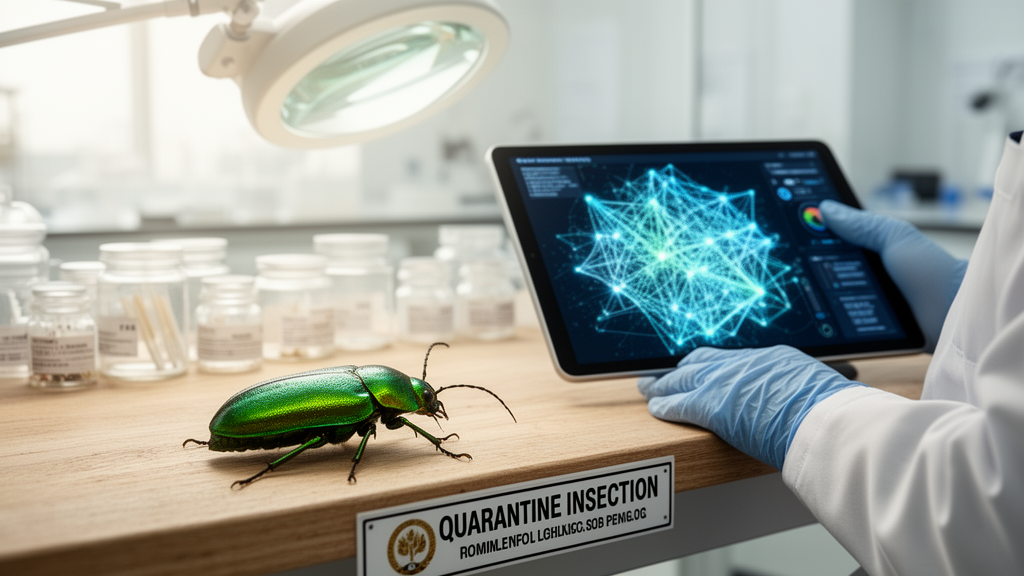
The relentless expansion of global trade over the past century has inadvertently created a high-speed highway for invasive insect species, allowing them to cross continental boundaries and establish footholds in new ecosystems. Among the most problematic of these hitchhikers is the genus Agrilus, a group of metallic jewel beetles that includes over 3,300 species and is one of the most species-rich animal genera on Earth. While many of these beetles are harmless, two specific species, Agrilus planipennis and Agrilus anxius, have caused catastrophic ecological and economic damage in North America, Russia, and Ukraine. The emerald ash borer, Agrilus planipennis, is particularly notorious for decimating ash tree populations, prompting the European Union to mandate strict surveillance programs in all member states to prevent its introduction. However, the current methods for detecting these pests are labor-intensive and slow, creating a critical bottleneck in the rapid response efforts required to protect Europe’s forests.
Traditional surveillance relies heavily on green-colored traps placed at entry points and in surrounding forests. These traps are effective at attracting a wide variety of Agrilus species, but this very success becomes a liability. The traps capture not only the target invasive species but also a multitude of native beetles that look remarkably similar. Because the morphological differences between many Agrilus species are subtle and require significant taxonomic expertise to identify, phytosanitary agencies spend countless hours sorting through specimens. This manual process impedes the efficient rapid response needed to contain an outbreak, as experts must physically examine each beetle to determine if it is a regulated pest or a harmless native species. The need for a faster, more automated identification system has become a priority for plant health inspectors and entomologists alike.
Researchers recently published a study in the journal NeoBiota that demonstrates how artificial intelligence can bridge this gap. The team tested the efficacy of the Entomoscope, a low-cost, open-source photomicroscope developed by the Karlsruhe Institute of Technology. This device uses high-resolution digital imaging to capture detailed images of insect specimens, which are then processed by a pre-trained Convolutional Neural Network (CNN). The goal was to create a system that could automatically detect, image, and classify beetle specimens, specifically focusing on 13 Agrilus species, including the two high-priority invasive pests. By integrating this hardware with advanced machine learning algorithms, the researchers aimed to provide a practical tool that could be deployed in laboratories and field stations across Europe.
The study involved a rigorous benchmarking process to determine the most effective neural network architecture. The researchers compared models from three different families: YOLOv8, YOLO11, and EfficientNet. They trained these models on a dataset comprising 469 specimens from 13 species, collected in Canada, France, Poland, and Slovenia. To ensure the models could handle real-world conditions, the dataset was carefully partitioned to simulate the variability encountered in actual surveillance workflows. This included variations in lighting, specimen condition, and operator handling. The team selected the YOLOv8l model as the most robust performer, achieving a Top-1 accuracy of 90.2% on a “real-world” test set that mimicked the challenges of field deployment.
A critical aspect of the research was the distinction between “laboratory” validation and “real-world” performance. Standard validation methods often use randomly shuffled data, which can lead to overly optimistic accuracy scores that do not reflect how the model will perform in the field. The researchers introduced a “real-world” test set, also known as an Out-Of-Distribution (OOD) set, which included images collected later in the process to account for data drift. When tested on this challenging set, the YOLOv8l model maintained high accuracy, significantly outperforming models trained with simpler strategies. This performance gap highlighted the importance of robust training methodologies that expose the model to diverse and randomized data combinations, ensuring it can generalize to new, unseen specimens.
The results showed that the AI system was particularly effective at identifying the high-priority invasive species. The model achieved 100% accuracy in correctly identifying Agrilus planipennis and Agrilus anxius, the two species regulated by EU legislation. This perfect identification rate is crucial for phytosanitary agencies, as it allows for the immediate flagging of potential threats without the need for immediate expert review. The system also successfully filtered out background noise, correctly identifying empty images or non-target objects, which reduces the workload for inspectors. By autonomously sorting through thousands of specimens, the AI can prioritize only those identified as high-priority pests for detailed examination, streamlining the surveillance process and enabling a faster response to potential invasions.
However, the study also acknowledged the limitations of the current system. While the model excelled at detecting invasive species, it struggled with distinguishing between certain native species. For example, Agrilus hastulifer and Agrilus pratensis were frequently misidentified, with the model often confusing them with other native species like Agrilus graminis. This suggests that while the AI is a powerful triage tool, it is not yet a complete replacement for expert taxonomic assessment. The researchers noted that the model relies on pixel clusters and visual features that may not align perfectly with the morphological characteristics used by human taxonomists. Therefore, the system is best viewed as a decision-support tool that assists experts rather than replacing them entirely.
Another significant finding was the model’s ability to reject unknown species. In operational surveillance, traps may collect species that were not included in the training dataset. To test this, the researchers introduced images of two native species, Agrilus biguttatus and Agrilus convexicollis, which were not part of the training data. The model correctly classified 100% of these images as “unknown” using a confidence threshold of 0.5. This capability is vital for detecting potential new invasive species that have not yet been cataloged. By flagging these unknown specimens, the system can alert phytosanitary personnel to the presence of a potential non-native species that requires further scrutiny through morphological or molecular analysis.
The use of explainability techniques, such as Eigen-CAM, provided insights into how the model makes its decisions. The analysis revealed that the neural network focused on specific morphological regions, such as the shape and texture of the elytra, the margins of the head, and the structure of the eyes. These features are consistent with those used by human experts, suggesting that the AI is learning biologically relevant traits rather than random patterns. This alignment increases confidence in the model’s reliability and provides a basis for understanding its errors. The researchers emphasized that while the model is highly effective for the species it was trained on, its performance may vary with new taxa, highlighting the need for continuous expansion of the reference image dataset.
This study provides a robust proof-of-concept for an AI-driven surveillance system that can significantly enhance the detection of invasive Agrilus beetles. The combination of the low-cost Entomoscope and the validated deep-learning methodology offers a practical solution for phytosanitary agencies across Europe. By moving beyond standard laboratory validation to test for robustness against real-world data drift, the researchers have established a framework for developing trustworthy biosecurity tools. Future work will focus on expanding the species library and integrating the model into field-ready systems, potentially using cloud-based applications to allow real-time identification. As global trade continues to increase the risk of invasive species, such AI-based tools will play an increasingly important role in protecting biodiversity and agricultural resources.
Subject of Research: AI-based image recognition for surveillance of invasive Agrilus jewel beetles
Article Title: Image-based recognition using advanced neural networks can aid surveillance of Agrilus jewel beetles
Article References: Caruso, V., Shirali, H., Bouget, C., Cerretti, P., Curletti, G., de Groot, M., Groznik, E., Gutowski, J. M., Pylatiuk, C., Plewa, R., Roques, A., Sallé, A., Sweeney, J., Van Rooyen, K., Wührl, L., & Rassati, D. (2026). Image-based recognition using advanced neural networks can aid surveillance of Agrilus jewel beetles. NeoBiota, 105, 319-336. https://doi.org/10.3897/neobiota.105.180959
Image Credits: AI Generated
DOI: 10.3897/neobiota.105.180959
Keywords: Agrilus, Artificial Intelligence, Invasive Species, Phytosanitary Surveillance, Convolutional Neural Networks, Entomology, Biosecurity, Image Recognition, Emerald Ash Borer, European Union, Image-based, recognition
Cite Scienmag News
Cassandra Pierce. (October 18, 2026). Neural Networks Detect Invasive Jewel Beetles for EU Surveillance. Scienmag. https://scienmag.com/neural-networks-detect-invasive-jewel-beetles-for-eu-surveillance/
Cassandra Pierce. "Neural Networks Detect Invasive Jewel Beetles for EU Surveillance." Scienmag, 18 October 2026, https://scienmag.com/neural-networks-detect-invasive-jewel-beetles-for-eu-surveillance/. Accessed 18 October 2026.
Cassandra Pierce. "Neural Networks Detect Invasive Jewel Beetles for EU Surveillance." Scienmag. October 18, 2026. https://scienmag.com/neural-networks-detect-invasive-jewel-beetles-for-eu-surveillance/


