


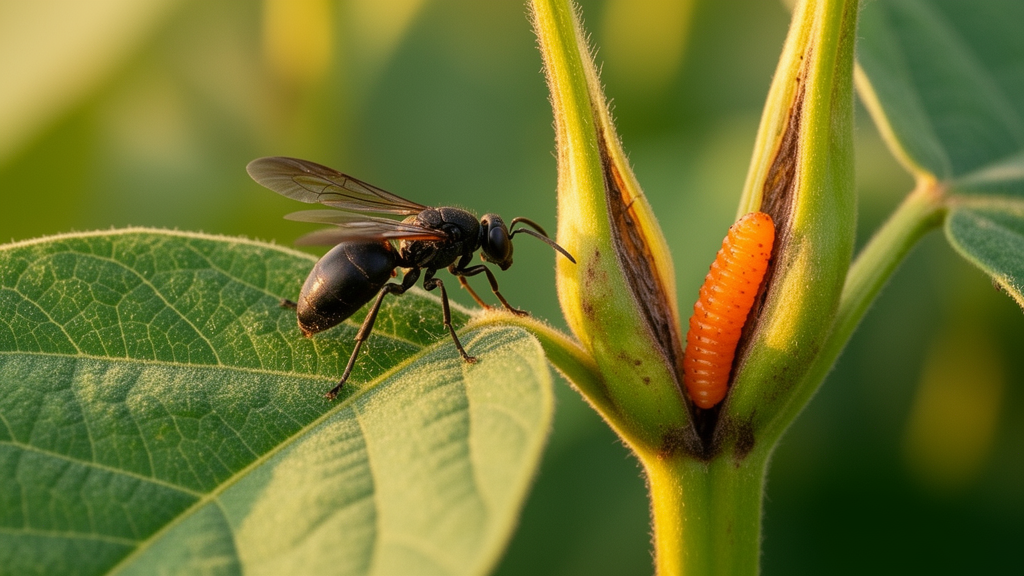
Researchers have identified a tiny parasitoid wasp, Synopeas ruficoxum, as a second natural enemy of the soybean gall midge, a pest that threatens crop yields across the midwestern United States. This discovery, published in the Journal of Hymenoptera Research, marks a significant step forward in the potential biological control of Resseliella maxima, a fly that has caused substantial economic losses in soybean fields. The study integrates morphological analysis, molecular biology, and ecological field data to confirm the host-parasitoid relationship, providing crucial data for pest management strategies. By identifying this new natural enemy, scientists hope to develop more sustainable methods to protect soybean crops from the destructive effects of gall midges without relying solely on chemical pesticides.
The soybean gall midge, Resseliella maxima, is a relatively recently described species that has become a major concern for agricultural producers. It has been reported in seven states in the midwestern USA, where it infests soybean stems, leading to galls that can reduce yield significantly. The pest also attacks other plants in the Fabaceae family, including sweet clover, alfalfa, and dry beans. Understanding the natural enemies of R. maxima is essential for developing integrated pest management programs. Previous surveys in Minnesota had already identified one parasitoid, Synopeas maximum, but the discovery of S. ruficoxum in Nebraska expands the known range of natural enemies and suggests a more complex ecological interaction.
The study involved collecting soybean stems infested with R. maxima from fields in Lancaster County, Nebraska, in 2021, and from fields near Syracuse and Wahoo in Nebraska in 2023. These stems were placed in emergence buckets in the laboratory, where adult insects were monitored and collected. A total of 31 Synopeas adults were reared from the infested stems, with 26 belonging to a morphotype that had not been previously observed in Minnesota. All of these 26 wasps were female, a detail that prompted further investigation into their reproductive biology. The rearing process revealed that the wasps emerged from 21 to 62 days after the stems were collected, indicating a specific developmental timeline linked to the host’s life cycle.
To confirm the identity of the wasps, researchers used DNA barcoding, specifically amplifying the cytochrome oxidase subunit I (COI) region. The sequences obtained from the Nebraska specimens were compared to publicly available data, revealing a close match with specimens collected in Eastern Canada. This geographic distribution extends beyond the known range of R. maxima, suggesting that S. ruficoxum may have other hosts or that the range of the midge is broader than currently documented. The phylogenetic analysis supported the monophyly of S. ruficoxum and placed it in a distinct species group within the genus Synopeas, separate from S. maximum. This genetic distinction is important for understanding the evolutionary history and ecological roles of these parasitoids.
Further molecular assays confirmed that R. maxima larvae in the field are indeed parasitized by S. ruficoxum. PCR screening of field-collected larvae detected S. ruficoxum DNA in two out of seven samples, providing direct evidence of the parasitoid-host association. This confirmation is critical for validating the potential of S. ruficoxum as a biological control agent. The study also screened the wasps for Wolbachia, a bacterium known to mediate asexual reproduction in many insects. While 70% of the S. ruficoxum specimens tested positive for Wolbachia, this prevalence does not fully support the hypothesis that Wolbachia is the sole driver of the all-female population. Other factors may be responsible for the asexual reproduction, a characteristic that could influence the wasp’s effectiveness in pest suppression.
The reproductive biology of S. ruficoxum presents interesting challenges and opportunities for biological control. The consistent presence of only female wasps suggests thelytokous parthenogenesis, where females reproduce without mating. This asexual reproduction can lead to rapid population growth, which is advantageous for pest control, but it also raises questions about genetic diversity and long-term adaptability. In contrast, S. maximum, the other known parasitoid of R. maxima, reproduces sexually, with both males and females observed in the field. The difference in reproductive strategies between the two species may affect their population dynamics and their ability to coexist in the same ecosystem. Understanding these dynamics is crucial for predicting how the parasitoid community will respond to changes in host abundance and environmental conditions.
The morphological redescription of S. ruficoxum provided in the study advances the ability to identify this species in the field. The original description was based on a single female specimen and was insufficient for diagnosis. The new description includes detailed measurements and images of the head, mesosoma, metasoma, and wings, highlighting key diagnostic features such as the elongate metasoma and the specific arrangement of setae. These features distinguish S. ruficoxum from other species in the Synopeas craterum-group, such as S. craterum and S. abdominator. Accurate identification is essential for monitoring the distribution and abundance of the parasitoid and for evaluating its impact on R. maxima populations. The study also notes that the species epithet refers to the color of the coxae, which are typically lighter than the rest of the body, although coloration can vary due to age and preservation.
The discovery of S. ruficoxum as a natural enemy of R. maxima opens new avenues for research into the ecology and evolution of host-parasitoid interactions. The two known parasitoids of R. maxima, S. maximum and S. ruficoxum, may specialize on different developmental stages of the host, with S. ruficoxum potentially targeting larvae that have burrowed deeper into the plant tissue. This niche partitioning could allow the two species to coexist and jointly impact host populations. Future studies should investigate the phenology, population density, and spatial variation of the two parasitoids to better understand their roles in the ecosystem. Additionally, assessing the host specialization of S. ruficoxum will be important for determining its suitability as a biological control agent. If the wasp is highly specific to R. maxima, it could be a valuable tool for managing the pest without harming other beneficial insects.
In conclusion, the identification of Synopeas ruficoxum as a second parasitoid of the soybean gall midge represents a significant contribution to the field of biological control. The study demonstrates the importance of integrating multiple disciplines, including morphology, molecular biology, and ecology, to unravel the complex relationships between pests and their natural enemies. As agricultural systems face increasing pressure from pests and climate change, the development of sustainable pest management strategies is more important than ever. The findings of this study provide a foundation for future research and practical applications, offering hope for more effective and environmentally friendly ways to protect soybean crops. Continued monitoring and research will be essential to fully realize the potential of S. ruficoxum in controlling R. maxima and ensuring the long-term health of soybean production in the United States.
Subject of Research: Synopeas ruficoxum Buhl (Hymenoptera, Platygastridae) is a natural enemy of soybean gall midge, Resseliella maxima Gagné (Diptera, Cecidomyiidae)
Article Title: Synopeas ruficoxum Buhl ( Hymenoptera , Platygastridae ) is a natural enemy of soybean gall midge, Resseliella maxima Gagné ( Diptera , Cecidomyiidae )
Article References: von Gries, S. C., Awad, J., Talamas, E. J., McMechan, A. J., Koch, R. L., & Lindsey, A. R. I. (2025). Synopeas ruficoxum Buhl (Hymenoptera, Platygastridae) is a natural enemy of soybean gall midge, Resseliella maxima Gagné (Diptera, Cecidomyiidae). Journal of Hymenoptera Research, 98, 721-742. https://doi.org/10.3897/jhr.98.163211
Image Credits: AI Generated
Keywords: Synopeas, ruficoxum, Buhl, Hymenoptera, Platygastridae, natural, enemy, soybean, gall, midge, Resseliella, maxima
Cite Scienmag News
Alan Morgan. (October 18, 2026). New Parasitoid Wasp Identified as Soybean Gall Midge Enemy. Scienmag. https://scienmag.com/new-parasitoid-wasp-identified-as-soybean-gall-midge-enemy/
Alan Morgan. "New Parasitoid Wasp Identified as Soybean Gall Midge Enemy." Scienmag, 18 October 2026, https://scienmag.com/new-parasitoid-wasp-identified-as-soybean-gall-midge-enemy/. Accessed 18 October 2026.
Alan Morgan. "New Parasitoid Wasp Identified as Soybean Gall Midge Enemy." Scienmag. October 18, 2026. https://scienmag.com/new-parasitoid-wasp-identified-as-soybean-gall-midge-enemy/


