


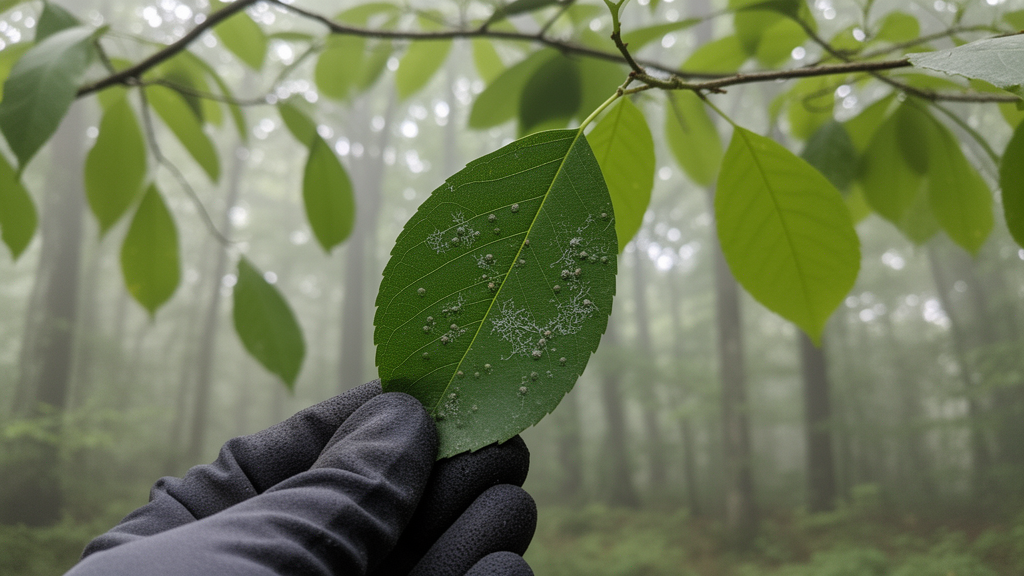
Foliar fungal communities, which reside on and within plant leaves, are critical components of the plant microbiome that influence ecosystem dynamics and plant health. Despite the ecological importance of these microbial assemblages, the specific drivers that shape their composition have remained poorly understood. Researchers recently conducted a comprehensive study to investigate how host plant identity, mycorrhizal symbiosis types, and leaf functional traits influence the structure of these fungal communities. By utilizing a common garden experimental design, the team was able to isolate the effects of plant characteristics from environmental variables, providing a clearer picture of the biological factors governing phyllosphere diversity.
The study was conducted at the MycoPhylo experimental field in southeastern Estonia, a site specifically designed to integrate plant phylogenetic diversity with various mycorrhizal types. The researchers sampled leaf tissue from 158 plots representing 110 distinct plant species, ensuring that all plants were of similar age and exposed to comparable edaphic and microclimatic conditions. This controlled environment allowed the scientists to test specific hypotheses regarding the influence of host phylogeny, mycorrhizal associations, and leaf phenotypic characters on foliar fungal assemblages. The experimental setup included trees, shrubs, and herbaceous plants, providing a broad representation of plant growth forms.
Using a metabarcoding approach targeting the Internal Transcribed Spacer (ITS) region of the fungal ribosomal RNA, the team generated a high-resolution profile of the fungal communities present on the leaves. The sequencing data revealed that the fungal communities were dominated by the classes Dothideomycetes, Tremellomycetes, and Taphrinomycetes. Functional guild analysis indicated that plant pathogens and saprotrophs were the most abundant ecological groups within these assemblages. The high level of taxonomic diversity observed underscores the complexity of the phyllosphere and the importance of understanding the mechanisms that regulate microbial colonization in this exposed habitat.
The statistical analysis revealed that plant growth form and mycorrhizal association were significant drivers of foliar fungal alpha diversity and community composition. Plant phylogenetic eigenvectors accounted for up to 25.8% of the variation in fungal richness, indicating that evolutionary history plays a substantial role in determining which fungi can successfully colonize a host. Specifically, plants belonging to certain families, such as Grossulariaceae and Cistaceae, harbored relatively higher fungal richness compared to hosts from families like Lauraceae and Betulaceae. This phylogenetic signal suggests that closely related plant species may share similar microbial communities due to conserved leaf traits or shared evolutionary pressures.
Mycorrhizal type emerged as another key factor influencing fungal community structure, although the effect sizes were modest. Ectomycorrhizal plants were notably richer in Taphrinomycetes and Pucciniomycetes compared to arbuscular mycorrhizal and ericoid mycorrhizal hosts. This finding suggests that the belowground symbiotic relationship between the plant and mycorrhizal fungi may indirectly affect the aboveground microbial community, possibly through changes in leaf nutrient allocation or defense chemistry. However, the study noted that mycorrhizal type is often correlated with other host traits, making it difficult to disentangle the direct effects of the symbiosis from the effects of plant taxonomy and growth form.
Leaf functional traits, such as thickness and hairiness, showed a weaker but still significant influence on fungal richness. Thinner-leaved species generally harbored more fungal operational taxonomic units than thick-leaved species, a pattern consistent with previous studies suggesting that tougher leaf structures may limit fungal proliferation. Leaf hairiness, or the presence of trichomes, also had a minor effect on fungal richness, potentially due to the production of chemical compounds by the hairs that inhibit fungal colonization. Despite these correlations, the overall impact of these morphological traits on community composition was less pronounced than that of plant phylogeny and growth form.
The relationship between host phylogeny and fungal community dissimilarity was further examined using Mantel tests, which revealed weak but guild-dependent associations. While total fungal and saprotroph communities showed a positive relationship with host phylogenetic distance, plant pathogenic fungi did not exhibit a significant phylogenetic signal. This distinction highlights the different ecological strategies employed by various fungal groups; pathogens may be more influenced by specific host species identity and immune responses, whereas saprotrophs may be more responsive to broader phylogenetic and structural traits of the host plant. These findings suggest that the assembly of foliar fungi is a complex process involving multiple interacting factors.
The study also found that plant deciduousness significantly affected fungal community composition, even though it did not influence fungal richness. Deciduous plants harbored higher proportions of certain fungal classes, such as Tremellomycetes and Taphrinomycetes, compared to evergreen plants. This difference may be attributed to the structural and chemical properties of deciduous leaves, which are often thinner and shorter-lived, making them more susceptible to fungal colonization. Evergreen leaves, with their thicker cuticles and longer lifespan, may provide a more stable but less permissive environment for many fungal taxa. These results emphasize the importance of considering leaf phenology when studying phyllosphere microbial communities.
Overall, the findings indicate that host phylogeny and plant functional traits contribute to, but do not solely determine, the structure of foliar fungal assemblages under field conditions. The integration of host evolution with functional ecology provides a robust framework for understanding phyllosphere mycobiome variation. By identifying the specific plant characteristics that drive fungal diversity, this research offers valuable insights for managing plant health and resilience in managed ecosystems. Future studies should focus on the temporal dynamics of these communities and the causal mechanisms linking belowground mycorrhizal interactions to aboveground microbial assembly.
Subject of Research: Drivers of foliar fungal community composition in a common garden experiment
Article Title: Impact of plant species, mycorrhizal type, and leaf traits on foliar fungal communities (in a common garden experiment)
Article References: Ariyan, M., Mikryukov, V., Khalil, H., Gohar, D., Hosseyni Moghaddam, M. S., Drenkhan, R., & Tedersoo, L. (2026). Impact of plant species, mycorrhizal type, and leaf traits on foliar fungal communities (in a common garden experiment). IMA Fungus, 17, Article e173358. https://doi.org/10.3897/imafungus.17.173358
Image Credits: AI Generated
DOI: 10.3897/imafungus.17.173358
Keywords: foliar fungi, plant microbiome, mycorrhizal symbiosis, phyllosphere, plant phylogeny, leaf traits, metabarcoding, fungal diversity, common garden, ecological drivers, Impact, plant
Cite Scienmag News
Morgan Morrow. (October 18, 2026). Plant Traits and Phylogeny Shape Leaf Fungal Communities. Scienmag. https://scienmag.com/plant-traits-and-phylogeny-shape-leaf-fungal-communities/
Morgan Morrow. "Plant Traits and Phylogeny Shape Leaf Fungal Communities." Scienmag, 18 October 2026, https://scienmag.com/plant-traits-and-phylogeny-shape-leaf-fungal-communities/. Accessed 18 October 2026.
Morgan Morrow. "Plant Traits and Phylogeny Shape Leaf Fungal Communities." Scienmag. October 18, 2026. https://scienmag.com/plant-traits-and-phylogeny-shape-leaf-fungal-communities/


