


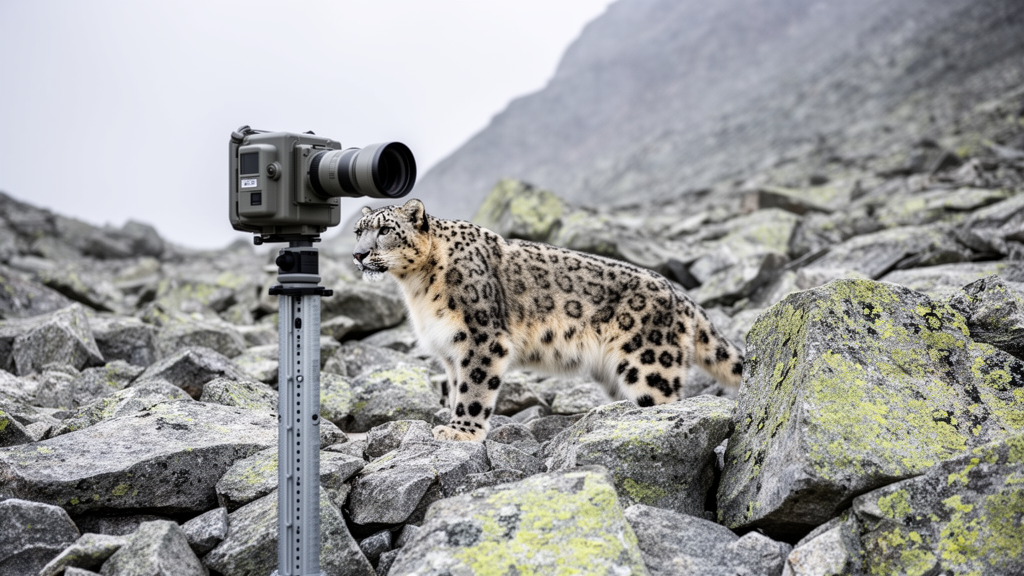
Deep learning has quietly become one of the most powerful tools in modern conservation, and a new study published in PLOS One pushes that capability to a striking new level. Researchers led by Srikanth Busa and Johnwesily Chappidi have built an Optimized Bilateral Segmentation Deep Learning Network, a system that identifies wild animals in photographs with accuracy approaching perfection. The reported numbers are remarkable: 99.8 percent overall accuracy, 99.4 percent precision, 99.6 percent recall, and a false positive rate of just 0.2 percent. For a field where camera traps routinely generate hundreds of thousands of images that must be sorted by hand, those figures hint at a genuine transformation in how wildlife is monitored across the planet.
The central challenge the team set out to solve is one that anyone who has scrolled through trail-camera footage will recognize instantly. Wild animals do not pose against clean studio backdrops. They appear half-hidden behind branches, dappled in shifting light, camouflaged against leaf litter, or blurred mid-stride at dusk. Conventional convolutional neural networks, which excel at object recognition in curated datasets, often stumble when the background is as visually busy as the animal itself. The network can latch onto bark texture, shadow edges, or grass movement and misclassify the scene entirely. The researchers’ answer was architectural rather than simply computational: teach the network to look at the image from two directions at once.
That is where bilateral segmentation enters the picture. Instead of processing an image through a single pipeline, the Bilateral Segmentation Deep Learning Network, or BSDLN, separates the task of understanding what matters from the task of discarding what does not. One branch of the architecture works to extract the features that define an animal, such as contour, texture, and body shape, while the parallel branch actively suppresses the influence of complex background information. The two streams are then reconciled so that the final classification rests on the animal, not its surroundings. The effect is a kind of learned visual discipline, a way of forcing the model to attend to the creature in the frame rather than the forest around it.
Architecture alone, however, does not guarantee good training. Neural networks are notoriously sensitive to their internal settings, and the parameters that govern how a convolutional neural network learns can make the difference between a model that converges smoothly and one that stalls in a mediocre solution. The team turned to an unusual ally: a nature-inspired optimization algorithm called Harris Hawks Optimization. HHO is a metaheuristic modeled on the cooperative hunting behavior of hawks, which swirl, ambush, and dive in coordinated patterns to catch prey. Translated into mathematics, the algorithm sends a population of candidate solutions searching through the parameter space, balancing exploration of new regions with exploitation of promising ones, much as the birds balance scouting with striking.
In this system, Harris Hawks Optimization takes direct responsibility for tuning the convolutional neural network’s weight parameters, but its most consequential role is dynamic learning-rate adjustment. The learning rate determines how far the model moves with each training step, and getting it wrong in either direction is costly. Too large, and the model overshoots good solutions and oscillates; too small, and training crawls or freezes in a local minimum. By continuously adapting the learning rate to the observed behavior of gradients and losses during training, the HHO-driven approach balances speed against accuracy in real time. The researchers report that this adaptive mechanism measurably improved both convergence and classification performance compared with fixed schedules.
Before any training began, the team confronted the unglamorous but decisive work of data preparation. Images were gathered from a variety of online sources to build a diverse dataset of wild animal appearances. Raw photographs, however, are rarely analysis-ready, so the pipeline incorporated image-processing steps designed to rescue detail from poor conditions. Adaptive Histogram Equalization was applied to redistribute brightness across the image, pulling contrast out of dark, washed-out, or unevenly lit frames so that an animal’s edges and markings become visible to the algorithm. Median filtering followed, a technique that suppresses salt-and-pepper noise while preserving the sharp boundaries that segmentation depends on. Together, these preprocessing steps ensured that the network learned from enhanced, consistent inputs rather than the noisy originals.
The entire framework was implemented in Python, the lingua franca of machine learning research, and evaluated with a battery of statistical metrics designed to expose weaknesses that a single headline number can hide. The results were compared against alternative approaches to verify that the gains were real rather than incidental. Alongside the 99.8 percent accuracy, the system achieved 99.5 percent on the F1-score, the harmonic mean of precision and recall, and 99.3 percent specificity, meaning it correctly identified the vast majority of frames that contained no animal at all. The false negative rate of 0.3 percent is arguably the most conservation-relevant figure of all, because a missed detection is a missed data point about a species’ presence, movement, or decline.
Why do these numbers matter beyond the leaderboard? Automated wildlife monitoring is rapidly becoming the backbone of ecology at scale. Camera trap networks now span continents, and acoustic sensors add millions of additional recordings each year. Human analysts cannot keep pace, and backlogs of unclassified images delay the insights that conservation decisions depend on. A detection system with a false positive rate of 0.2 percent dramatically reduces the manual verification burden, because reviewers spend their time on genuinely ambiguous cases rather than correcting routine errors. High specificity matters equally, since systems that cry wolf train their human supervisors to distrust them.
The study also fits into a broader trajectory that the authors describe for the field. The next wave of wildlife-focused deep learning is expected to lean on multimodal data, fusing imagery with sound, thermal signatures, and other sensor streams to push accuracy further, while a parallel effort is producing lightweight models compact enough to run on edge devices deployed in remote habitats. A network that can classify confidently on a solar-powered camera trap, without shipping every image across a costly connection, would extend intelligent monitoring to places that currently lack bandwidth or power. The bilateral segmentation approach, by reducing the computational weight of background clutter, aligns naturally with that efficiency agenda.
There is, as always, a gap between benchmark performance and field reality, and the researchers are careful to frame their results as a strong foundation for automated wildlife monitoring rather than a finished deployment. Datasets assembled from online sources, however diverse, cannot fully capture the lighting chaos, motion blur, and occlusion of a monsoon-season camera trap in dense jungle. Yet the direction of travel is unmistakable. By combining a segmentation architecture that separates animal from background, an optimization algorithm inspired by hunting hawks, and disciplined image preprocessing, the team has demonstrated that wild animal detection can be pushed to accuracy levels that were theoretical ambitions only a few years ago. If such systems scale as their creators hope, the eyes watching the world’s remaining wilderness may soon be tireless, cheap, and very, very sharp.
Subject of Research: Deep learning network for automated wild animal detection in wildlife monitoring
Article Title: Optimized bilateral segmentation deep learning network for wild animal detection
Article References: Busa, S., Chappidi, J., Archana, G., Palakayala, A. R., Vidya Lakshmi, G. V., Syed, K., & Begum, S. S. A. (2026). Optimized bilateral segmentation deep learning network for wild animal detection. PLOS One, 21(10), e0360422. https://doi.org/10.1371/journal.pone.0360422
Image Credits: AI Generated
DOI: 10.1371/journal.pone.0360422
Keywords: deep learning, wildlife monitoring, computer vision, convolutional neural networks, Harris Hawks Optimization, image segmentation, conservation technology, camera traps, PLOS One, machine learning, adaptive histogram equalization, edge computing
Cite Scienmag News
Blake Davidson. (October 18, 2026). AI Learns to See Animals Hidden in the Wild With Near-Perfect Accuracy. Scienmag. https://scienmag.com/ai-learns-to-see-animals-hidden-in-the-wild-with-near-perfect-accuracy/
Blake Davidson. "AI Learns to See Animals Hidden in the Wild With Near-Perfect Accuracy." Scienmag, 18 October 2026, https://scienmag.com/ai-learns-to-see-animals-hidden-in-the-wild-with-near-perfect-accuracy/. Accessed 18 October 2026.
Blake Davidson. "AI Learns to See Animals Hidden in the Wild With Near-Perfect Accuracy." Scienmag. October 18, 2026. https://scienmag.com/ai-learns-to-see-animals-hidden-in-the-wild-with-near-perfect-accuracy/


