


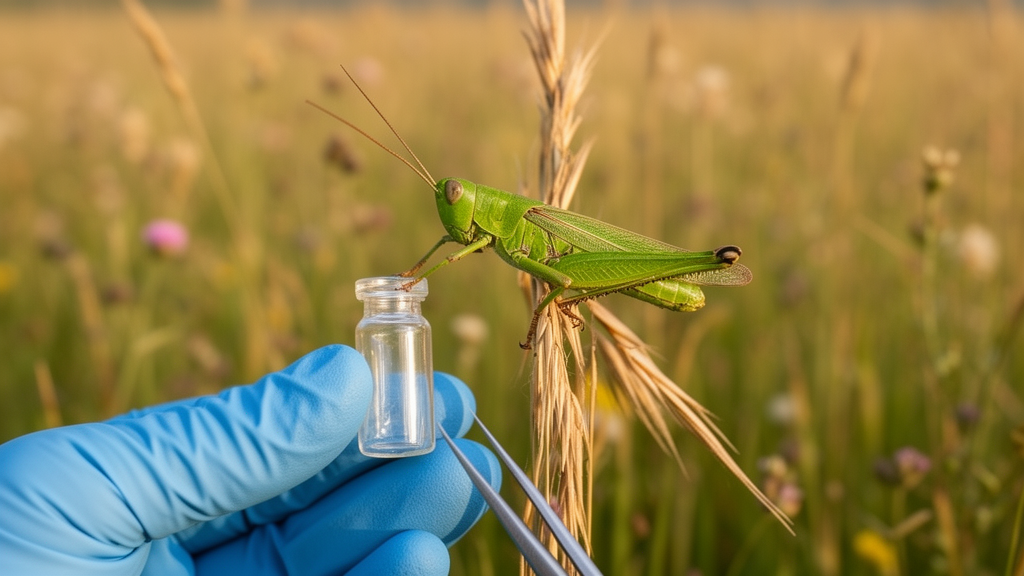
The biodiversity of the Caucasus region continues to reveal hidden chapters in the story of its invertebrate fauna, with a recent discovery adding a new entry to the list of grasshopper species known from Georgia. Researchers have documented the first occurrence of Tropidopola turanica Uvarov, 1926, a member of the family Acrididae, in the country. This finding is significant not only for extending the known geographic range of the species but also for demonstrating the utility of DNA barcoding in resolving taxonomic uncertainties in understudied regions. The discovery was made during a routine collecting effort in Tbilisi, highlighting how even urban environments can harbor species that were previously thought to be absent from the area. The integration of morphological identification with molecular data provides a robust framework for confirming such records, ensuring that the addition of this species to the Georgian fauna is scientifically sound and reproducible.
The genus Tropidopola Stål, 1873, is part of a diverse lineage within the order Orthoptera, which includes grasshoppers, crickets, and katydids. Within Georgia, the family Acrididae is particularly well-represented, with approximately 80 species recorded to date. However, the genus Tropidopola had not been previously documented in the country, despite its wide distribution across the Mediterranean region, the Middle East, Central Asia, and parts of Africa. The species T. turanica is known to inhabit damp meadows and the beds of reeds, Cyperus, and Juncus in desert or semi-desert areas near water bodies. Its presence in Georgia suggests that suitable microhabitats exist within the country that support this species, even if they were not previously recognized by entomologists. This finding underscores the importance of continued surveying efforts in diverse habitats, including those that may seem unlikely candidates for such specialized insects.
The specific specimen that led to this record was collected in Dighomi Park in Tbilisi, Georgia, at coordinates 41.769476°N, 44.773614°E, and an elevation of 426 meters above sea level. The collection took place on June 20, 2022, when a single female was found in the thickets of Phragmites australis, a common reed species. The collector, A. Seropian, preserved the specimen in 96% ethanol and stored it at -30 °C to maintain its integrity for subsequent analysis. This accidental discovery during the CaBOL (Caucasus Barcode of Life) project highlights the value of broad-scale sampling initiatives, which can uncover species that targeted surveys might miss. The fact that the specimen was found in an urban park rather than a remote natural reserve suggests that T. turanica may be more adaptable to human-modified environments than previously assumed, or that the park provides a microclimate similar to its preferred natural habitats.
To confirm the identity of the specimen, researchers employed a combination of morphological examination and DNA barcoding. The specimen was photographed using a Canon EOS 60D camera with a Canon EF 60 mm f/2.8 Macro USM lens, and digital images were prepared using Zerene Stacker image stacking software and Adobe Photoshop CS6 to enhance detail. The external morphology of T. turanica is characterized by a very elongated, cylindrical body and slender hind tibia muscles that are weakly developed. This physical adaptation reflects its lifestyle, as these grasshoppers typically sit motionless in an ambush on the grass during the day, avoiding danger by moving to the other side of the grass rather than jumping. The voucher specimen is now kept at Ilia State University under the number CaBOL-ID 1023967, serving as a physical reference for future studies.
The molecular analysis involved extracting DNA from leg tissue using the Quick-DNA Magbead Plus Kit from Zymo Research. The partial sequences of cytochrome oxidase subunit I (COI) were amplified by polymerase chain reaction (PCR) using the primer pairs LCOI490-JJ and HCO2198-JJ. The thermal cycling conditions included an initial denaturation at 95°C for 1 minute, followed by 15 cycles of denaturation at 94°C for 30 seconds, annealing at 55°C for 1 minute with a 1°C decrease per cycle, and extension at 72°C for 1 minute and 30 seconds. This was followed by 25 cycles of denaturation at 94°C for 35 seconds, annealing at 45°C for 1 minute, and extension at 72°C for 1 minute and 30 seconds, concluding with a final extension at 72°C for 5 minutes. The PCR amplicons were visualized on 1% agarose gels, and sequencing was performed at the Beijing Genomics Institute in Hong Kong, China. The sequences were analyzed using Geneious Prime 2022.1.1, ensuring accurate alignment and comparison with existing data.
The newly obtained DNA barcode was submitted to the Barcode of Life Data System (BOLD) database, where it was assigned the accession number BOLD:AFB9057. This is the first T. turanica sequence submitted to the BOLD Systems database, marking a significant contribution to the global reference library for this species. The nearest neighbor to the new barcode in the BOLD system was an unidentified Acrididae from Pakistan, with a p-distance of 6.25%. The second and third best matches were also unidentified Acrididae from Pakistan, with p-distances of 6.27%. The nearest congener in the BOLD system was T. cylindrica (Marschall, 1836), from France, Corsica, with a p-distance of 6.45%. Given the maximum p-distance of 0.2% between the unidentified Acrididae from Pakistan and T. cylindrica from France, it is likely that the former belong to the same species, further supporting the distinctiveness of the Georgian specimen.
The discovery of T. turanica in Georgia has implications for understanding the biogeography of the species and the broader patterns of insect distribution in the Caucasus. The species is currently marked as part of the distribution range in the Orthoptera Species File Online database, but there was no prior literary data on its presence in Georgia. This gap in the literature is now filled by the combination of morphological and molecular evidence provided in this study. The use of DNA barcoding has proven to be an effective tool for identifying species in regions where taxonomic expertise may be limited or where morphological characters are subtle. By depositing the DNA sequences in the BOLD database, researchers have made this data available to the global scientific community, facilitating future studies and comparisons.
The ecological preferences of T. turanica are closely tied to its habitat, which includes damp meadows and the beds of reeds and other aquatic plants. The presence of Phragmites australis in Dighomi Park likely provided the necessary conditions for the species to thrive, offering both food and shelter. The behavior of these grasshoppers, characterized by their ambush strategy and limited jumping ability, suggests that they are well-adapted to environments where they can remain hidden from predators. This adaptation may also explain why the species was not previously detected in Georgia, as it may have been overlooked due to its cryptic behavior and the lack of targeted surveys for this specific genus.
The CaBOL project, which aims to barcode the biodiversity of the Caucasus region, has played a crucial role in this discovery. By conducting expeditions and collecting efforts in various parts of Georgia, including urban and protected areas, the project has generated a wealth of data that is contributing to a more comprehensive understanding of the region’s fauna. The accidental discovery of T. turanica in Dighomi Park demonstrates the importance of broad-scale sampling and the potential for unexpected findings in well-studied areas. As the project continues, it is likely that more species will be added to the list of known fauna in Georgia, further enriching our knowledge of the region’s biodiversity.
In conclusion, the first barcode-assisted record of Tropidopola turanica from Georgia represents a significant contribution to the field of entomology and biogeography. The combination of morphological identification and DNA barcoding has provided strong evidence for the presence of this species in the country, filling a gap in the existing literature. The discovery highlights the importance of continued surveying efforts and the use of modern molecular tools in documenting biodiversity. As more data is collected and analyzed, our understanding of the distribution and ecology of T. turanica and other species in the region will continue to grow, providing valuable insights into the complex interactions between organisms and their environments.
Subject of Research: First barcode-assisted record of Tropidopola turanica in Georgia
Article Title: The first barcode-assisted record of Tropidopola turanica Uvarov, 1926 ( Orthoptera , Acrididae ) from Georgia
Article References: Arsenashvili, E., & Seropian, A. (2023). The first barcode-assisted record of Tropidopola turanica Uvarov, 1926 (Orthoptera, Acrididae) from Georgia. Caucasiana, 2, 109-111. https://doi.org/10.3897/caucasiana.2.e105742
Image Credits: AI Generated
DOI: 10.3897/caucasiana.2.e105742
Keywords: Tropidopola turanica, Georgia, DNA barcoding, Orthoptera, Acrididae, Biodiversity, Biogeography, CaBOL project, Entomology, Molecular identification, first, barcode-assisted
Cite Scienmag News
Margaret Porter. (October 18, 2026). First Barcode Record of Tropidopola turanica in Georgia. Scienmag. https://scienmag.com/first-barcode-record-of-tropidopola-turanica-in-georgia/
Margaret Porter. "First Barcode Record of Tropidopola turanica in Georgia." Scienmag, 18 October 2026, https://scienmag.com/first-barcode-record-of-tropidopola-turanica-in-georgia/. Accessed 18 October 2026.
Margaret Porter. "First Barcode Record of Tropidopola turanica in Georgia." Scienmag. October 18, 2026. https://scienmag.com/first-barcode-record-of-tropidopola-turanica-in-georgia/


