


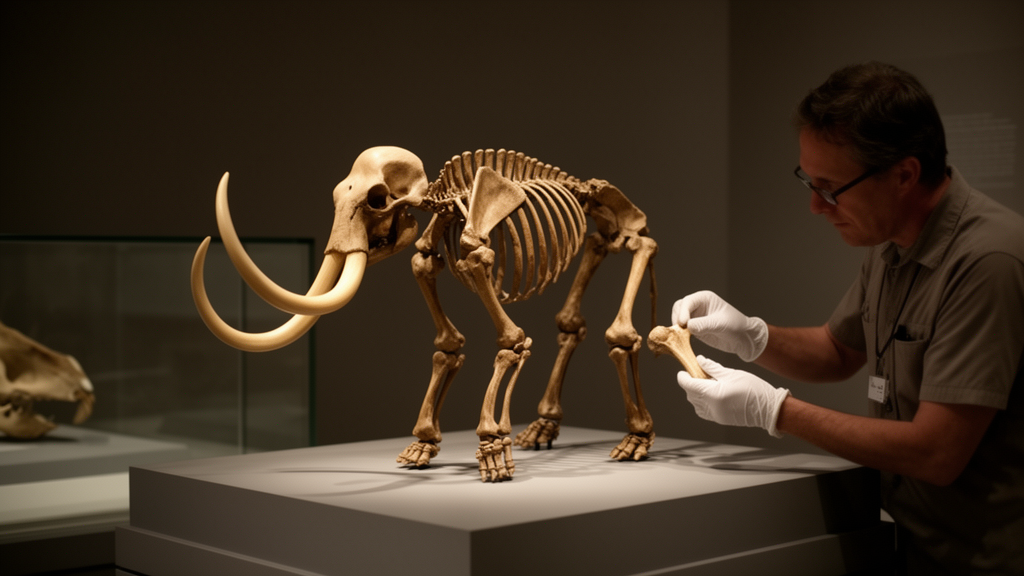
A woolly mammoth calf that died roughly 45,000 years ago in a Swiss peat bog is rewriting what scientists know about the earliest days of life in Earth’s most iconic Ice Age mammal. The skeleton, excavated in 1890 and 1891 from the so-called Mammutloch, or Mammoth Pit, at Niederweningen in the Wehntal Valley northwest of Zürich, was the first perinatal mammoth ever scientifically described. Now a team has re-investigated its anatomy using modern imaging and comparative methods, and the results, published in the Swiss Journal of Palaeontology, suggest the animal lived for no more than a few months after birth, and that a stunted foreleg may have contributed to its death.
The Niederweningen site is one of the richest Late Pleistocene localities in Europe. During the summer of 1890, gravel excavation for a new railway embankment exposed more than 100 mammoth bones, tusks and molar teeth belonging to at least seven individuals, embedded in a peat horizon within lacustrine silts. Formal excavations led by the Zürich zoologist Arnold Lang the following year recovered a largely complete perinatal mammoth skeleton, now displayed in the Natural History Museum of the University of Zurich. Radiocarbon and luminescence dating place the Upper Peat Complex, which yielded the remains, between roughly 60,000 and 40,000 years before present, during the early to middle part of Marine Isotope Stage 3. At that time the valley floor was an acid swamp fringed by reeds and mossy pools, in an open tundra-like landscape some four degrees Celsius cooler than today, with mean July temperatures of about ten degrees and winter means below minus ten.
Determining the age at death of a perinatal proboscidean is notoriously difficult, because the skeletons of late foetuses and newborn calves are strikingly similar. The team therefore attacked the problem from four directions: ontogenetic allometry, meaning how proportions change with growth, especially compared with perinatal mammoths from Russia; the microstructure of the long bones; the sequence of tooth eruption; and the timing of cranial suture closure. Measurements were taken with callipers to an accuracy of a hundredth of a millimetre, following established protocols for proboscidean teeth and appendicular bones, and the fossils were scanned with a NIKON XTH 225 ST micro-CT scanner hosted by the University of Zurich. The tibia was scanned at 139 kilovolts and 198 microamperes, yielding a voxel size of about 0.104 millimetres, while higher-resolution scans of the palate and mandible resolved features as small as 0.026 millimetres. Segmentation software then allowed the researchers to trace internal growth layers through the scan stacks and render external bone surfaces semi-transparent.
The most compelling evidence of postnatal life came from the tibial midshaft. In cross-section, the cortical bone remains thin and porous, with extensive trabecular bone throughout the diaphysis, indicating active endochondral ossification. Quantitative analysis revealed a porosity of 76.08 percent, reflecting the enormous proportion of void spaces in the developing bone, together with a woven-parallel fibrolamellar matrix and laminar to plexiform vascularisation, a combination characteristic of very rapid appositional growth. Crucially, a distinct change in tissue microstructure in axial view marks the boundary between prenatal and postnatal periosteal bone deposition, a transition previously documented in full-term stillborn and neonatal African elephants. The postnatal layer in the Niederweningen tibia closely resembles the bone microstructure of neonatal Columbian mammoths, and a similar layer of postnatal deposition was identified in the maxilla. Together these findings strongly indicate that the calf survived birth, even though its dentition shows no obvious wear.
That absence of wear is itself puzzling. In woolly mammoths, crown wear on the second deciduous premolar supposedly begins at zero to one months of age, and on the third deciduous premolar at roughly 0.3 to 0.4 months. The Niederweningen calf’s palate preserves four teeth in situ: the second deciduous premolars with four plates each and the third deciduous premolars with seven plates, with crown formation complete and no interplate cementum deposition. Odontochronologically, the individual probably belongs to Dental Stage 1, spanning three months to two years. What the teeth do show, on all five remaining teeth, are tiny pits etched into the enamel at the tips of the plate conules, in some cases penetrating through the enamel and into the dentine, visible both to the naked eye and in the micro-CT scans.
The origin of these lamellar pits has long been debated. In the famous Yamal Peninsula calf Lyuba, which died at about one month, virtually identical pits were attributed either to incomplete mineralization or to postmortem dissolution pitting, possibly caused by bacteria producing lactic acid, rather than to mastication. Breast milk is weakly acidic to neutral, with a pH of 6.5 to 7.5, and lactose can be fermented by amelolytic oral bacteria such as Streptococcus mutans, leading to enamel demineralization. Strontium-to-calcium and barium-to-calcium ratios in mammoth juveniles suggest that plant consumption began only between two and three African Elephant Equivalent Years, far later than weaning initiation in extant elephants, although the stomach contents of the month-old Lyuba indicate coprophagy. The delayed introduction of plant food supports the interpretation that the pits formed for reasons other than eating vegetation.
One histological feature the team could not confirm is the neonatal line, a prominent microfeature in dentine and enamel, expressed as enlarged striae of Retzius, that records the physiological stress of birth and separates tissue formed before and after delivery. In Lyuba and the Khroma calf, whose ages at death were estimated at about 30 to 35 days and 52 to 57 days respectively, the line was identified by counting daily or weekly dentine growth increments between the line and the pulp cavity surface. The researchers attribute their inability to detect it in the Niederweningen teeth partly to method: micro-CT is non-destructive and three-dimensional but produces lower-resolution images than histological sectioning under cross-polarized light. They also raise a provocative climatic hypothesis. Both previously documented mammoth neonates came from above 70 degrees north, inside the Arctic Circle, whereas Niederweningen lies at 47 degrees north with a milder climate. In humans, children born in milder climates have thinner neonatal lines, because birth stress is reduced and maternal and foetal metabolism can follow the circadian rhythm, and season of birth also influences line thickness, with spring and summer births producing thinner lines.
Among the most striking anatomical findings is anisomelia of uncertain aetiology, a marked asymmetry in which the right foreleg is stunted relative to the left. The radii and ulnae display the discrepancy clearly. Anisomelia may be congenital, as in hemihypertrophy, when one side of the body grows more than the other, or acquired through trauma or disease. The condition can affect gait, posture and spinal alignment, and the authors speculate that the stunted right foreleg may have contributed to the calf’s death. Juvenile proboscideans seldom stray from their mothers or the herd, but they are not uncommonly entrapped in swamps or watering holes, and the team suggests the animal may have become mired in the quagmire when ground frozen solid in winter thawed during the brief summer months, a scenario also proposed for the articulated adult mammoth excavated at the site in 2003.
The allometric comparisons reveal wide size variation in dental and appendicular dimensions, some of it non-ontogenetic. First-born calves in African elephants are typically 15 percent smaller than subsequent offspring, a pattern that appears to hold in mammoths as well. Spatio-temporal environmental differences, nutritional status and genetic diversity may also play a role. Mammoth populations belonged to regionally structured mitochondrial clades, and the Niederweningen assemblage probably belongs to Clade I, which ranged across trans-Beringian Eurasia and North America, unlike many Russian mammoths. The humerus from Niederweningen is significantly smaller than that of a one-year-old Russian mammoth and almost identical to a neonate, while the radius is significantly larger than the Russian neonate and the tibia overlaps with one-year-olds, all pointing to a postnatal individual of at most a few months.
Beyond the individual calf, the study carries broader implications for mammoth ecology and extinction. Proboscideans sit at the slow end of the fast-slow life-history continuum, with the longest gestation of any land mammal, about 22 months, single offspring and the largest neonates. Yet the bone microstructure of the Niederweningen calf demonstrates remarkably rapid postnatal growth, even as the absence of tooth wear from mastication reinforces evidence of strong maternal dependence and an altricial life-history strategy, likely an adaptation to seasonal fluctuations in resource availability at high latitudes and to increased predation risk. The authors note that this extended period of dependence may have been significant for extinction if mothers were hunted, leaving calves unable to survive alone. The woven bone, the absence of extensive secondary osteons and the lack of significant biomechanical loading all confirm a perinatal stage, and the team argues that microanatomical investigation of long bones provides an effective method for distinguishing prenatal from postnatal mammoths, one that would benefit greatly from a more complete ontogenetic series in future studies.
Subject of Research: Perinatal woolly mammoth from Niederweningen, Switzerland
Article Title: Anatomy of a perinatal woolly mammoth ( Mammuthus primigenius ) from Niederweningen (Late Pleistocene), Switzerland
Article References: Scarborough, M. E., Furrer, H., Scheyer, T. M., Sánchez-Villagra, M. R., & Carrillo-Briceño, J. D. (2026). Anatomy of a perinatal woolly mammoth (Mammuthus primigenius) from Niederweningen (Late Pleistocene), Switzerland. Swiss Journal of Palaeontology, 145, 487-504. https://doi.org/10.3897/sjp.145.183721
Image Credits: AI Generated
Keywords: Anatomy, perinatal, woolly, mammoth, Mammuthus, primigenius, Niederweningen, Late, Pleistocene, Switzerland, scientific research
Cite Scienmag News
Harold Sullivan. (October 18, 2026). Baby Mammoth From Switzerland Reveals Secrets of Its First Months. Scienmag. https://scienmag.com/baby-mammoth-from-switzerland-reveals-secrets-of-its-first-months/
Harold Sullivan. "Baby Mammoth From Switzerland Reveals Secrets of Its First Months." Scienmag, 18 October 2026, https://scienmag.com/baby-mammoth-from-switzerland-reveals-secrets-of-its-first-months/. Accessed 18 October 2026.
Harold Sullivan. "Baby Mammoth From Switzerland Reveals Secrets of Its First Months." Scienmag. October 18, 2026. https://scienmag.com/baby-mammoth-from-switzerland-reveals-secrets-of-its-first-months/


