


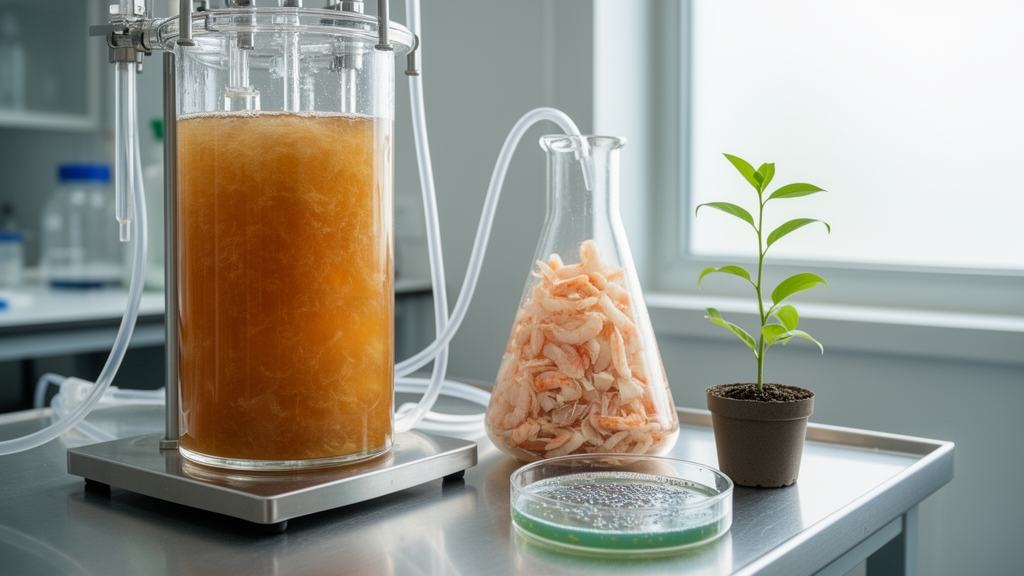
Researchers at the University of Toronto have developed a scalable microbial platform that converts raw chitin directly into chitobiose, a high-value disaccharide with significant potential for agricultural applications. This breakthrough addresses a critical bottleneck in the production of chitin-derived oligosaccharides, which have previously relied on hazardous chemical processing or costly enzymatic methods. By engineering a specific strain of Streptomyces venezuelae, the team has created a cost-effective fermentation process that yields highly enriched chitobiose without the need for chitin pretreatment or additional enzymatic steps. The resulting product shows promise as a biostimulant that promotes plant growth and enhances immune responses, offering a sustainable solution for valorizing chitin waste streams in the agricultural sector.
Chitobiose, a disaccharide composed of two N-acetylglucosamine units, is a key component of chitin, a structural polysaccharide found in the exoskeletons of crustaceans and insects as well as in the cell walls of fungi. While chitin itself is abundant and renewable, its direct agricultural utility is limited due to its insolubility and complex structure. Chitobiose, however, is water-soluble and bioactive, making it an ideal candidate for use as a plant biostimulant. Despite its potential, the commercial availability of chitobiose has been hindered by the high costs associated with its production. Traditional methods involve the use of strong acids or bases to break down chitin, followed by enzymatic hydrolysis, which is both environmentally unfriendly and economically unviable for large-scale production.
To overcome these limitations, the research team focused on a transporter mutant of Streptomyces venezuelae, specifically the ΔdasBC strain. Streptomyces species are known for their ability to degrade complex polysaccharides and produce a wide range of bioactive compounds. The ΔdasBC mutant lacks the dasBC transporter genes, which are responsible for the uptake of chitin oligosaccharides. By removing these transporters, the researchers effectively trapped the chitobiose produced by the bacterium in the extracellular environment, allowing for easier recovery and higher yields. This genetic modification transformed the bacterium into a highly efficient factory for chitobiose production, capable of converting raw chitin directly into the desired product.
The fermentation process was optimized to maximize the titer of chitobiose, resulting in an estimated yield of approximately 450 mg/L. This yield was achieved without the need for any chitin pretreatment or enzymatic steps, significantly reducing the complexity and cost of the production process. The product was analyzed using liquid chromatography/mass spectrometry, which confirmed that it was highly enriched for chitobiose. Importantly, the analysis showed the absence of detectable longer N-acetylglucosamine oligomers, indicating a high degree of purity. This purity is crucial for agricultural applications, as it ensures that the biostimulant has a consistent and predictable effect on plant growth and immunity.
To evaluate the agricultural potential of the produced chitobiose, the researchers tested the crude spent medium as a biostimulant on Arabidopsis thaliana, a model plant widely used in plant biology research. When applied as a soil additive, the spent medium increased the rosette size of Arabidopsis by up to 22% and induced beneficial changes to root development. These results suggest that chitobiose can promote plant growth by enhancing nutrient uptake and improving overall plant health. The increase in rosette size is a direct indicator of improved photosynthetic capacity and biomass production, which are critical for crop yield. The changes in root development may also contribute to better water and nutrient absorption, further supporting plant growth.
In addition to promoting growth, the chitobiose-enriched spent medium also demonstrated potent immune-priming activity. When applied as a foliar pretreatment, it decreased infection symptoms caused by Botrytis cinerea, a common fungal pathogen that causes gray mold in many crops. The pretreatment also increased the immunity-related responses to fungal elicitors, indicating that chitobiose can prime the plant’s defense mechanisms to respond more effectively to pathogen attack. This immune-priming activity surpassed that of a commercially available chitin oligomer mix at an equivalent mass concentration, highlighting the potency of the highly enriched chitobiose produced by the engineered Streptomyces strain. The ability to enhance plant immunity is particularly valuable in sustainable agriculture, as it can reduce the need for chemical fungicides and other pesticides.
The development of this microbial platform represents a significant step forward in the sustainable valorization of chitin waste streams. Chitin is a major component of crustacean and insect exoskeletons, and large quantities are generated as waste from the seafood and insect farming industries. Currently, much of this waste is discarded or used for low-value applications, such as animal feed or soil amendments. By converting chitin waste into a high-value bioproduct, this research provides a new economic incentive for the recycling of these materials. The use of a microbial fermentation process also reduces the environmental impact of chitin processing, as it avoids the use of hazardous chemicals and reduces energy consumption.
The findings of this study have broader implications for the field of agricultural biotechnology. The ability to produce highly enriched chitobiose in a scalable and cost-effective manner opens up new possibilities for the development of biostimulants that can improve crop yield and resilience. As the global population continues to grow, the demand for food is expected to increase, putting pressure on agricultural systems to produce more with less. Biostimulants such as chitobiose can play a crucial role in meeting this challenge by enhancing plant growth and defense without the need for synthetic fertilizers or pesticides. The use of microbial platforms for the production of bioactive compounds also aligns with the principles of green chemistry and sustainable manufacturing.
Future research will focus on optimizing the fermentation process for industrial-scale production and evaluating the effects of chitobiose on a wider range of crop species. The team also plans to investigate the mechanisms by which chitobiose promotes plant growth and immunity, with the aim of developing even more effective biostimulants. The potential for this technology to transform the agricultural industry is significant, and the researchers are working to bring this product to market in the near future. The successful translation of this research from the laboratory to the field will require further validation in real-world agricultural settings, but the initial results are highly promising. This work demonstrates the power of synthetic biology and metabolic engineering to create new solutions for global challenges, such as food security and environmental sustainability.
Subject of Research: Microbial production of chitobiose for agricultural biostimulation
Article Title: Scalable production of highly enriched chitobiose shows promise in agriculture, promoting plant growth and bolstering immunity
Article References: van der Meij, A., Loranger, M. E. W., Yoshioka, K., & Nodwell, J. R. (2026). Scalable production of highly enriched chitobiose shows promise in agriculture, promoting plant growth and bolstering immunity. Biotechnology for Biofuels and Bioproducts. https://doi.org/10.1186/s13068-026-02829-4
Image Credits: AI Generated
DOI: 10.1186/s13068-026-02829-4
Keywords: chitobiose, chitin, Streptomyces, plant immunity, biostimulant, sustainable agriculture, fermentation, Arabidopsis, plant growth, bioactive compounds, Scalable, production
Cite Scienmag News
Morgan Morrow. (October 18, 2026). Microbial Platform Converts Chitin Waste Into Plant Growth Booster. Scienmag. https://scienmag.com/microbial-platform-converts-chitin-waste-into-plant-growth-booster/
Morgan Morrow. "Microbial Platform Converts Chitin Waste Into Plant Growth Booster." Scienmag, 18 October 2026, https://scienmag.com/microbial-platform-converts-chitin-waste-into-plant-growth-booster/. Accessed 18 October 2026.
Morgan Morrow. "Microbial Platform Converts Chitin Waste Into Plant Growth Booster." Scienmag. October 18, 2026. https://scienmag.com/microbial-platform-converts-chitin-waste-into-plant-growth-booster/


