


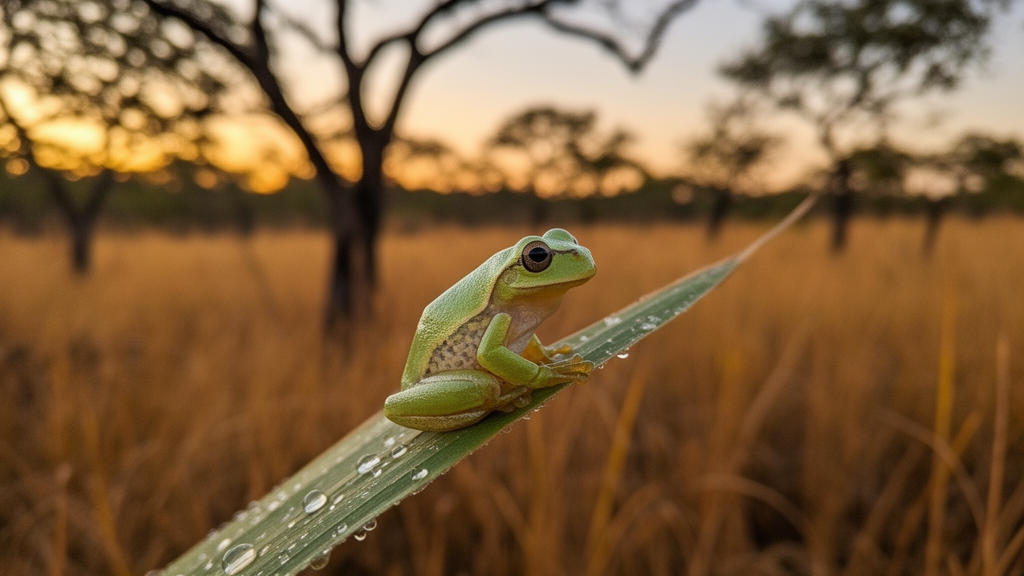
Researchers have formally described a new species of glassfrog, Vitreorana micaelae, from the Cerrado biome in central Brazil. This discovery adds the eleventh known species to the genus Vitreorana and marks the second confirmed glassfrog endemic to the Cerrado ecosystem. The finding is significant because it expands the known geographic range of the genus, which has previously been associated primarily with the Amazon Basin and the Atlantic Forest. The new species was identified through an integrative taxonomic approach that combined detailed morphological analysis, molecular genetic data, and bioacoustic recordings. This multi-faceted methodology allows for a robust distinction between the new species and its close relatives, ensuring accurate classification within the family Centrolenidae.
The new species is characterized by its small body size, with adult males measuring between 21.7 and 26.1 millimeters in snout-vent length. This compact stature distinguishes it from other members of the genus, such as Vitreorana assuh, which is significantly larger, and Vitreorana helenae, which is smaller. The frogs exhibit a shagreened dorsal skin texture, a rounded snout in dorsal view, and a sloping snout profile. These external features, combined with the absence of vomerine teeth and a specific pattern of webbing on the feet, provide a clear morphological diagnosis. The ventral surface is translucent, revealing the white hepatic peritoneum and green bones that are hallmark traits of glassfrogs, while the parietal and visceral peritonea bear white iridophores.
Genetic analysis of the mitochondrial 16S rRNA gene fragment revealed that Vitreorana micaelae is most closely related to Vitreorana parvula. Uncorrected pairwise genetic distances between the new species and V. parvula range from 3.5% to 5.2%, which is lower than the divergence observed with other congeners. In contrast, the genetic distance to Vitreorana eurygnatha, a species morphologically similar to the new find, is approximately 6.7%. The overall genetic distances among sampled Vitreorana species range from 3.5% to 9.6%, indicating a moderate level of divergence within the genus. These molecular data support the recognition of V. micaelae as a distinct evolutionary lineage, separate from previously described species in the region.
Bioacoustic data provide another critical layer of evidence for the species’ distinctiveness. The advertisement call of Vitreorana micaelae is composed of two distinct call types, a feature not observed in other Vitreorana species, which typically emit a single call type. The first type, designated as call type I, is a short call lasting between 17.1 and 25.1 milliseconds, consisting of a single note with two or three pulses. The second type, call type II, is a longer call ranging from 45.6 to 115.6 milliseconds, composed of a combination of one primary note and two or three secondary notes. The dominant frequency for both call types hovers around 4,700 Hz, with specific ranges of 4,651.2 to 4,737.3 Hz for the short calls and 4,694.2 to 4,758.8 Hz for the long calls. This complex emission pattern offers a unique acoustic signature that further differentiates the species from its congeners.
The type locality for Vitreorana micaelae is a gallery forest along a small stream near the São Bartolomeu River in the municipality of Luziânia, in the state of Goiás. This habitat represents a humid, forested environment within the broader Cerrado biome, which is typically characterized by open savannas. The frogs were found calling on vegetation approximately 2.5 meters above the stream water, indicating a preference for riparian zones. The species is currently known from two localities in Luziânia, including the type locality and a previous record from 2013 that was initially misidentified as Vitreorana eurygnatha. This distribution highlights the importance of gallery forests as refugia for forest-associated anurans in the Cerrado, providing a habitat niche that supports species otherwise associated with denser rainforests.
The discovery of Vitreorana micaelae underscores the potential for underestimated biodiversity in the Cerrado biome. Historically, taxonomic surveys in this region have focused more heavily on the open phytophysiognomies of the Cerrado, leaving forested formations such as gallery and ciliary forests less thoroughly studied. This uneven distribution of research attention has likely led to an underestimation of species richness in these habitats. The presence of V. micaelae in the core area of the Cerrado suggests a historical connection between these gallery forests and the Atlantic Forest, potentially indicating a biogeographic link that has facilitated the colonization of these isolated forest patches by lineages typically found in the Amazon or Atlantic regions. Further studies are needed to clarify the phylogeographic relationships among Vitreorana lineages in the Cerrado and the Atlantic Forest.
Despite its discovery, Vitreorana micaelae faces significant anthropogenic threats. The construction of river dams, land conversion for agriculture, and potential mining activities pose risks to the integrity of its habitat. The filling of the Corumbá IV Hydroelectric Power Plant reservoir in the past has already impacted local fauna, as evidenced by the rescue of one specimen in 2005. Due to the limited data available on population size, fragmentation, and the specific impact of these threats, the researchers recommend classifying the species as Data Deficient under the IUCN Red List criteria. This classification highlights the urgent need for more comprehensive ecological studies to assess the conservation status of this newly described species and to develop effective protection strategies for its habitat.
The specific epithet micaelae honors Micaela de Jolepian L. Vaz, the wife of the lead author, in recognition of her support for his research on Neotropical biodiversity. The holotype and paratypes are deposited in the herpetological collection of the Pontifícia Universidade Católica de Goiás (CEPB) in Goiânia, Brazil. The type series includes nine adult males collected between 2005 and 2014, with the majority gathered in December 2014. These specimens provide a foundational dataset for future comparative studies and conservation monitoring. The integration of morphological, molecular, and bioacoustic data in this study exemplifies the modern approach to anuran taxonomy, ensuring that new species are recognized with high confidence and providing a robust framework for understanding the evolutionary history of glassfrogs in South America.
Subject of Research: Unveiling a small new glassfrog of the genus Vitreorana (Anura, Centrolenidae) from Cerrado, central Brazil
Article Title: Unveiling a small new glassfrog of the genus Vitreorana ( Anura , Centrolenidae ) from Cerrado, central Brazil
Article References: Vaz-Silva, W., Pereira de Andrade, S., Filho Rocha, C., Victor Jr., E. P., Brandão, R. A., & Maciel, N. M. (2026). Unveiling a small new glassfrog of the genus Vitreorana (Anura, Centrolenidae) from Cerrado, central Brazil. ZooKeys, 1291, 93-110. https://doi.org/10.3897/zookeys.1291.193210
Image Credits: AI Generated
DOI: 10.3897/zookeys.1291.193210
Keywords: Unveiling, small, glassfrog, genus, Vitreorana, Anura, Centrolenidae, Cerrado, central, Brazil, scientific research
Cite Scienmag News
Drew Townsend. (October 18, 2026). Tiny Glassfrog Discovered in Central Brazil’s Cerrado. Scienmag. https://scienmag.com/tiny-glassfrog-discovered-in-central-brazils-cerrado/
Drew Townsend. "Tiny Glassfrog Discovered in Central Brazil’s Cerrado." Scienmag, 18 October 2026, https://scienmag.com/tiny-glassfrog-discovered-in-central-brazils-cerrado/. Accessed 18 October 2026.
Drew Townsend. "Tiny Glassfrog Discovered in Central Brazil’s Cerrado." Scienmag. October 18, 2026. https://scienmag.com/tiny-glassfrog-discovered-in-central-brazils-cerrado/


